
Connecticut
State-by-State Tax Expenditure Reports
• By ITEP Staff
Below is a list of tax expenditure reports published in the states.

State Rundown 5/7: Federal Showers Make States Dour
• By ITEP Staff
The effects of last year’s federal tax and spending cuts continue to ripple through the states. With gas prices soaring due to the Iran war, some states are attempting to provide a bit of relief in the form of gas tax reductions and suspensions.
State Rundown 4/8: Budget and Tax Packages Take Shape as Sine Die Approaches in Many States
• By ITEP Staff
State legislative sessions are wrapping up, and final tax and budget packages are making their way to governors’ desks.
State Tax Watch 2026
• By ITEP Staff
ITEP tracks tax discussions in legislatures across the country and uses our unique data capacity to analyze the revenue, distributional, and racial and ethnic impacts of many of these proposals. State Tax Watch offers the latest news and movement from each state.

These States Are Most Impacted by the Spike in Gas Prices
• By Carl Davis
The recent spike in gasoline prices is on pace to cost American drivers an extra $9.4 billion per month. Gas prices are up dramatically across the country, but the South has been hit hardest and is on pace to pay $4.2 billion more per month.
State Rundown 3/18: New Mexico Enacts Most Significant Corporate Tax Reform of the Year
• By ITEP Staff
As states lawmakers continue to weigh their linkages to the federal tax code in light of the recent federal tax law, New Mexico provides a blueprint for limiting multinational corporate tax avoidance.
State Rundown 3/12: Washington Lawmakers Pass Millionaires’ Tax, Expand Working Families Tax Credit
• By ITEP Staff
Washington is on its way to making history after the legislature approved the “millionaires’ tax,” a 9.9 percent tax on income over $1 million. The bill, which is expected to raise more than $3 billion a year, making significant investments in public education and childcare, will also expand the Working Families Tax Credit – the […]
State Rundown 3/4: Budget Realities Set In
• By ITEP Staff
As many state legislative sessions near or cross the halfway point, lawmakers are facing tough choices.

Testimony: ITEP’s Marco Guzman Details a Package of Tax Bills for the Connecticut General Assembly Finance Committee
• By Marco Guzman
This testimony was delivered to the Connecticut General Assembly Finance Committee on February 26, 2026. My name is Marco Guzman, and I am a Senior Analyst at the Institute on Taxation and Economic Policy (ITEP). ITEP is a non-profit, non-partisan tax policy organization, conducting rigorous analyses of tax and economic proposals and providing data-driven recommendations […]
State Rundown 2/25: Sausage-Making Season Is Upon Us
• By ITEP Staff
National Sausage Month isn’t until October, but now is the time of year when state lawmakers are really diving into their sausage-making processes, as separate legislative houses and oftentimes political parties send competing bills, budgets, and visions back and forth to grind out their differences.

What Did 2025 State Tax Changes Mean for Racial and Economic Equity?
• By Brakeyshia Samms
The results are a mixed bag, with some states enacting promising policies that will improve tax equity and others going in the opposite direction.
State Rundown 1/22: Cautious Tone Noticeable in Most Statehouses
• By ITEP Staff
Most states are adopting a very cautious approach so far this year as legislators begin their sessions and governors make their annual addresses, thanks to ongoing economic uncertainty and federal retrenchment.

State and Local Policymakers Can Resist Austerity Even Amid Historic Federal Retreat
• By Kamolika Das
The progressivity of the federal tax code has been waning. State and local policymakers should respond by protecting their revenue bases, promoting equity, and safeguarding vulnerable communities from harmful budget cuts.
State Rundown 10/27: As Temperatures Cool Tax Policy Heats Up
• By ITEP Staff
States across the nation are debating how best to respond to costly new federal tax cuts.

State Earned Income Tax Credits Support Families and Workers in 2025
• By Neva Butkus
Nearly two-thirds of states now have an Earned Income Tax Credit (EITC). Momentum continues to build on these credits that boost low-paid workers’ incomes and offset some of the taxes they pay, helping lower-income families achieve greater economic security.

Trump’s Tax Law Clobbers State Budgets. Now’s the Time to Prepare.
• By ITEP Staff
The Trump megabill hands the richest 1% a trillion-dollar windfall while gutting funding for health care, education, and disaster relief — leaving communities to pick up the pieces. State and local leaders must step up, tax the wealthiest fairly, and safeguard the essentials that keep America healthy, educated, and safe.

State Tax Action in 2025: Amid Uncertainty, Tax Cuts and New Revenue
• By Aidan Davis, Neva Butkus, Marco Guzman
Federal policy choices on tariffs, taxes, and spending cuts will be deeply felt by all states, which will have less money available to fund key priorities. This year some states raised revenue to ensure that their coffers were well-funded, some proceeded with warranted caution, and many others passed large regressive tax cuts that pile on to the massive tax cuts the wealthiest just received under the federal megabill.

Which States Expanded Refundable Credits in 2025?
• By Neva Butkus
Refundable tax credits were a big part of state tax policy conversations this year. In 2025, nine states improved or created Child Tax Credits or Earned Income Tax Credits.

Sales Tax Holidays Miss the Mark When it Comes to Effective Sales Tax Reform
• By Miles Trinidad
Sales tax holidays are often marketed as relief for everyday families, but they do little to address the deeper inequities of regressive sales taxes. In 2025, 18 states offer these holidays at a collective cost of $1.3 billion.

How Do State Estate and Inheritance Taxes Work?
• By ITEP Staff
Estate and inheritance taxes are taxes on wealth passed on after someone’s death. They are a common way for states to tax the inheritances of wealthy individuals. These taxes ensure that those very large estates help pay for public services like schools, hospitals, and parks.
How Much Would Every Family in Every State Get if the Megabill’s Tax Cuts Given to the Rich Had Instead Been Evenly Divided?
• By Michael Ettlinger
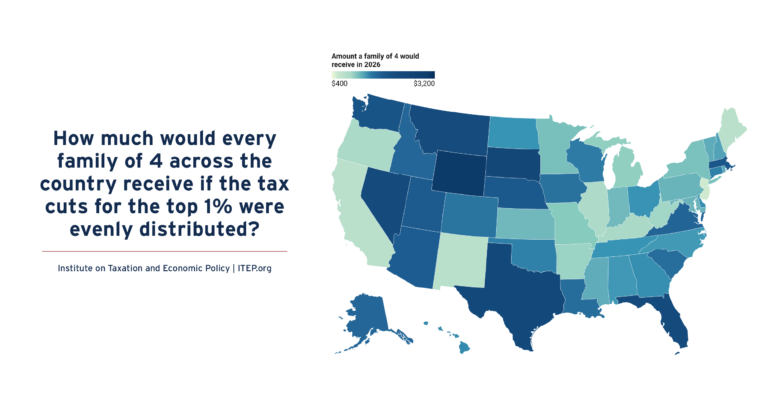
If instead of giving $117 billion to the richest 1 percent, that money had been evenly divided among all Americans, we'd each get $343 - or nearly $1,400 for a family of four.

Analysis of Tax Provisions in the Trump Megabill as Signed into Law: National and State Level Estimates
• By Steve Wamhoff, Carl Davis, Joe Hughes, Jessica Vela
President Trump has signed into law the tax and spending “megabill” that largely favors the richest taxpayers and provides working-class Americans with relatively small tax cuts that will in many cases be more than offset by Trump's tariffs.

Trump Megabill Will Give $117 Billion in Tax Cuts to the Top 1% in 2026. How Much In Your State?
• By Michael Ettlinger
The predominant feature of the tax and spending bill working its way through Congress is a massive tax cut for the richest 1 percent — a $114 billion benefit to the wealthiest people in the country in 2026 alone.

How Much Do the Top 1% in Each State Get from the Trump Megabill?
• By Carl Davis
The Senate tax bill under debate right now would bring very large tax cuts to very high-income people. In total, the richest 1 percent would receive $114 billion in tax cuts next year alone. That would amount to nearly $61,000 for each of these affluent households.
State Rundown 6/5: States Wrap Sessions, Some Prepare for Fiscal Uncertainty
• By ITEP Staff
States use the final hours of their legislative sessions to address deficits and preserve revenue in preparation for the times ahead.

Institute on Taxation
and Economic Policy
ITEP is a non-profit, non-partisan tax policy organization. We conduct rigorous analyses of tax and economic proposals and provide data-driven recommendations to shape equitable and sustainable tax systems.
Subscribe to ITEP Emails
Tax research and policy news in your inbox.
Promote Fair Tax Policy
Your gift to ITEP promotes tax justice. With your help, we do research that supports taxing millionaires and billionaires, taxing big corporations and raising revenue for the things our people, our communities and our planet need.
Together, we can create a country with more economic justice, more racial justice, more climate justice… and more tax justice.