
Citations
ITEP's Citations Research Priorities
Arkansas Advocates for Children & Families: The Definition of Regressive
June 20, 2024 • By ITEP Staff
Today the Legislature, in a special session called by the Governor, begins discussion of Senate Bill 1. According to an analysis by the Institute on Taxation and Economic Policy, this bill will eliminate at least $450 million in tax revenue every year from general revenue. This revenue is essential for services important to all Arkansans, such as education and health services. What’s more, this tax giveaway prevents strategic investment in our state to help all Arkansans thrive. We deserve investment from our elected officials, not a race to the bottom.
Video: ITEP’s Carl Davis Discusses Arkansas’ Upside-Down Tax Code
January 11, 2024
The “Who Pays?” report, a nationwide report that highlights the tax systems of each of the 50 states, shows Arkansas is one of the many states that “exacerbate inequality” for low-income and middle-class Arkansans. “The Arkansas tax system right now is not very balanced,” said Carl Davis, research director for the Institute on Taxation and […]
Arkansas Democrat Gazette: State’s Tax Relief Not Created Equal
October 10, 2023
For the second consecutive special session in about 13 months, the Arkansas General Assembly last month approved a temporary nonrefundable income tax credit for low-income and middle-income taxpayers as part of a tax cut package that permanently trimmed the state’s top individual and corporate income tax rates. Read more.
Testimony of ITEP’s Neva Butkus Before the Arkansas Senate Revenue and Tax Committee
September 12, 2023 • By Neva Butkus
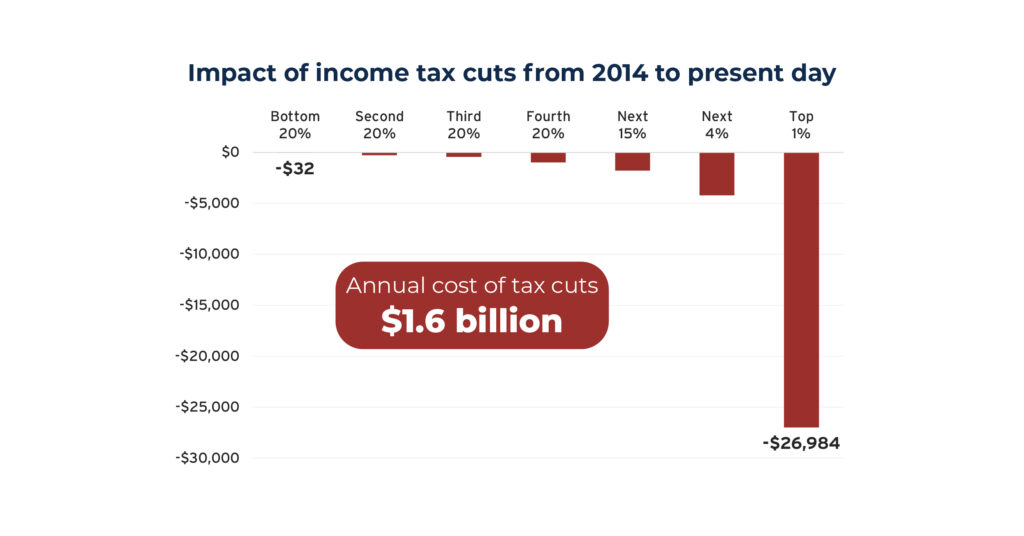
The corporate and personal income tax changes under Senate Bill 8 would cost the state more than $200 million, with 70 percent of the overall cuts benefiting Arkansans in the top 20 percent of households.
Arkansas Advocates for Children: Lawmakers Returning To Work This Week Should Reject Costly Tax Cuts For The Wealthy
September 12, 2023 • By ITEP Staff
In a dramatic development, Arkansas lawmakers are returning to work at the state Capitol this week, after Gov. Huckabee Sanders called for a special session of the Legislature last Friday. Top of the agenda? Whether Arkansas should adopt another round of costly income tax cuts that primarily benefit wealthy households and corporations, on top of cuts already […]
Arkansas Times: A Decade of Tax Cuts for the Rich (and Pretty Much Nothing for You or Me)
May 2, 2023
Taxes help pay for the public services that many of us take for granted — most of our state budget goes to funding education and health services that benefit us all, whether we personally use them or not. But there are better and worse ways for a state to raise revenue. Read more.
Arkansas Times: Making Arkansas Worse Again
April 13, 2023
With the 2023 legislative session blessedly at its end, Arkansas progressives (plus moderates and anyone to the left of the Proud Boys) know what complete and utter political defeat looks like. Read more.
Arkansas Advocates for Children: Vital Services At Risk With Income Tax Elimination
March 31, 2023 • By ITEP Staff
We all want to live in a state with great schools, well-maintained infrastructure, thriving communities, and strong families. But Arkansas’s Governor and many legislative leaders have expressed their support for sharply cutting – or even eliminating – our personal income tax, which would undermine our ability to ever achieve this goal. Read more.
Bloomberg: Did You Pay Your ‘Fair Share’ of Federal Income Tax This Year?
March 31, 2022
And according to the Institute on Taxation and Economic Policy, the impact would have a definite geographic tilt. The states where more than 40% of residents would face tax increases are largely in the South, including Mississippi, West Virginia, Arkansas, Louisiana, Alabama, Kentucky, Oklahoma, Georgia, New Mexico, South Carolina, and Florida. read more
Arkansas Advocates for Children and Families: Tax Cut Plan Even More Expensive, Skewed Toward The Wealthy
February 7, 2022 • By ITEP Staff
The likely proposal for the long-discussed special session seems to have settled, and its main feature would be to cut the top personal and corporate income tax rates. This disproportionately benefits the wealthy, and the corporate income tax cut will largely be captured by out-of-state shareholders, meaning the revenue will leave the state economy entirely. […]
Bloomberg: SALT Debate Forces Rich Americans to Confront Widening Tax Gap
December 10, 2021
Lawmakers in Arizona, Arkansas, Idaho, Iowa, Louisiana, Missouri, Montana, North Carolina, Ohio and Oklahoma have also approved cuts to their top personal income tax going into effect either this year or in future years. “There are states moving in different directions,” said Carl Davis, research director at the left-leaning Institute on Taxation and Economic Policy. […]
Arkansas Democrat-Gazette: Income tax cut bills roll through Arkansas House and Senate; steel plant incentive also meets approval
December 9, 2021
The state Democratic House Caucus held a news conference Wednesday morning to release several proposals that they said would be a better use of the $600 million a year that the Institute on Taxation and Economic Policy estimated was how much the income tax rate cuts would eventually reduce state general revenue. The House Democrats’ […]
Arkansas Times: Arkansas income tax cut plan favors the rich. Duh.
October 8, 2021
Analyses by the Institute on Taxation and Economic Policy (ITEP) show that plans to cut the top income tax rate would largely benefit Arkansans with the highest incomes and cost hundreds of millions in annual revenue. ITEP estimates that cutting the top tax rate from 5.9 percent to 5.5 percent would cost the state $138 million annually. […]
Arkansas Advocates for Children and Families: Proposed Cuts to the Top Tax Rate Are Costly and Heavily Favor the Rich
October 8, 2021 • By ITEP Staff
As the Arkansas Legislature concludes the 2021 general session, our attention must turn to the special session they are preparing to begin to discuss personal income tax cuts. Although income tax cuts may sound like something everyday Arkansans would welcome, when we examine the details, it turns out most Arkansans will be getting a bad […]
Arkansas Times: Can’t Forget the Millionaires: Income Tax Cut on Agenda Today
March 23, 2021
Arkansas Advocates for Children and Families has run the numbers by the Institute on Taxation and Economic Policy. It says 72 percent of the tax cut will go to people making more than $192,000 a year. The tax cut would take effect in 2022. When fully implemented, it would cut revenue by $27.4 million a […]
Bloomberg: Gas Tax for Infrastructure Sparks Fears of Political Backlash
May 1, 2019
Some 30 states have raised their fuel taxes since 2003 -- including Republican-led Ohio, Arkansas and Alabama this year -- according to the Institute on Taxation and Economic Policy. States tack on an average tax of nearly 29 cents per gallon, according to the U.S. Energy Information Administration.
Arkansas Democrat Gazette: Arkansas Senate Panel Fives Fast Nod to Governor’s Tax-cut Plan
February 5, 2019
While the finance department projected the governor’s tax will eventually reduce tax revenue by $97 million a year after it’s fully implemented, Lisa Gee, a senior policy analyst for the Institute on Taxation and Economic Policy in Washington, D.C., said last week that she projected the governor’s income-tax cut would reduce state revenue by $157 […]
Arkansas Advocates for Children and Families: Tax Cut Bill Filed: Plan Revised But Not Fixed
January 31, 2019 • By ITEP Staff
An analysis by the Institute on Taxation and Economic Policy (ITEP) shows that the benefits of this proposal are even more heavily skewed towards the richest taxpayers than the previous version. That’s because there are no changes to the standard deduction, and all the significant changes in marginal tax rates only affect taxpayers with more […]
Arkansas Democrat-Gazette: State Finance Official Says 200,000 Filers Would See Tax Increase in Plan’s Current Form; Governor Wants Fix
January 11, 2019
Rep. Lane Jean, R-Magnolia, said he started digging last month into a written analysis of the plan given by Lisa Christiansen Gee, senior policy analyst at the Institute on Taxation and Economic Policy in Washington, D.C. The analysis, given to the task force last fall, suggested some taxpayers would pay more in net income taxes […]
Arkansas Times: Race, History and Taxes
December 6, 2018
According to the Institute on Taxation and Economic Policy, the poorest 20 percent of Arkansas taxpayers, those making less than $18,600, pay 11.3 cents in state and local taxes on every dollar they earn, compared to 6.9 cents on every dollar being paid by the top one percent of taxpayers making more than $442,000. Read […]
Wyo File: Why Are We Footing the Bill for Billionaires?
November 16, 2018
he question, then, will be: Who pays? That question — “Who pays?” — is also at the center of a report released last month by the Washington, D.C.-based Institute on Taxation and Economic Policy. The report, Who Pays? A Distributional Analysis of the Tax Systems in All 50 States, looks at the different tax rates […]
The Governor’s Proposed Personal Income Tax Cut: Who Wins and Who Loses?
November 15, 2018 • By ITEP Staff
Governor Asa Hutchinson proposed a personal income tax cut as part of his balanced budget plan for the 2019 legislative session, released on November 14.
Tax Proposals Target Benefits to Those at the Top, Corporations
November 12, 2018 • By ITEP Staff
The Arkansas Legislative Tax Reform and Relief Task Force’s recommendations would make the state’s tax system even more regressive than it already is. According to a new analysis by Arkansas Advocates for Children and Families and the Institute on Tax and Economic Policy, the net overall impact of the combined recommendations would actually raise taxes on the neediest Arkansans. At the same time, it would target a bigger share of the decrease to those with the highest incomes.
Arkansas Advocates for Children and Families: Arkansas Tax System Worsens Economic Inequality
October 17, 2018 • By ITEP Staff
Another key driver of inequality in Arkansas’s tax system is the preferential treatment given to capital gains income. Currently, half of all capital gains income is exempted, or ignored, from income taxes even though nearly no one makes a significant share of their income through capital gains (except for the top 1 percent). According to a report from the Congressional Budget Office, capital gains make up 38 percent of the income of the richest 1 percent of households in this country, compared to just 5 percent of the income for the poorest households.
Arkansas Times: Report: Arkansas Taxes Unfair ….. To the Poor
October 17, 2018 • By ITEP Staff
Arkansas Advocates for Children and Families is highlighting a new report relevant to ongoing legislative discussions of "tax reform." It does not suggest the problem is taxation on the rich.

Institute on Taxation
and Economic Policy
ITEP is a non-profit, non-partisan tax policy organization. We conduct rigorous analyses of tax and economic proposals and provide data-driven recommendations to shape equitable and sustainable tax systems.
Subscribe to ITEP Emails
Tax research and policy news in your inbox.
Promote Fair Tax Policy
Your gift to ITEP promotes tax justice. With your help, we do research that supports taxing millionaires and billionaires, taxing big corporations and raising revenue for the things our people, our communities and our planet need.
Together, we can create a country with more economic justice, more racial justice, more climate justice… and more tax justice.