California Gov. Gavin Newsom went to Texas recently and addressed some false claims that Lone Star State leaders like to make about taxes. “Texas taxes poor folks more than we tax our richest,” he said.
He’s right. In fact, poor families in Texas pay a higher share of their income in taxes – 12.8 percent – than is paid by any income group in California.
Newsom continued by comparing the tax structure of California to both Texas and Florida. Sixteen states tax their poorest residents at rates higher than what California taxes its richest, including Texas and Florida. The poorest 40 percent of families in both Texas and Florida pay higher effective tax rates than similarly situated families pay in California. And those Florida and Texas families also pay much more than their wealthier neighbors. In Texas, the wealthiest households pay just one-third the tax rate paid by Texas’ poorest households. Florida is even more extreme, charging its wealthiest households one-fifth what the poorest households pay.
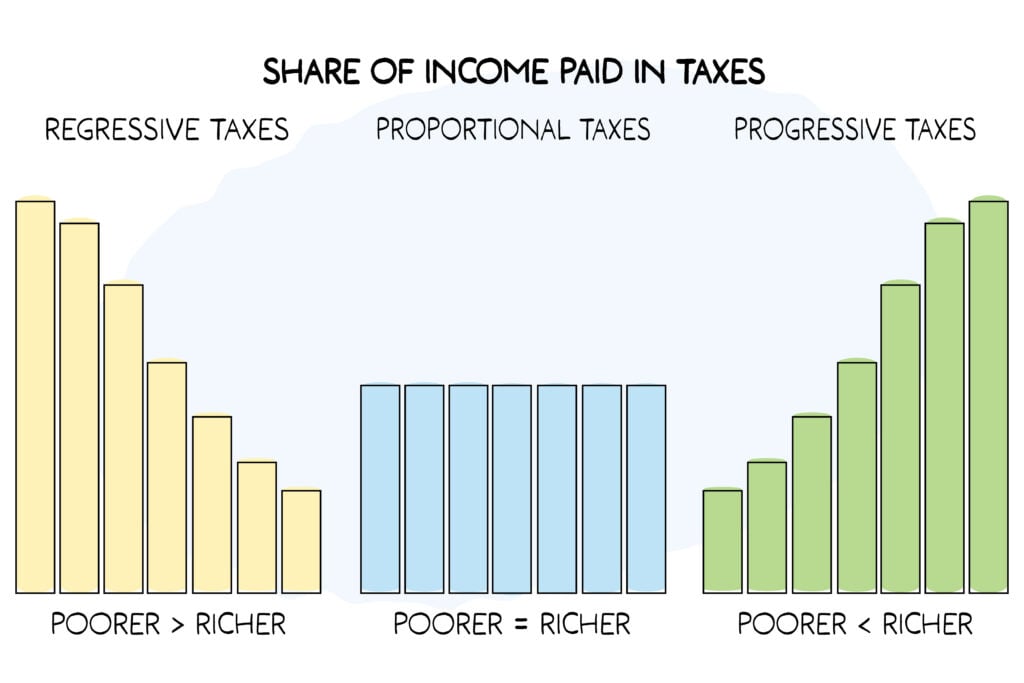
Why? Texas and Florida rely mostly on property taxes and taxes on sales (or consumption) for revenue. Both sales and property taxes are regressive, charging a higher share of income for low- and middle-income households than for higher-income households. In other words, Texas and Florida excel at giving generous tax treatment to the wealthiest households, leaving low-income households to foot most of the bill.
By contrast, California has one of the nation’s least regressive tax systems. Much of California’s revenue is raised through a graduated-rate income tax, a system that bases tax rates on household income. Progressive tax structures like this facilitate equity, ensuring that everyone is charged a rate that is attuned to their ability to pay.
Because it has a graduated-rate income tax, California can fund robust services that benefit all Californians without needing to levy exceptionally high taxes on the working class. For example, because California has paid to expand its Medicaid program (known as MediCal), only 5.9 percent of Californians lack health insurance. By comparison, 16.7 percent of Texans and 10.9 percent of Floridians are uninsured. California’s investments in affordable housing, as the California Budget and Policy Center points out, have doubled the production of units in recent years. California is also home to an exceptional public higher education system, with the most affordable community colleges in the nation, state universities that excel at providing economic mobility for low-income students, and a high share of elite research universities. California’s K-12 teachers are also paid a higher median salary than those in Texas or Florida. Enrollment in publicly funded childcare has increased as the state has expanded access. And so on.
How California and Texas raise revenue sets the states apart. While Texas relies on regressive taxes, such as sales and property tax, California relies mostly on a progressive income tax. As Newsom asked, which is really a high tax state, California or Texas? For low-and moderate-income families, the answer is clear: Texas.