
Overview
- Land value taxation is a method of property taxation that taxes the value of the land rather than the value of any improvements, such as buildings or structures.
- Modern uses of land value taxation mostly use split-rate taxation, which taxes land and improvements at different rates. Kentucky, Pennsylvania, and Virginia are the only states that currently allow certain municipalities to adopt split-rate property taxation.
- Much of the recent interest around land value taxation has more to do with land use policy than with potential revenues generated. Land value taxation penalizes vacant or underutilized property, while encouraging denser uses. This approach can be progressive but requires thoughtful design and may require tradeoffs among different groups of taxpayers.
- Communities that wish to adopt pure land value taxation or split-roll property taxation have multiple considerations, including state law requirements, zoning, assessment capacity, local tax incidence, and complementary land use policies.
Introduction
Few tax policies have been as mythologized as the land value tax. Henry George, a political economist who popularized the tax in his 1879 treatise Progress and Poverty, proposed using it as the basis of a “single tax” to replace all other taxes at the federal, state, and local level.
He was responding to the combined effects of the Depression of 1873-1879 and the Gilded Age – a period in which widespread unemployment coincided with extreme wealth concentration.1 At the time, most of the richest Americans earned their money from the Industrial Revolution. Much of their wealth was held in real estate, and George’s proposed solution to excessive wealth concentration was to tax the land those wealthy people owned.2
National reformers, however, had a different idea. They focused their attention on passing the 16th Amendment authorizing the federal income tax, and land value taxation was mostly abandoned as a national movement.3
Land value taxation has had unusually disparate political support over the past 150 years from working-class laborers to free-market capitalists.4 A recent uptick in support has come from housing advocates and urbanists, who see land value taxation as a way to encourage denser housing development and disincentivize land speculation on vacant or underutilized land.
Real estate taxes remain the single largest source of tax revenue for most local governments, and land value taxation would mark a fundamental shift in how localities tax it.
What is Land Value Taxation?
The underlying concept for land value taxation (LVT) suggests that taxing property should be based on the underlying value of the land rather than the value of any improvements to land, like buildings, landscaping, drainage systems, utility connections, or other additions. Land is a fundamentally different asset from other forms of wealth since it cannot be created or moved and derives most of its value from societal change, like neighbor investment and agglomeration, and collective or government investment rather than individual effort.
LVT exposes a contradiction: land values typically rise because of collective public investment such as improved infrastructure, zoning decisions, clustering of workers and businesses, and cultural vitality, yet this publicly created value often translates into private wealth for lucky landowners who happen to live near these improvements.
For instance, land values may increase if a city builds a new train station in a neighborhood; local homeowners and business owners get wealthier without having done any work to the physical structure on top of their land.
Land value taxation also strengthens incentives for economic development and discourages property owners from holding vacant property.
Under a traditional property tax system, a homeowner or business is taxed on the combined value of the land and whatever buildings sit on it (a house, apartment building, office, factory, etc.), so investing in more productive or well-maintained buildings leads to higher tax bills. This creates a benefit for the owners of vacant lots, who pay a lower traditional property tax because there is no structural value to be taxed. Moving to LVT would encourage the owner of vacant lots to develop properties to more productive uses rather than speculate on future growth in property values.
Henry George’s original vision for the LVT was far more radical than most contemporary proposals, since he proposed the LVT as a “single tax” that would replace all other taxes including income, sales, estate, and business taxes. In practice, to the extent that land value taxation has been adopted in the U.S. and abroad, it has rarely replaced other taxes. The radical nature of George’s plan made it politically unpalatable, as his proposed tax rate would have to be very high. Even replacing all local taxes with a land value tax would be fiscally challenging, so most modern land value tax proposals often focus only on replacing or improving the property tax.
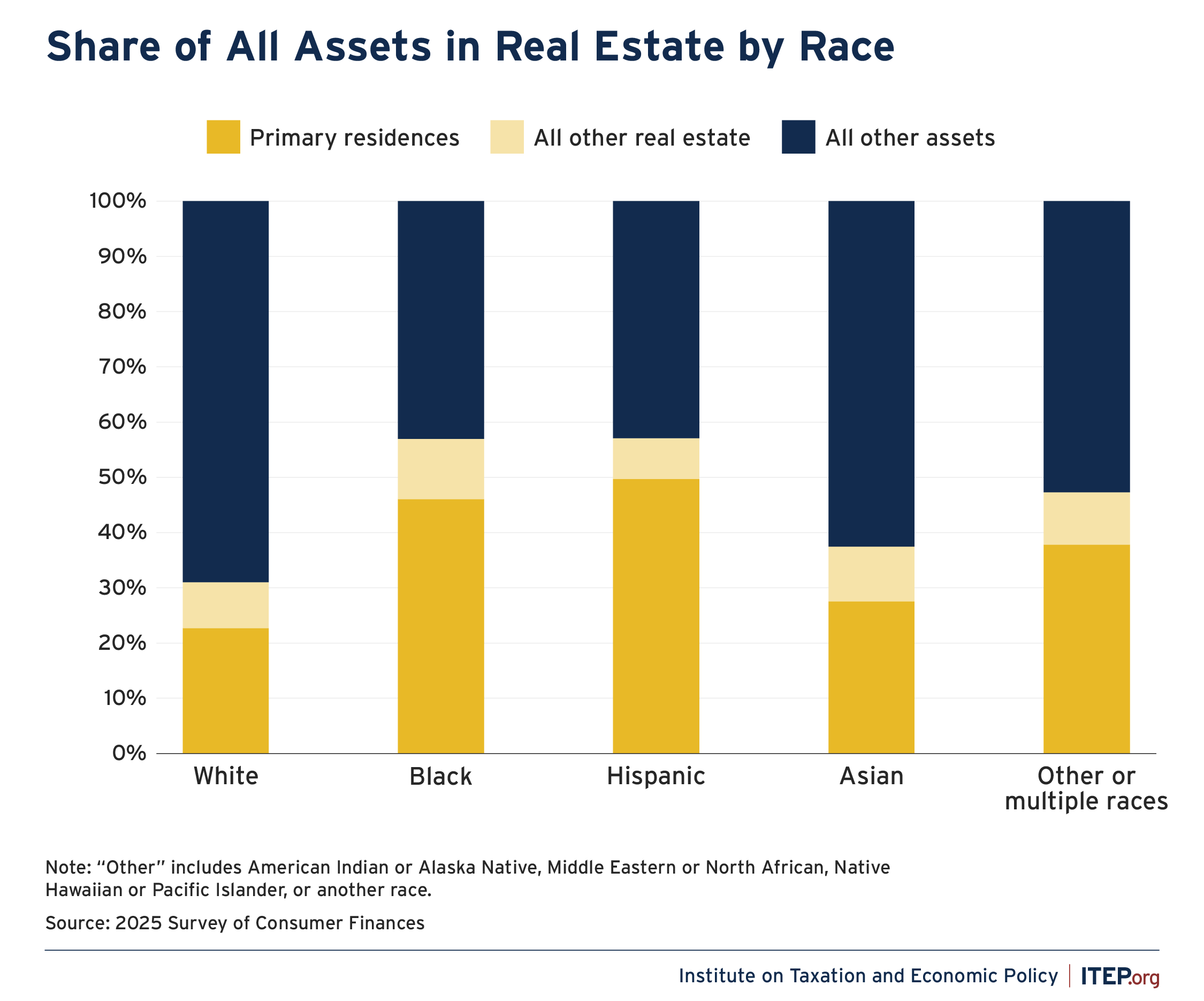
Inequality in the 21st century is primarily driven by the growth in value of intangible assets, such as stocks, bonds, and other types of equities.5 In the U.S., the largest share of low- and middle-income families’ wealth are tied up in real estate, primarily in the form of primary residences; this is especially true of Black and Latino families.6
Figure 1:
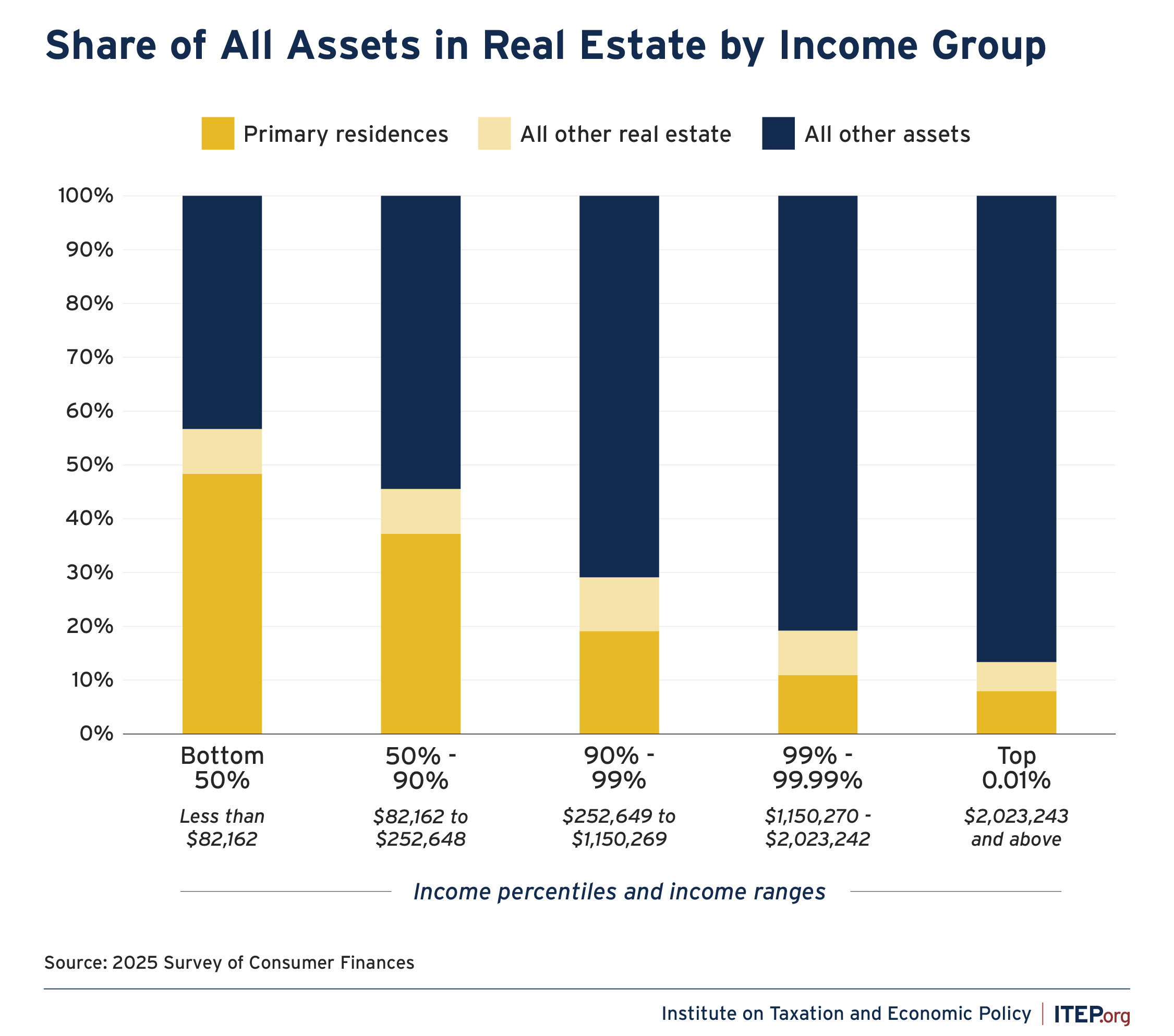
Figure 2:
Compared to George’s time, taxing land values might not be as progressive a tax as it once was. Instead, the logic for land value taxation in the 21st century is primarily focused on inducing the development of new housing, denser land uses, and revitalizing urban communities. While these outcomes don’t inherently advance tax fairness, there are certainly positive secondary effects that may make land value tax a valuable tool for certain cities.
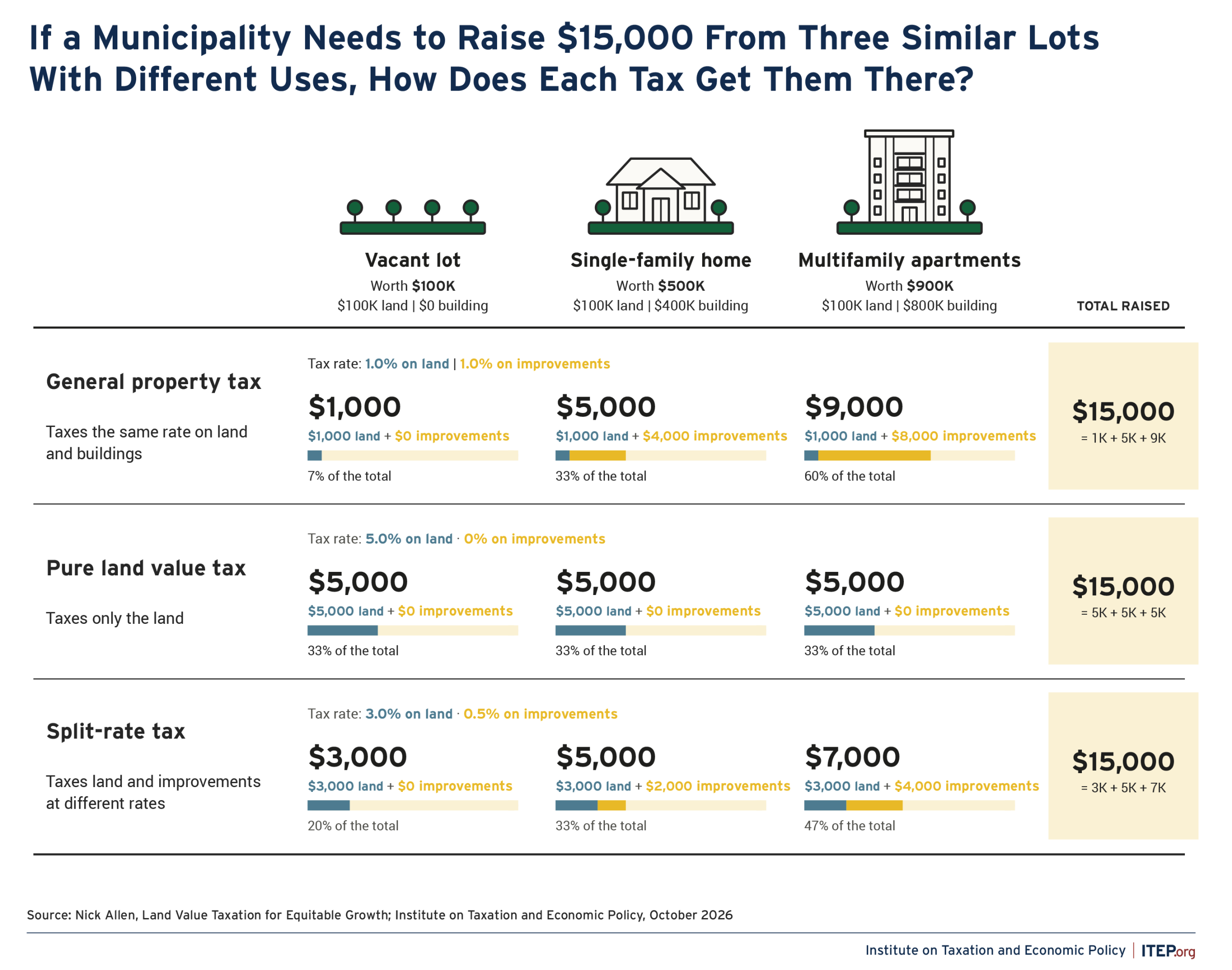
A few communities in the U.S. have adopted split-rate tax systems that tax land at higher rates than improvements, moving towards LVT while maintaining the basic architecture of the property tax system. For example, split-rate cities in Pennsylvania still tax land and buildings, and land is taxed at a higher rate. These split-rate systems represent a compromise between pure Georgist theory and existing tax structures. This structure is easier to integrate into existing assessment practices.
Hence, modern LVT is not George’s radical idea of the single tax on wealth; rather, it is a form of property tax reform aimed at driving specific development patterns. Throughout the rest of this brief, “land value tax” and “LVT” refer to this more modern split-rate take rather than the initial proposal of land as the sole revenue base.
Figure 3:
Are Land Value Taxes Progressive?
The distribution of an LVT – that is, how the tax will ultimately land on households of varying incomes and demographic characteristics – is not a simple question.
Since LVT reforms are often revenue-neutral, some property owners will pay more tax and some will pay less than they would under a traditional property tax system. Roughly speaking, the owners of less-developed properties in neighborhoods where land is more expensive will pay more; the owners of more-developed properties where land is less expensive will pay less.
In some cases, that could mean higher taxes for higher-income households and business owners. For example, consider an investor-owned vacant lot next to a large multifamily apartment building. LVT will likely raise taxes on the vacant lot owner and reduce taxes on the multifamily apartment building; a portion of the reduced taxes on the apartment building will be passed through to renters. Since investors tend to have above-average incomes and renters tend to have below-average incomes, the result will be a more progressive tax (that is, a tax that rises with income).
In other cases, it could mean the reverse — higher taxes for some lower-income households. Consider two adjacent single-family homes sitting on equally valuable pieces of land, a small older home and a large new luxury build. LVT would increase taxes on the older home and reduce them on the new home, which – if the older home’s owner has lower income than the newer one’s – would be a regressive shift.
The situation is further complicated by the fact that LVT depends greatly on the accuracy of assessments. A major factor with the administration of any property tax is the ability for assessors to accurately capture the value of a given piece of land. Particularly in the experience of Pennsylvania described below, the progressivity of the tax matched closely with the ability of assessors to determine the value of land separately from the improvements on top of the property.
However, land value tax has the added benefit of returning the benefits of public investment to the community. Governments that recapture the growth in property value due to improvements can, in turn, put those investments directly back into the community. This is superior to a traditional property tax, which is less tailored toward collecting tax revenues based on the growth in property values due to the activity of the city rather than the property owner.
Studies from LVT advocates on Cincinnati, Detroit, and Washington, D.C. find that the shifts to split-rate typically reduce the estimated tax on multifamily properties, with more mixed results for single-family homeowners based on the overall value of single-family homes in a region.7 These studies typically use a neighborhood matching technique that matches median neighborhood incomes to home values in those neighborhoods. These studies also generally push for widespread and denser housing development, which in turn can drive down the overall cost of housing. This itself can have a progressive effect, even if it is not driven by an explicitly progressive tax design.
Where LVT is Legal Right Now
Pennsylvania
Pennsylvania is the only state in the country where cities use land value taxation. As of this writing, 11 communities, including the state capital Harrisburg, use the system. The cities are mostly small- and mid-sized communities, and many are former steel or oil towns contending with the loss of major industry. As described below, Pennsylvania has allowed cities to adopt LVT since the early 20th century, though some cities that previously used LVT have since abandoned the system.
Figure 4:
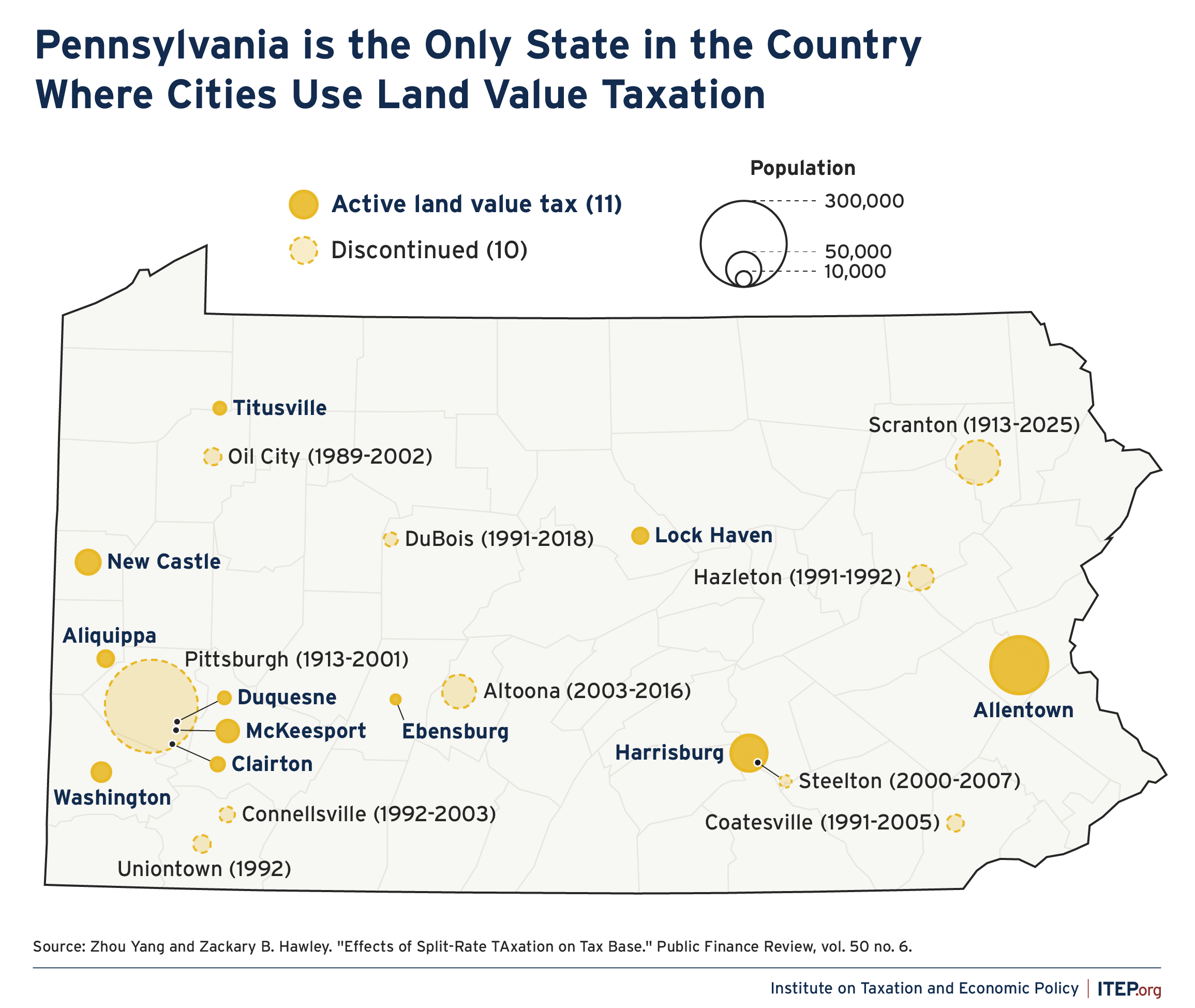
The 11 LVT cities administer it in different ways, with varying land-to-improvements tax ratios, assessment accuracy, and frequency. Pennsylvania state law has no required reassessment schedule, meaning cities may be relying on assessments that could be decades old. This makes horizontal equity – that is, relative tax bills between similar properties – worse over time, as it preserves low assessments for improving properties, and preserves high assessments for declining properties. These underlying flaws in Pennsylvania’s property tax system make it hard to generalize that the policy has been uniformly progressive.
Poor assessment practices led the two longest-running LVT systems in the state to abandon the system. Pittsburgh and Scranton, which had both used the system since 1913, stopped using LVT in 2001 and 2025, respectively, due to political blowback over new assessments.8
Studies of the land value tax in Pennsylvania have focused primarily on how it affects land use and property values. One comprehensive study of impacts on market and land values found that the largest property value benefits accrued to commercial properties rather than to residential or industrial uses. This held down property taxes for residential homeowners and meant that the value creation was focused on the downtowns of the cities that used split rates rather than outlying areas.9
Another study found that collectively, Pennsylvania municipalities that adopted LVT stimulated development and increased housing density compared to cities that did not. This makes those towns stronger, as additional housing stock and increased economic development encourages residents to stay and even reinvest in the community in the face of economic downturns. This is of particular importance as many of the cities that adopted LVT were former steel towns, which suffered the most following deindustrialization in the 1980s.10
Virginia
Virginia allows eight of its 38 cities to use land value taxation, including state capital Richmond, but none have yet implemented it. Virginia already requires cities and counties to assess land and buildings separately, giving these eight cities a head start on adopting LVT so long as assessment practices are transparent, fair, and accurate.
The Progress and Poverty Institute, a national group that advocates for land value taxes, modeled the potential impact of a revenue-neutral land value tax in Richmond. Its analysis found that doing so could be slightly progressive by shifting the tax onto land-intensive parcels (like large vacant lots or sprawling commercial properties) and wealthier neighborhoods. Adopting the change prior to mass rezoning processes could help recapture some of the windfall land value created by upzoning.11
Kentucky
In April 2026, Kentucky passed a law allowing Louisville to use split-rate taxation.12 Though final tax rates have yet to be determined, the city pushed to adopt split-rate to address vacant properties. Advocates for passage emphasized that the shift would raise taxes on surface parking and underutilized parcels rather than increasing taxes on properties with improvements.13
Proposals in Other States
In most of the U.S., land value taxation would require a change in state law and, in some cases, a change to the state constitution. The Center for Land Economics, which advocates for land value taxation, tracks ongoing legislative interest across states:14
- California: In 2023, legislators in California proposed a study of adopting land value taxation statewide. Though the bill attracted significant interest from urbanist groups, it did not get out of committee.15
- Colorado: In 2024, lawmakers in Colorado proposed a constitutional amendment that would allow local governments to use land value taxation with resident approval. The proposal did not advance, illustrating the ongoing constitutional and political barriers in the state.16
- District of Columbia: In 1997, the D.C. Tax Revision Commission studied LVT but did not recommend adoption due to administrative complexity and uncertain distributional effects. However, advocates across the District have continued to urge the city to adopt LVT to encourage housing development to combat the city’s housing shortage.17In 2025, a staff memo of the D.C. Tax Revision Commission found that revenue-neutral adoption would decrease taxes on larger multifamily housing and certain commercial uses, while increasing taxes on single-family homeowners, small multifamily buildings, vacant properties, and certain land-use intensive commercial and industrial properties. While it would be more progressive than the city’s current property tax, concerns about the possibility of rising bills for low-income homeowners might mean the city would need to adopt additional reforms.18
- Maryland: Maryland has considered adopting land value taxation in Baltimore to combat persistent vacancy, and along transit corridors in the D.C. suburbs to promote denser development and to capture the rapid property value growth in those areas. The most recent proposal was written in 2025.19
- Michigan: Following the city’s bankruptcy and property tax foreclosure crisis in 2013, Detroit was plagued by abandoned homes and thousands of vacant lots. In 2023, then-Mayor Mike Duggan pushed for the city to adopt land value taxation to combat chronic vacancy and abandonment, advocating for a state bill. Despite bipartisan support, news reports suggested many legislators remained unconvinced that LVT would help the city and rejected the bill.20 A study published by the Lincoln Institute of Land Policy found that moving to a split-rate land tax would reduce the taxes paid by homeowners most harmed by tax foreclosures, while also incentivizing development of the vacant lots in the city.21 As of 2026, the city has 122,000 vacant residential lots – nearly one-third of the city’s 378,000 lots.22
- Minnesota: Legislators in Minnesota have repeatedly introduced bills to allow localities to experiment with various forms of land value taxation, including a recent push in the 2023-2024 session.23
- Ohio: A recent report co-published by the Center for Land Economics and the Notre Dame Student Policy Network found that Cincinnati could improve property tax progressivity by using split-rate taxation. The tax mix would shift away from lower-valued homes onto vacant lots, certain commercial corridors, and higher-valued homes.24 In 2026, a bill in the Ohio Senate proposed constitutional changes to allow localities to opt into a version of split-rate taxation.25
- Oregon: Traditional property tax limits like Measures 5 and 50 in Oregon have strained local budgets since they were passed in the 1990s. One study from the Northwest Economic Research Center found that moving to a land value tax system would improve progressivity in Portland by increasing the effective tax rates in higher-income neighborhoods.26 In 2025, the legislature requested a study into the feasibility of LVT, including tax distribution, economic incentives, and its impact on different jurisdictions. The study has yet to be completed.27
How to Determine Whether Land Value Taxation Is Appropriate for Your Community
Before undertaking LVT reform, a community should articulate what the goals of such a policy would be, ensure that it is permitted by state law, develop strong assessment capacity, enact zoning rules that are consistent with the LVT, and carefully monitor implications for tax progressivity and racial equity.
Articulate clear goals
Land value taxation can serve multiple goals, such as reducing speculative land holding, encouraging denser development, shifting taxes from homeowners to underused land, or generating revenue for public investment. But there are tradeoffs, and the design implications of each goal differ significantly.
For example, a revenue-neutral split-rate reform that lowers taxes on homeowners while raising it on vacant lots is a better approach for a community principally concerned about blight, while a revenue-positive LVT is a better approach for funding transit expansion but may increase taxes on a broad group of properties. And no LVT would be right for a community that is concerned about inducing excessive development, as evidenced by the experience of Hawai’i described below.
Policymakers should be explicit about their primary goal before designing a system and honest about what LVT cannot do, as well as what it can.
It’s also important for policymakers to acknowledge that while LVT can change incentives at the margin and encourage productive development, it cannot generate economic activity where underlying conditions for it are absent. A locality still needs solid population and job growth, public infrastructure, and financing and investment capital for LVT to make a meaningful difference.
In communities facing population loss, limited job growth, inadequate infrastructure, weak housing markets, or long histories of disinvestment, policymakers should pair LVT with complementary economic development, housing, and infrastructure investments rather than expect the tax shift alone to generate revitalization.
Amend State Law, If Needed
State law is usually the barrier to local LVT adoption. Many state constitutions include uniformity clauses requiring all real property to be taxed at the same rate, prohibiting differential taxation of land versus improvements. Policymakers should, as a first step, determine whether their state has a uniformity clause, whether existing law permits differential taxation through property classification, and whether enabling legislation exists or would require a constitutional amendment.
Develop Assessment Capacity
Any meaningful LVT system requires reliably separating land value from improvement value. In many U.S. jurisdictions, assessors technically do maintain separate land and improvement estimates, but their quality and accuracy vary enormously. Even in locations where the total assessment of each property is quite accurate, the assessment’s estimated split between land and improvements may be much less accurate and this will have serious consequences when a jurisdiction starts taxing them at different rates. In Pittsburgh, decades of deferred reassessment meant that when land values were finally updated to reflect actual market conditions, the corrections were enormous and politically destabilizing.
Before pursuing LVT, local governments need to make sure that their assessments are accurate and up to date and will remain so going forward. Unfortunately, many states’ property tax assessment systems already are less transparent and equitable than they should be, so adding a requirement that land and improvements be valued separately could require extensive preparation and increased funding.
Jurisdictions may need expanded assessment oversight, stronger accuracy checks, more regular assessments, transparent assessment methodologies and data, and better access to the appeals process.
Modern assessment practices prioritize computer-assisted mass appraisal (CAMA) systems, frequently relying on one or more statistical regression techniques using dozens of individualized data points for each property, including recent sale prices. These systems can improve accuracy but are often opaque to taxpayers.
Being transparent with taxpayers and other parts of local and state government empowers the public to ensure these models accurately represent the condition of properties with or without improvements.28
Combine LVT with Zoning Reforms
Land value taxation creates an incentive to develop land more productively but only where more productive development is legally permitted. In much of the U.S., zoning restricts density, limits permitted uses, and caps building height in ways that prevent the kind of intensive development that LVT is designed to encourage.
LVT can reduce land speculation in underused commercial areas, but policymakers must honestly and accurately determine how much of the development gap reflects zoning constraints compared with larger economic trends in a given region. LVT cannot create a demand on land for commercial or industrial use with no existing economic interest from business.
Address Taxpayer Impacts
Land value tax proposals can roughly be divided into two categories: those designed to be revenue-neutral (shifting who pays property taxes without changing total revenues) and those designed to generate additional revenue. Detroit’s proposed split-rate reform is explicitly revenue-neutral, designed to provide tax cuts to homeowners exceeding what existing assistance programs offer. Other proposals, including discussions in the District of Columbia, have framed LVT as a funding mechanism for capital improvements and transportation.
Revenue-neutral designs raise taxes on some properties and reduce taxes on others, producing clear “winners and losers” that could invite political backlash, especially from land-rich owners, speculators, and commercial property holders with high land-to-building ratios. Revenue-positive designs can also have winners and losers, but raising revenue for an identifiable public purpose can also improve public support for higher taxes.
To the extent possible, policymakers should task analysts with modeling distributional effects at the parcel level before advancing any concrete proposals. An analysis completed for the District of Columbia’s Tax Revision Commission was able to show not only parcel-level tax changes, but also how those changes would impact neighborhoods citywide.29
To the extent that LVT leads to higher property taxes on some low-income property owners, or worsens existing racial disparities, policymakers can consider design approaches to broaden support, such as phase-in provisions, exemptions for certain property types, or property tax circuit breakers.30
Can LVT Promote Racial Equity?
On racial equity, the picture is nuanced, and it’s best to think of LVT as one equity tool among many.
Historical racial segregation and discriminatory housing policies allowed white households to capture disproportionate gains from appreciating land values while excluding many Black families from those benefits.
Land value tax proponents argue that LVT can partially address this legacy by reducing speculative landholding, capturing a greater share of socially created land values for public benefit, and shifting taxes away from improvements and toward valuable land. In many communities, this can reduce taxes on homeowners with relatively modest land values while increasing them on high-value urban sites.
At the same time, LVT is not a substitute for complementary equity policies. Development incentives may increase investment in some neighborhoods, while generating little development in others. In Pittsburgh, LVT spurred development in the central business district with limited spillover into historically marginalized neighborhoods, which protected existing homeowners from higher taxes but also kept them from capturing the benefits of development.
Overall, LVT is best understood as one tool within a broader equity strategy that includes anti-displacement measures, community land trusts, and targeted affordable housing investments.
History of Land Value Taxes in the U.S.
Pennsylvania: The U.S. Laboratory of Split-Rate
Pennsylvania, Henry George’s birthplace, has been the most active laboratory for split-rate land value taxation. Pennsylvania is the only state to have authorized this for over a century, allowing Pittsburgh and Scranton to adopt the tax in 1913.31 Before 1913, Pennsylvania law required land and improvements to be taxed at equal rates, but land speculation among wealthy steel barons sparked legislation allowing Pittsburgh and Scranton to gradually lower rates on improvements and increase rates on land.32
LVT was uncontroversial in Pittsburgh through the early 1970s. The early decades of LVT likely discouraged speculation and land hoarding, as Pittsburgh land values only rose by 20 percent compared to other cities where land prices tripled in the 1920s. Though slow price growth frustrated real estate interests, it also protected those same landlords during the Great Depression when land values in other cities plummeted.33 During the mid-20th century, the land tax differential was fairly modest, and the tax was a stabilizing force rather than an incentive to increase housing and industrial construction.
By 1965, Pennsylvania had passed legislation allowing many more cities to adopt split-rate property taxes, though only Pittsburgh and Scranton actually used LVT.34 In the 1970s, the steel industry collapsed, destroying property values and tax revenues across the state. Pittsburgh doubled down on LVT, dramatically increasing the land tax differential until buildings were taxed at a fraction of the land rate.
A landmark 1997 study found that the split-rate system contributed to commercial investment and redevelopment, especially in the central business district. Though the authors do not attribute all the redevelopment to land value taxation, the effect was a marked difference from 15 other Midwestern cities included in the study.35
Many cities across the state ended up under state control as their steel industries collapsed and their tax bases dwindled. Multiple cities turned to the land value tax to spur redevelopment. Harrisburg adopted split-rate taxation in 1975 after Tropical Storm Agnes worsened blight and disinvestment. More than a dozen cities followed Harrisburg’s lead and adopted split-roll in the 1980s and 1990s. Studies looking at the impact across these cities found that cities that adopted split-roll saw varying increases in building permits and higher construction rates compared to cities that did not use split-rate.36
Despite the nearly 80-year success of split-rate, Pittsburgh’s system was repealed in 2001 due to a political backlash to a long-overdue citywide property reassessment. Though the switch to a flat-rate system was supposed to be temporary, the city has not readopted split-rate since. However, a 2006 study showed that an estimated 54 percent of homeowners paid more under the combined millage than they would have under split-rate.37
Many smaller cities that experimented after Harrisburg have also abandoned split-rate due to similar problems with reassessment schedules. Pennsylvania is one of the only states in the country that does not require regular property tax reassessments for any city or county, and infrequent reassessments have led to problems across the state regardless of the adoption of split-rate.38
As of November 2026, 11 cities in the state still use split-rate property taxation.
Hawai’i: “They Paved Paradise to Put Up a Parking Lot”
Hawai’i adopted and then rescinded LVT, not because it was ineffectual, but because critics considered it too impactful in sparking rapid construction.39
The split-rate system was launched in the 1960s to make more land available for development and support tourism (following statehood, the Hawai’i state government administered the property tax rather than individual counties). The law phased in the tax from 1965, starting with the improvement tax rate at 90 percent of the land rate and eventually decreasing it to 40 percent over a ten-year period.40 Hawai’i subsequently experienced a construction boom, especially in hotels.
Early academic studies from the 1970s found that fully eliminating taxes on improvements in Waikiki could increase hotel investment by as much as 25 percent.41 Since the construction boom in Waikiki was primarily focused on tourism and hotel building, rather than residential construction, there was significant local backlash against the new, taller constructions and the rapid transformation of Waikiki Beach.
The state legislature rescinded the law that created the tax by 1977 even though the tax essentially worked as intended. Some reasonably argued that poor urban planning and zoning decisions were to blame for Waikiki’s overdevelopment, but the split tax became the scapegoat.
After the statewide tax was repealed, Hawai’i transferred the administration of property taxes to counties. Over the next few decades, three counties – Hawai’i, Honolulu, and Kaua’i – reinstated versions of split-rate taxation at different times but they eventually all shifted to conventional rates.42
Hawai‘i’s experience demonstrates how land value taxation can meaningfully spark urban development while attracting political backlash when the redevelopment happens too quickly.
Other Historical Experiments
Houston
In 1911, Houstonians elected J.J. Pastoriza first as Tax Commissioner and later elected him mayor. As Houston Tax Commissioner, Pastoriza pushed for the adoption of a split-rate tax system that brought in more revenue with a lower overall tax rate. However, the system was found to have violated Texas’ constitutional requirement that all properties be taxed uniformly and was ultimately struck down.43
New York
In 1993, Gov. Mario Cuomo signed legislation allowing the city of Amsterdam to adopt a land-value-weighted property tax. The system was later repealed due to difficulties with implementation and a change in municipal leadership.44
Connecticut
In 2013, Connecticut lawmakers introduced legislation to allow a pilot program permitting up to three municipalities to adopt split-rate taxation while conducting a tax-incidence study to evaluate the distributional impacts across income groups and businesses. As of 2026, no towns have requested to be part of the pilot.
Subsequent research by the University of Connecticut used parcel-level assessment data to find that depending on specific neighborhood characteristics, a land value tax could modestly shift taxes towards high-value parcels while promoting development incentives.45 That study indicated that the shift to a land value tax would be more progressive than the current real estate tax.
A later analysis by the same researchers concluded that inconsistencies in land assessments in Hartford, New Haven, and New London could make implementing land value taxes difficult without first improving their valuation practices.
Conclusion
LVT can be an effective policy tool with real theoretical grounding and some empirical support, but its effectiveness depends heavily on local conditions, institutional capacity, and the specific outcomes policymakers are seeking to achieve. Designing a progressive LVT is possible but requires thoughtful design and implementation choices.
LVT works best when paired with robust and regularly updated assessments and a strong pre-existing market for the development LVT is designed to encourage. It hasn’t worked as well when policymakers have failed to simultaneously invest in reassessments or complementary policies. Under the right conditions and with honest expectations, land value taxation can reshape land-use incentives in meaningful ways.
Endnotes
- 1. Gary Richardson and Tim Sablik. “Banking Panics of the Gilded Age: 1863-1913.” Federal Reserve History, Dec. 4, 2015; Trevor Jackson. “How the Gilded Age Economy Broke the World.” New York Times, book review, Jun. 1, 2026.
- 2. Hugh Rockoff. “Great Fortunes of the Gilded Age.” NBER Working Paper No. 14555, Dec. 2008.
- 3. Sheldon Pollack. “Origins of the Modern Income Tax, 1894-1913.” The Tax Lawyer, vol. 66 no. 2 (Winter 2013), pp. 295-330; Michael Hudson. “Henry George’s Political Critics.” The American Journal of Economics and Sociology, vol. 67 no. 1 (Jan. 2008), pp. 1-46; Christopher William England. “Land and Liberty: Henry George, the Single Tax Movement, and the Origins of 20th Century Liberalism.” PhD diss., Georgetown University, Aug. 2015.
- 4. Annika Neklason. “The 140-Year-Old Dream of ‘Government Without Taxation.’” The Atlantic, Apr. 15, 2019.
- 5. Board of Governors of the Federal Reserve System. “Distributional Financial Accounts, Q1 2026.” Accessed Sep. 10, 2026.
- 6. Ibid.
- 7. Notre Dame Student Policy Network. “From the Ground Up: An Analysis of Land Value Tax in Cincinnati, Ohio.” Prepared in partnership with the Center for Land Economics, Apr. 20, 2026; John E. Anderson and Nick Allen. “Split Rate Property Taxation in Detroit: Findings and Recommendations.” Lincoln Institute of Land Policy, Apr. 2022; DC Tax Revision Commission Staff Report. “Tax land and buildings at different rates.” 2025.
- 8. Jim Lockwood. “Scranton proposes 2026 budget without tax increases.” The Times-Tribune, Nov. 7, 2025. Nicole Hallman. “Scranton 2026 Budget: No Tax Hike, Ends 112-Year Split Millage.” The Pocono Review, Dec. 26, 2025.
- 9. Zhou Yang and Zackary B. Hawley. “Effects of Split-Rate Taxation on Tax Base.” Public Finance Review, vol. 50 no. 6 (2022),
- 10. Zhou Yang, “The Effects of the Two-Rate Property Tax: What Can We Learn from the Pennsylvania Experience?” Lincoln Institute of Land Policy working paper, 2014.
- 11. Stephen Hoskins and Josie Faass, “Enhancing Equity in Taxation: A Land Value Tax for Richmond, VA,” Progress & Policy Institute, March 2024.
- 12. Kentucky General Assembly. House Bill 607, enrolled Apr. 14, 2026.
- 13. Roberto Roldan. “One idea for increasing development in downtown Louisville: More taxes on parking lots.” Louisville Public Media, Apr. 2, 2026.
- 14. Center for Land Economics. “Where is Land Value Tax Legislation Being Considered?” Last updated Jul. 27, 2026; accessed Sep. 1, 2026.
- 15. California Legislative Information. AB-362 Real property taxation: land value taxation study. 2023-2024 session.
- 16. Colorado General Assembly. 2024. Senate Concurrent Resolution 24B-001: Concerning Authorization for a Local Government That Levies an Ad Valorem Tax to Instead, Subject to Local Voter Approval, Levy a Land Value Tax. Colorado General Assembly. https://leg.colorado.gov/bills/scr24b-001
- 17. Matt Girardi. “It’s Time for a Land Value Tax for Metro.” Greater Greater Washington, February 26, 2025.
- 18. DC Tax Revision Commission Staff Report. “Tax land and buildings at different rates.” 2025.
- 19. Maryland General Assembly. (2025). H.B. 330, 2025 Leg., 446th Sess. (Md. 2025). LegiScan.
- 20. Beth LeBlanc. “Duggan’s Detroit tax shift plan stalls again in Michigan House even with GOP help.” Detroit News, Oct. 11, 2023.
- 21. John E. Anderson and Nick Allen. “Split Rate Property Taxation in Detroit: Findings and Recommendations.” Lincoln Institute of Land Policy, Apr. 2022.
- 22. Rob Hubbard. “Taxing land vs. The buildings on it at core of House bill.” Minnesota House of Representatives, Session Daily. Apr. 3, 2024.
- 23. Notre Dame Student Policy Network. “From the Ground Up: An Analysis of Land Value Tax in Cincinnati, Ohio.” Prepared in partnership with the Center for Land Economics, Apr. 20, 2026.
- 24. Marty Schladen. “Tax change would spur Ohio development – and help low-income families most, new study says.” Ohio Capital Journal, Jul. 21, 2026.
- 25. Peter Hulseman, Adam Rovang, Devin Bales, and Hoang The Nguyen. “Land Value Tax Analysis: Simulating the Tax in Multnomah County.” Northwest Economic Research Center, Portland State University, June 2019.
- 26. Oregon Legislative Assembly. 2025. HB 2124: Relating to Land Value Taxation; Prescribing an Effective Date. Oregon Legislative Information System.
- 27. William Healey. “Best Practices in U.S. Assessment.” International Association of Assessing officers’ Technical Standards. Presented at the FIG Congress May 24-29, 2026.
- 28. DC Tax Revision Commission 2025.
- 29. Carl Davis and Brakeyshia Samms. “Preventing an Overload: How Property Tax Circuit Breakers Promote Housing Affordability.” Institute on Taxation and Economic Policy, May 11, 2023.
- 30. Brakeyshia Samms and Nick Johnson. Circuit Breaker Credits: The Best Tools for Property Tax Affordability. Institute on Taxation and Economic Policy, November 9, 2026. https://itep.org/circuit-breaker-credits-the-best-tools-for-property-tax-affordability/
- 31. Richard F. Dye and Richard W. England, eds. 2009. The U.S. Experience (p. 12) in Land Value Taxation: Theory, Evidence, and Practice. Cambridge, MA: Lincoln Institute of Land Policy
- 32. Dan Sullivan. “Bringing prosperity through freedom, equality, local autonomy and respect for the commons.” Saving Communities, February 2, 2008.
- 33. “The Local Tax Enabling Act.” Pennsylvania Act No. 511 of 1965.
- 34. Wallace E. Oates and Robert M. Schwab. “The Impact of Urban Land Taxation: The Pittsburgh Experience.” National Tax Journal 50(1), 1997.
- 35. Kepner and Mattoon 2023; Robert M. Schwab and Amy Rehder Harris. “An Analysis of the Graded Property Tax. Chapter G” in Taxing Simply, Taxing Fairly: A Report of the District of Columbia Tax Revision Commission. Washington, DC: District of Columbia Tax Revision Commission, 1998.
- 36. Mark Alan Hughes, “Why So Little Georgism in America: Using the Pennsylvania Case Files to Understand the Slow, Uneven Progress of Land Value Taxation,” Lincoln Institute of Land Policy (Working Paper, 2006).
- 37. “Pennsylvania Property Assessment: A Self-Evaluation Guide for County Officials.” Local Government Commission Property Assessment Reform Task Force, Jun. 13, 2018.; Kate Giammarise and Chris Potter. “Lawsuit calls on Pa. To change ’grossly non-uniform’ property tax assessment system.’ 90.5 WESA, Jul. 15, 2025.
- 38. Joni Mitchell’s “Big Yellow Taxi” lyrics were supposedly inspired by her trip to Waikiki in 1972. Robert Hilburn. “Both Sides, Later.” Los Angeles Times, Dec. 8, 1996.
- 39. Richard F. Dye and Richard W. England, eds. 2009. The U.S. Experience (p. 14) in Land Value Taxation: Theory, Evidence, and Practice. Cambridge, MA: Lincoln Institute of Land Policy.
- 40. Susan L. Roakes, “Reconsidering land value taxation: The golden key?” in Land Use Policy, Vol. 13. No 4 pp. 261-272, 1996.
- 41. Richard F. Dye and Richard W. England, eds. 2009. The U.S. Experience (p. 20) in Land Value Taxation: Theory, Evidence, and Practice. Cambridge, MA: Lincoln Institute of Land Policy.
- 42. Stephen Davis. “Joseph Jay Pastoriza and the Single Tax in Houston, 1911-1917.” The Houston Review, pp. 56-76; Shane Phillips, host. UCLA Housing Voice, “Land Value Tax Would Fix This with Lars Doucet,” UCLA Lewis Center for Regional Policy Studies, Apr. 22, 2026.
- 43. Donald J. Reeb. “The Adoption and Repeal of the Two Rate Property Tax in Amsterdam, New York.” Lincoln Institute of Land Policy working paper WP98DR1, 1998.
- 44. Jeffrey P. Cohen and Michael J. Fedele, “Connecticut’s Land Value Taxation Public Act: Who Would Bear the Burden?” University of Connecticut School of Business / Journal of Real Estate Research. Working paper (2016).
- 45. Jeffrey P. Cohen and Michael J. Fedele. “Where in Connecticut is the Best Location for a Split Tax? An Analysis of Land Assessment Equity in Several Cities.” Buildings, vol. 7 (2017).