
Citations
6,208 posts
NBC News: How Much Does Illegal Immigration Cost America? Not As Much As Trump Claims
December 22, 2018
“It sounds extraordinarily high to me,” said Meg Wiehe, deputy director at the nonpartisan Institute on Taxation and Economic Policy (ITEP). Read more
The American Prospect: The 2018 Economy in 12 Graphs
December 21, 2018
Thanks to some bold number crunching by the nerds at the Institute for Taxation and Economic Policy, the figure compares a regressive, supply-side tax cut, like the one we got last year, to a highly progressive expansion of the Earned Income Tax Credit, the GAIN Act, proposed by Ohio Senator Sherrod Brown and California Representative […]
Economic Progress Institute: Rhode Island Standard of Need
December 20, 2018 • By ITEP Staff
The RISN calculates a household budget for families with two young children, and for single adults. The no-frills budget includes the costs of housing, food, transportation, health care, child care and other necessities including clothing, toiletries and telephone service. The RISN also demonstrates how work supports like food assistance, tax credits, and child care and health care subsidies help close the gap between income and basic need expenses. By taking all of these factors into account, the RISN provides a more realistic measure of the economic security of Rhode Islanders than the federal poverty level.
CNBC: Democrats Are Going to Attack the GOP Tax Law from Several Angles, Including SALT Caps and Breaks for Corporations
December 18, 2018
Many of the changes that Democrats are seeking have little chance of enactment amid divided government in Washington. But Alan Essig, executive director of the Institute on Taxation and Economic Policy, said Democrats are looking beyond the next two years. “While it may be difficult for the next Congress and President Trump to agree on […]
Voices for Utah Children: Response to Govenor’s Budget Recommendations FY2020
December 17, 2018 • By ITEP Staff
As a percent of income, 95% of Utah’s families pay more in sales and other local taxes than the top 5% of higher income families.
Georgia Budget & Policy Institute: Increase the State Tobacco Tax for Healthier Georgia
December 15, 2018 • By ITEP Staff
Georgia could raise more than $400 million a year to make critical investments for the health and well-being of Georgia residents by raising the cigarette tax by at least $1 per pack. Georgia has the third-lowest state cigarette tax rate out of the 50 states and the District of Columbia. At 37 cents per pack, it falls far below the national average of $1.72. Over the past decade, many states have increased tobacco tax rates as a way to raise new revenue while reducing smoking rates and the health care costs associated with smoking. Georgia has not increased its cigarette…
Washington Post: In Early Win for Party’s Left, House Democrats Back off Tax Rule
December 11, 2018
Henry Connelly, a spokesman for Pelosi, said the rule was unnecessary to prevent Democrats from hiking taxes on the middle class. He also noted that House Republicans waived their rule to pass their tax law in 2017, because the legislation did raise taxes on some families. “Unlike the House GOP, at the end of the […]
Washington Post: Does the Republican Tax Law Encourage Outsourcing?
December 6, 2018
“These multinational firms are going to want to stay below the 10 percent threshold, because that means the U.S. tax system won’t touch their foreign earnings,” said Matt Gardner, a tax expert at the Institute on Taxation and Economic Policy, a left-leaning think tank. “If you move a whole factory overseas, that sharply increases what […]
Arkansas Times: Race, History and Taxes
December 6, 2018
According to the Institute on Taxation and Economic Policy, the poorest 20 percent of Arkansas taxpayers, those making less than $18,600, pay 11.3 cents in state and local taxes on every dollar they earn, compared to 6.9 cents on every dollar being paid by the top one percent of taxpayers making more than $442,000. Read […]
Think Progress: Trump Didn’t Know GOP Tax Bill Incentivizes Businesses to Offshore Jobs
November 30, 2018
Those findings echoed previous analysis from non-partisan agencies like like the Institute on Taxation and Economic Policy, which found the Republican Tax Cuts and Jobs Act would make offshore tax dodging even worse than it was before. The Center on Budget and Policy Priorities similarly found that the plan is “likely to lead to more outsourcing of U.S. […]
New Mexico Voices for Children: The Cliff Effect: One Step Forward, Two Steps Back
November 29, 2018 • By ITEP Staff
This report focuses on the cliff effect that occurs with the loss of child care assistance for New Mexico families. Losing child care assistance is especially detrimental to families because the cost of child care is so high. High-quality child care costs more than tuition and fees at New Mexico’s 4-year public universities, so it is an expense that even middle-income families struggle to meet. This report looks at the intensity of the child care cliff effect in New Mexico, as well as problems with income eligibility ceilings and co-pays, and offers policy solutions to these problems.
Public Assets Institute: A Fairer Tax System Would Help Working Families
November 29, 2018 • By ITEP Staff
The report looks at how well states distribute taxes based on family incomes. In most states lower-income families pay a higher percentage of their income in state and local taxes than those at the top. That’s the definition of a regressive tax system. Vermont’s is one of the least regressive in the country.
The EITC Boosts Opportunities for Communities of Color
November 28, 2018 • By ITEP Staff
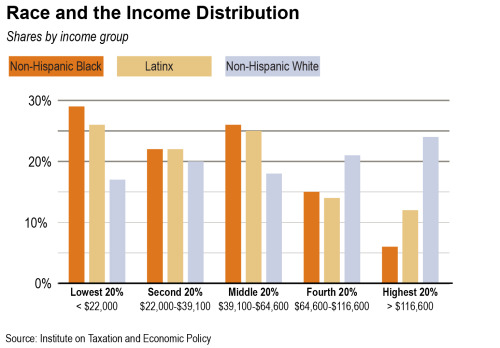
State and local taxes play an important role in shaping economic opportunity. These tax revenues pay for the schools, roads, parks, and libraries that create a foundation for thriving communities. Yet we know that Virginia’s state and local tax system is upside down. In Virginia, households with low and modest incomes pay a higher share of their incomes toward state and local taxes than the highest-income households. In tax policy terms, this is known as a regressive system. And since historical and present-day barriers for communities of color have resulted in stark differences in income by race, this means these…
Fortune: It’s Too Easy for the Ultra-Rich to Pass Down Wealth. Here’s How to Fix That
November 26, 2018
The first is to tax extreme wealth directly—specifically, with a 1% tax on the assets of the wealthiest 0.1% of households, those with assets greater than $20 million. Such a wealth tax would raise nearly $1.9 trillion over the next 10 years, according to forthcoming research from the Institute on Taxation and Economic Policy that […]
New York Daily News: Cyber Monday Shopping Deals Blunting by Supreme Court Ruling
November 26, 2018
“This is about improved enforcement of a tax that’s already on the books,” echoed Carl Davis, research director at the Institute on Taxation and Economic Policy, to CNBC. “For years, shoppers have been able to evade these taxes by shopping with certain online retailers.” Read more
NorthJersey.com: Democrats Taking Another Run at SALT Restoration
November 24, 2018
While it remains to be seen whether bipartisan support for a full or partial SALT restoration is feasible or even affordable in the new Congress, the fight – or at least the conversation – is one well worth having. Indeed, homeowners, particularly in the northern part of New Jersey, are going to be hit hard […]
Voices for Illinois Children November Newsletter
November 21, 2018 • By ITEP Staff

The Institute for Taxation and Economic Policy (ITEP) released the sixth edition of its “Who Pays?” report on state tax systems. Voices’ policy analyst John Gordon detailed the findings of the report in a blog post. Illinois ranks #8 among ITEP’s “Terrible Ten” in terms of regressive state tax systems.
Wisconsin Budget Project: Wisconsin’s Tax System Requires the Least from Those Who Have the Most
November 21, 2018 • By ITEP Staff
Wisconsin residents with the lowest incomes pay about a third more of their income in state and local taxes than the wealthiest residents, according to new figures from the Institute on Taxation and Economic Policy. The poorest 20% of Wisconsin residents—a group with an average income of $14,700—pays 10.1 cents out of every $1 of their income in state and local taxes on average. In comparison, the richest residents of Wisconsin, who have an average income of $1.2 million, pay just 7.7 cents out of every $1 in income in state and local taxes.
Newark Star-Ledger: Your Property Tax Break Might Come Back if These Newly Elected Democrats Have Their Way
November 20, 2018
Rep. Bill Pascrell Jr., a member of the tax-writing House Ways and Means Committee, said he would introduce legislation in the new Congress to raise the $88 billion in revenue that the progressive Institute on Taxation and Economic Policy said it would cost to fully restore the state and local tax break. Read more
New York Times: Did a Tax Increase Tucked Into Trump’s Tax Cut Come Back to Bite Republicans?
November 19, 2018
Simply reinstating the unlimited cap, without also reversing the changes to the alternative minimum tax, would deliver no benefit to low-income and middle-class Americans, according to a new analysis by the Institute on Taxation and Economic Policy, a liberal think tank. More than 85 percent of the benefits would go to the top 5 percent […]
Daily Beast: Dear Nancy Pelosi and House Democrats: Why Are You Embracing Trickle-Down Economics?
November 19, 2018
The Institute on Taxation and Economic Policy has found that from 2000 to 2018, the richest 20 percent of Americans have enjoyed 65 percent of all the tax cuts, with the remaining 35 percent of tax cuts were divided between the other 80 percent. The lesson from this finding is not that we should make […]
Splinter: House Democrats Balk at Prospect of Being Good
November 17, 2018
That is a disastrous idea. Alan Essig, executive director of the Institute on Taxation and Economic Policy, noted the rule “could make it difficult, as a practical matter, to raise taxes—on the rich—without making the tax code a complicated mess. This is because few changes in the federal income tax would affect no one in […]
Lexington Herald Leader: Kentucky’s New Tax Favors for the Wealthy Won’t Spur the Economy. They Will Worsen Inequality.
November 16, 2018
Income inequality is soaring in an economy where the winners increasingly take all. The wealthiest one percent of Kentuckians make 94 times more a year on average than the bottom 20 percent. Despite that yawning gap, the state tax system is tilted in favor of those at the very top, as shown in a new […]
Slate: House Democrats Are Already Pursuing a Dumb Tax Stunt, and the Left Is Very Annoyed
November 16, 2018
But then, tucked at the bottom of page five, there’s an item that’s already setting off alarm bells across the left. The rule—endorsed by Pelosi and Richard Neal, the top Democrat on the House Ways and Means Committee—would “require a three-fifths supermajority to raise individual income taxes on the lowest-earning 80 percent of taxpayers.” The […]
Washington Post: Democrats Face Early Division in Rules over Taxes
November 16, 2018
The richest fifth of taxpayers are those who make more than $108,000 annually, said Steve Wamhoff, director of federal tax policy at the Institute on Taxation and Economic Policy. Some liberal Democrats said that if the party limits its own ability to raise taxes, it could make it harder for the House to adopt policies […]

Institute on Taxation
and Economic Policy
ITEP is a non-profit, non-partisan tax policy organization. We conduct rigorous analyses of tax and economic proposals and provide data-driven recommendations to shape equitable and sustainable tax systems.
Subscribe to ITEP Emails
Tax research and policy news in your inbox.
Promote Fair Tax Policy
Your gift to ITEP promotes tax justice. With your help, we do research that supports taxing millionaires and billionaires, taxing big corporations and raising revenue for the things our people, our communities and our planet need.
Together, we can create a country with more economic justice, more racial justice, more climate justice… and more tax justice.