
Hawaii
National Sausage Month isn’t until October, but now is the time of year when state lawmakers are really diving into their sausage-making processes, as separate legislative houses and oftentimes political parties send competing bills, budgets, and visions back and forth to grind out their differences.
Hawai’i Appleseed Center for Law and Economic Justice: A Fairer Tax Code for a Thriving Hawaiʻi
February 2, 2026
Hawaiʻi stands at a crossroads. The path we choose now will define our islands for generations. We can either accept a future of diminishing public goods and deepening inequality, or we can choose to build one of shared prosperity and collective resilience. Read more.
States Can Push Back Against Reckless Federal Tax Policy. Here’s How.
January 22, 2026 • By Aidan Davis, Wesley Tharpe

They should take steps to protect and boost their own revenues. And they should take a second look at their own tax cuts.
State Rundown 1/7: New Year, New Opportunities for Progressive Revenue
January 7, 2026 • By ITEP Staff
As we kick off a new year, several states are facing revenue shortfalls. Some lawmakers are approaching the challenge with sustainable and equitable solutions.
Re-Examining 529 Plans: Stopping State Subsidies to Private Schools After New Trump Tax Law
November 20, 2025 • By Miles Trinidad, Nick Johnson

The 2025 federal tax law risks making 529 plans more costly for states by increasing tax avoidance and allowing wealthy families to use these funds for private and religious K-12 schools.
States Should Move Quickly to Chart Their Own Course on SALT Deductions
July 17, 2025 • By Dylan Grundman O'Neill, Nick Johnson

While a federal SALT cap is hotly debated, capping deductibility at $10,000 was an unambiguously good idea at the state level. States would be smart to stick with the current cap or, better yet, go even farther and repeal SALT deductions outright. Going along with a higher federal SALT cap would double down on a regressive tax cut that will mostly benefit a small number of relatively wealthy state residents and cost states significant revenue.
How Much Would Every Family in Every State Get if the Megabill’s Tax Cuts Given to the Rich Had Instead Been Evenly Divided?
July 14, 2025 • By Michael Ettlinger
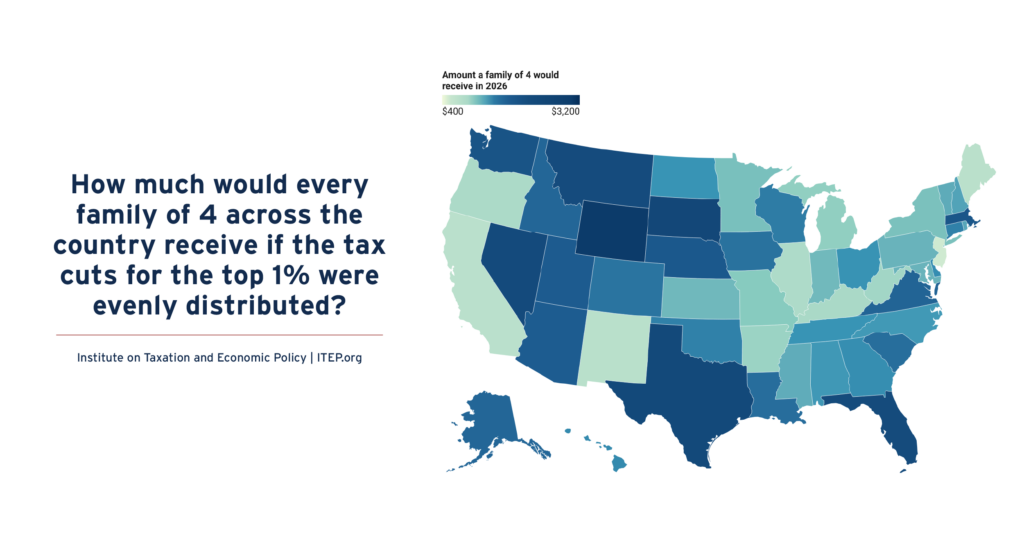
If instead of giving $117 billion to the richest 1 percent, that money had been evenly divided among all Americans, we'd each get $343 - or nearly $1,400 for a family of four.
Analysis of Tax Provisions in the Trump Megabill as Signed into Law: National and State Level Estimates
July 7, 2025 • By Steve Wamhoff, Carl Davis, Joe Hughes, Jessica Vela

President Trump has signed into law the tax and spending “megabill” that largely favors the richest taxpayers and provides working-class Americans with relatively small tax cuts that will in many cases be more than offset by Trump's tariffs.
Trump Megabill Will Give $117 Billion in Tax Cuts to the Top 1% in 2026. How Much In Your State?
June 30, 2025 • By Michael Ettlinger

The predominant feature of the tax and spending bill working its way through Congress is a massive tax cut for the richest 1 percent — a $114 billion benefit to the wealthiest people in the country in 2026 alone.

Institute on Taxation
and Economic Policy
ITEP is a non-profit, non-partisan tax policy organization. We conduct rigorous analyses of tax and economic proposals and provide data-driven recommendations to shape equitable and sustainable tax systems.
Subscribe to ITEP Emails
Tax research and policy news in your inbox.
Promote Fair Tax Policy
Your gift to ITEP promotes tax justice. With your help, we do research that supports taxing millionaires and billionaires, taxing big corporations and raising revenue for the things our people, our communities and our planet need.
Together, we can create a country with more economic justice, more racial justice, more climate justice… and more tax justice.