
Washington
Washington Post: Threat of Arizona Tax Measure Brings Together Liberals, Koch Brothers
November 6, 2018
(Meg Wiehe, a tax specialist at the Institute on Taxation and Economic Policy, argued the sales tax is passed on to the consumers and that these businesses are not “double taxed.”) Gullett also said that the organization “has received enormous support from the Arizona Association of Realtors,” calling the group “consistent defenders of consumers.” … […]
The New Orleans Advocate: James Gill: Louisiana’s Tax System Isn’t the Most Unfair in the Nation, But It’s not for Lack of Trying
November 3, 2018
According to a study just released by the Institute on Taxation and Economic Policy in Washington, Washington State sets the regressive standard, while we rank 14th. If your income is $17,100 or less in Louisiana, you'll pay 11.9 percent of it in taxes. That number shrinks the further you go up on the income scale and is roughly halved by the time you reach fat-cat territory. Sales and excise taxes take 9.2 percent from the poorest, and 1.2 percent from the richest.
The New Yorker: If Jeff Bezos Makes Washington the Second Headquarters of Amazon
November 3, 2018
Earlier this year, Seattle’s city council passed a tax on large corporations aimed at raising an estimated forty-seven million dollars a year for affordable-housing initiatives. But after about a month the city council repealed the tax—in response to a ballot challenge funded in part by Amazon, which threatened to leave Seattle if the tax was implemented. Matthew Gardner, a tax-policy analyst at the Institute on Taxation and Economic Policy, told the Washington Post, “Nobody on Seattle’s city council wants to be the one who chased Amazon out of town.”
State Rundown 10/31: Trick or Treat Advice to Savor for Tonight
October 31, 2018 • By ITEP Staff
Look out for potholes if you’re out trick-or-treating in Alabama tonight, where crumbling infrastructure figures to be a dominant debate in the coming legislative session. And be prepared to share the streets with disgruntled teachers if you‘re in Louisiana, where teachers are walking out to protest regressive tax policies that are sucking the lifeblood from the state’s schools. Meanwhile, Wisconsin residents are sharing scary stories of grotesquely large business tax subsidies and the “dark store” tax loophole they’ll be voting on next week. And you better expect the unexpected if you’re in Delaware, where Gov. John Carney shocked everyone by vetoing two broadly supported tax bills last week.
The Olympian: Olympia Went to Court to Block an Income Tax Proposal. Two Years Later, It’s Backing Seattle’s Version.
October 26, 2018 • By ITEP Staff

In 2016, an Olympia household earning $25,000 a year paid about 13 percent of its income in state and local taxes, while a household earning $250,000 paid less than 4 percent, according to the resolution. A report this month from the Institute on Taxation and Economic Policy said Washington has the most regressive tax structure in the country, thanks to its lack of a personal income tax and comparatively high sales taxes.
In this special edition of the Rundown we bring you a voters’ guide to help make sense of tax-related ballot questions that will go before voters in many states in November. Interests in Arizona, Florida, North Carolina, Oregon, and Washington state have placed process-related questions on those states’ ballots in attempts to make it even harder to raise revenue or improve progressivity of their state and/or local tax codes. In response to underfunded schools and teacher strikes around the nation, Colorado voters will have a chance to raise revenue for their schools and improve their upside-down tax system at the…
Real Change: Study: Washington Bottoms Out on US Tax Assessment
October 24, 2018 • By ITEP Staff
Guess what? Washington state’s taxation system continues to be one of the most regressive in the country. This news comes from the Institute on Taxation and Economic Policy (ITEP), which did a deep dive into the taxation policies of all 50 states.
Washington Examiner: Think tank: Texas Isn’t a Low-tax State if You’re Poor
October 23, 2018 • By Carl Davis
Carl Davis for the Institute on Taxation and Economic Policy: [ M]any states traditionally considered to be “low-tax states” are actually high-tax for their poorest residents. The “low tax” label is typically assigned to states that either lack a personal income tax or that collect a comparatively low amount of tax revenue overall. But a focus on these measures can cause lawmakers to overlook the fact that state tax systems impact different taxpayers in very different ways, and that low-income taxpayers in particular often do not experience these states as being even remotely “low tax.”
Seattle Met: Report: Washington State Taxes Are Still the Most Inequitable in the Country
October 18, 2018 • By ITEP Staff
In Washington state, the less money you make, the larger your percentage of income goes toward taxes. A study from the Institute on Taxation and Economic Policy released on Wednesday concludes that Washington state still has the most regressive taxes in the U.S., meaning the poorest households pay a disproportionate amount of taxes compared to the richest households in the state.
Iowa Fiscal Partnership: Tax Inequity: Iowa’s Continuing Story
October 17, 2018 • By ITEP Staff
Iowa taxes its middle- and low-income families more as a share of income than it does wealthy families, a long-term trend worsened by the 2018 tax overhaul. The latest “Who Pays” report by the Washington-based Institute on Taxation and Economic Policy (ITEP), again shows the effect of sales taxes and property taxes on lower-income households tilts Iowa’s overall tax system so the poorest pay the highest percentage in taxes.
Oregon Center for Public Policy: Undocumented Workers in Washington County Pay Millions in Oregon Taxes
October 17, 2018 • By ITEP Staff
An estimated 27,000 undocumented Washington County residents pay more than $20 million annually in state and local taxes. For perspective, that is enough to hire 232 teachers. Read more here
KUOW: Washington State Tops ‘Terrible Ten’ List for Taxes
October 17, 2018
Washington State's tax system is widening the gap between the rich and the poor. That's according to the Institute on Taxation and Economic Policy (ITEP) based in Washington, D.C. “What you see is that Washington’s tax system couldn’t possibly be further from hitting people evenly,” Carl Davis said. “People are having to devote very different shares of their household budgets to funding state and local government.”
Budget and Policy Center: Washington State Again Ranks Worst In The Nation For Our State Tax Code
October 17, 2018 • By ITEP Staff
Despite the many ways Washington state takes prides in its spirit of innovation, it still ranks dead last when it comes to its tax code, according to a new study by the Institute on Taxation and Economic Policy (ITEP). Our state has the most upside-down tax code in the country, forcing people with the lowest incomes to pay 17.8 percent in state and local taxes as a percent of their income – while the state’s wealthiest residents pay just 3 percent.
Budget and Policy Center: Unacceptable. Washington Still Has the Nation’s Most Inequitable State Tax Code
October 17, 2018 • By ITEP Staff
Washington state continues to have the most upside-down tax code of any U.S. state, according to a new report from the Institute on Taxation and Economic Policy (ITEP). It wrongly requires people with the lowest incomes to pay six times more in taxes as a percent of their income than the state’s wealthiest residents to fund investments that benefit all Washingtonians.
Politico Morning Tax: Desperately Seeking Clarity
October 17, 2018 • By ITEP Staff
MOST STATE TAX SYSTEMS REGRESSIVE: No state has more regressive taxes on its citizens than Washington, followed by Texas, Florida, South Dakota and Nevada, according to a distributional analysis of state tax systems that will be released today by the Institute on Taxation and Economic Policy. Most states take a larger share of income from low- and middle-income families than from wealthy families, it said. The 10 most regressive in the rankings tax their residents in the bottom 20 percent of the income scale at rates up to six times higher than the wealthy, while their middle-income families pay a rate up to…
Low Tax for Whom? Washington is a “Low Tax State” Overall, But Not for Families Living in Poverty
October 17, 2018 • By ITEP Staff
Washington’s tax system has vastly different impacts on taxpayers at different income levels. For instance, the lowest-income 20 percent of Washingtonians contribute 17.8 percent of their income in state and local taxes — considerably more than any other income group in the state. For low-income families, Washington is far from being a low tax state; in fact, it is the highest-tax state in the country for low-income families.

ITEP analysis reveals that many states traditionally considered to be “low-tax states” are actually high-tax for their poorest residents. The “low tax” label is typically assigned to states that either lack a personal income tax or that collect a comparatively low amount of tax revenue overall. But a focus on these measures can cause lawmakers to overlook the fact that state tax systems impact different taxpayers in very different ways, and that low-income taxpayers often do not experience these states as being even remotely “low tax.”
Washington: Who Pays? 6th Edition
October 17, 2018 • By ITEP Staff
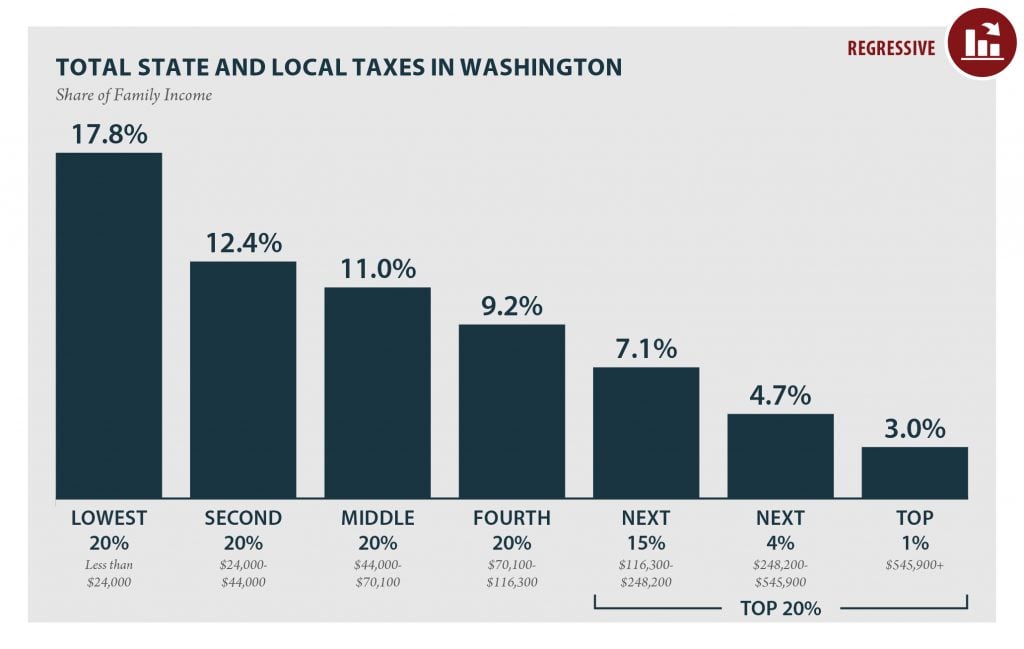
WASHINGTON Read as PDF WASHINGTON STATE AND LOCAL TAXES Taxes as Share of Family Income Top 20% Income Group Lowest 20% Second 20% Middle 20% Fourth 20% Next 15% Next 4% Top 1% Income Range Less than $24,000 $24,000 to $44,000 $44,000 to $70,100 $70,100 to $116,300 $116,300 to $248,200 $248,200 to $545,900 over $545,900 […]
State Rundown 10/12: Local Jurisdictions Fighting for Revenues, Independence
October 12, 2018 • By ITEP Staff
Voters all around the country are educating themselves for the upcoming elections, notably this week around ballot initiatives in Arizona and Colorado and competing gubernatorial tax proposals in Georgia and Illinois. But not all eyes are on the elections, as the relationship between state and local policy made news in Delaware, Idaho, North Dakota, and Ohio.
Concerned about Trump-family tax gaming? His law may prompt others to dodge.
October 5, 2018 • By Steve Wamhoff

“The IRS is wildly outgunned,” says Steve Wamhoff, director of federal tax policy at the Institute on Taxation and Economic Policy, a think tank in Washington. “You can’t keep cutting IRS funding and not expect more things like what The New York Times wrote about the Trumps. That’s bound to happen even more now.”
Washington Post: How big developers like Trump benefit from web of tax breaks
October 4, 2018
[Real estate investors] can fall behind on their debts and still face fewer tax penalties for having the debt forgiven than other kinds of investors, according to Steve Wamhoff, director of federal tax policy at the Institute on Taxation and Economic Policy. Trump took advantage of that, Wamhoff says, when he couldn’t repay debts on his Atlantic City casinos in the 1990s and early 2000s.
Tax Cuts 2.0 – Washington
September 26, 2018 • By ITEP Staff
The $2 trillion 2017 Tax Cuts and Jobs Act (TCJA) includes several provisions set to expire at the end of 2025. Now, GOP leaders have introduced a bill informally called “Tax Cuts 2.0” or “Tax Reform 2.0,” which would make the temporary provisions permanent. And they falsely claim that making these provisions permanent will benefit […]
State Rundown 9/26: States Cleaning Up from Florence, Gearing Up for November
September 26, 2018 • By ITEP Staff
Affordable housing efforts made news in Minnesota and Virginia this week, as tax breaks for homeowners and other victims of Hurricane Florence were made available in multiple states. Meanwhile, New Jersey is still looking into legalizing and taxing cannabis, and Wyoming continues to consider a corporate income tax. And gubernatorial candidates and ballot initiative efforts will give voters in many states much to consider in the November elections.
NJ.com: Murphy Pushes Plan to Save Property Tax Breaks
September 26, 2018
Only residents of New York, Connecticut, and California deduct more from federal taxes than New Jerseyans, according the progressive Institute on Taxation and Economic Policy. Most of the states hit hardest send billions of dollars more to Washington than they get back in services. Read more
The Washington Post: GOP Pushes for New $2 Trillion Round of Tax Cuts
September 11, 2018
Democrats said the GOP’s second round of tax cuts would punish the poor and the middle class, arguing that they will provide a pretext for later spending cuts to entitlement programs that help the elderly. The richest 1 percent of Americans would see an average $24,130 cut from extending the individual tax cuts, compared with […]
