National Sausage Month isn’t until October, but now is the time of year when state lawmakers are really diving into their sausage-making processes, as separate legislative houses and oftentimes political parties send competing bills, budgets, and visions back and forth to grind out their differences.
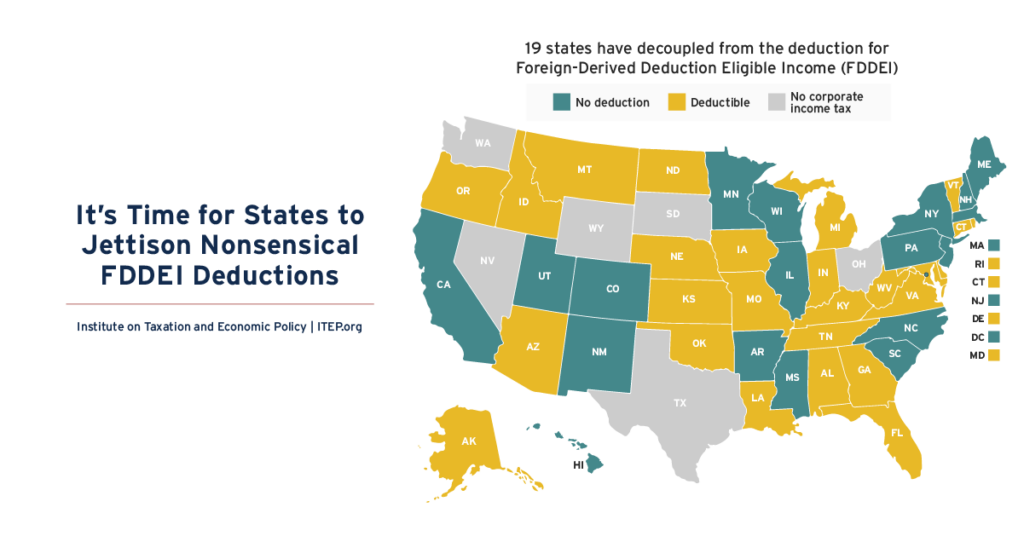
Florida, Georgia, Maine, Missouri, and South Dakota are all talking property taxes. Georgia, Ohio, South Carolina, and West Virginia are debating income tax cuts, while Connecticut has some progressive income tax increases on the table. Sales tax discussions are more salient in Alabama, South Dakota, and Virginia. “Sin taxes” are being considered in Utah (cigarettes) and Virginia (gambling). We’ll find out later how these sausage links turn out, and we are hopeful that more states will strongly consider de-link-ing from a particularly unhelpful federal corporate tax provision known as Foreign-Derived Deduction Eligible Income or the FDDEI Deduction.
Major State Tax Proposals and Developments
- Senators in SOUTH CAROLINA modified the House’s tax bill by amending the top income tax rate to 5.21 percent (down from the 6 percent current rate) instead of the proposed top rate of 5.39 percent. The bill still includes triggers that could phase out the state’s income tax entirely. – NEVA BUTKUS
- SOUTH DAKOTA Gov. Larry Rhoden’s proposal to allow counties to implement a half-percent sales tax to reduce property taxes for homeowners passed the Senate and now moves to a House committee. A separate proposal to keep South Dakota’s state sales at 4.2 percent stalled in the Senate. The bill was intended to prevent additional revenue from the scheduled increase in July 2027 from being used to provide property tax cuts. – MILES TRINIDAD
- The VIRGINIA House and Senate released their versions of the state’s budget. The Senate budget would eliminate the sales tax exemption for data centers, which is estimated to raise $1 billion over two years, and also includes a $100 rebate ($200 for joint filers) to Virginia taxpayers. The House proposal would raise about $270 million from skill games and digital gambling. Both chambers included an increase to the standard deduction, and neither proposal would align the state with the recent federal tax changes. – MILES TRINIDAD
State Roundup
- ALABAMA’s House passed a Second Amendment Sales Tax Holiday bill that will exempt firearms and related items from sales tax the last weekend in August. It is expected to reduce revenues by $360,000.
- Three proposed bills out of CONNECTICUT would raise progressive revenue. The bills include one that would establish a 1.75 percentage point surcharge on the top personal income tax bracket for capital gains income. Another would increase the top marginal personal income tax rate from 6.99 percent to 7.99 percent. Finally, lawmakers are considering a mansion tax that would establish a statewide property tax on homes assessed at over $3 million.
- The DISTRICT OF COLUMBIA‘s Attorney General has taken a stance in the debate between the District and Congress in their ability to cut ties with the federal tax bill that passed last year. The AG agreed that because the Senate failed to pass the congressional resolution until one day after the 30-day deadline and because it wasn’t retroactive, it would not alter taxpayer liabilities for tax year 2025. The issue remains contested.
- FLORIDA House and Senate lawmakers are proposing conformity bills that would decouple from multiple corporate provisions in OBBBA, including expansions to bonus depreciation, full expensing for research and development, and more.
- Meanwhile, Senators in FLORIDA remain unconvinced by the House’s property tax plan which would eliminate property taxes on non-school taxes for homesteads by 2027.
- Budget negotiations in GEORGIA have stalled as the House and Senate hash out competing tax cut plans. The Senate proposed $2 billion in income tax cuts – including the governor’s $250 per person tax rebate. The House is also pushing for an up-to-$500 property tax refund for homeowners.
- HAWAI’I lawmakers are moving ahead to remove cruise ships from the state’s landmark climate law, which continues to face legal challenges, that created a new green fee to fund climate and environmental projects across the state. Instead, cruise ships will pay a lower per-passenger fee that would be used for harbor improvements. Cruise ships were expected to generate about a third of the fee’s revenue. The changes would reduce the revenue to $10 million, down from $26 million annually.
- A MAINE property tax task force released its initial recommendations, which include more frequent payment options, utilizing the most targeted tool for property tax relief – the Property Tax Fairness Credit, and increasing the Homestead Property Tax Exemption to account for inflation.
- The MISSOURI House advanced a bill reforming property taxes. The measure makes a variety of changes to the state’s property tax that include: rescheduling local tax elections to the November general elections; allowing separate rates for different classes of property such as residential and commercial; and changing the revenue cap calculations.
- Lawmakers in OHIO stalled tax legislation that would conform the state to federal tax cuts and targeted a provision in particular that would expand the qualified small business stock (or QSBS) exclusion, which would overwhelmingly benefit fewer than 1,000 taxpayers who are mostly millionaires at the estimated cost of over $22 million over a decade. The bill as a whole is estimated to cost Ohio $63.3 million in 2026. While Republicans have enough votes to pass the bill, the failure to reach a two-thirds vote limits the ability to take effect within 90 days as Tax Day approaches.
- OKLAHOMA lawmakers have proposed taking $254 million from funds intended to be deposited in the state’s pension fund for teachers—which is currently underfunded for existing future obligations—and spending it directly on education. Proposed spending would go towards the state’s Parental Choice Tax Credit for private schools, boosting teacher pay, and literacy efforts.
- The OREGON Senate passed legislation that would move the statewide transportation funding referendum from the November general election to the May primary ballot. The referendum comes after opponents of the state’s transportation funding plan, which would increase gas taxes and vehicle fees to stabilize funding, gathered enough signatures to block implementation until a statewide referendum was held on it. The House must pass the bill by Feb. 25 to move the referendum to May.
- UTAH legislators are considering a bill that would raise the tax on cigarettes by $2 per pack and bring other nicotine-based products in line with the tax.
- The WEST VIRGINIA Senate approved a budget with a 10 percent cut to state income tax rates; it has been sent to the House. The two chambers remain far apart—the House version includes no income tax cut—so continued negotiations are expected over a final version.
What We’re Reading
- The New York Times writes about the proposal to create an income tax on millionaires in Washington state and how it has gained major steam this year.
- The State Innovation Exchange, the May Day Coalition, and others collaborated on a new report called “The Real Affordability Agenda: A Policy Manual To Put A Good Life For Everyone Back Within Reach,” touching on tax fairness, housing, employment policy, and more. A full report is available.
If you like what you are seeing in the Rundown (or even if you don’t) please send any feedback or tips for future posts to Aidan Davis at aidan@itep.org. Click here to sign up to receive the Rundown via email.