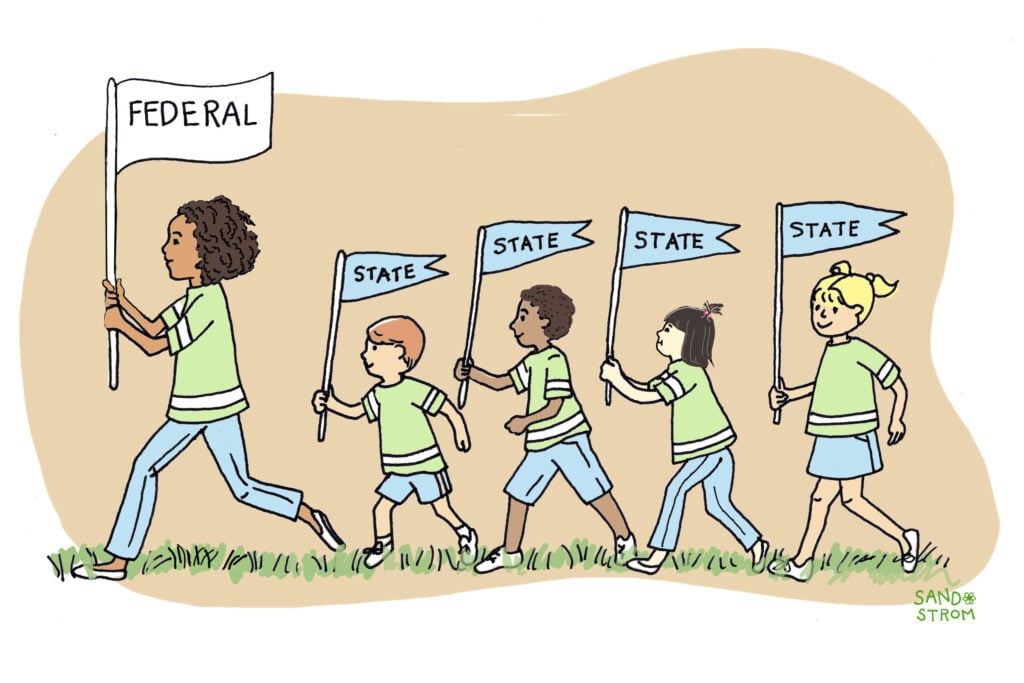
Policymakers in Maine and Oregon wisely said “no” last week to an income tax break for deep-pocketed tech investors and venture capitalists that was expanded in last year’s federal tax bill.
Maine Gov. Janet Mills and Oregon Gov. Tina Kotek each signed legislation to bar taxpayers from claiming the federal “qualified small business stock” (QSBS) exclusion on their state income tax returns. These states will join Alabama, California, Mississippi, and Pennsylvania as places where investors who have avoided federal tax on certain capital gains investments must nonetheless pay state income tax on those proceeds as they would on any other income. The District of Columbia took similar action last fall, and other states may do the same as the tax break’s cost soars.
Many states have conformed their own income tax laws to the QSBS tax break for decades. But a confluence of circumstances has inspired legislators and governors to question whether this is still a good idea.
- U.S. Treasury Department research published last year shows that the tax break is more costly than previously known, and that 94 percent of the exempted gains go to investors with more than $1 million in annual income.
- QSBS has been roundly criticized by tax policy experts across the political spectrum as wasteful, inefficient, and regressive.
- Congress in 2025 nonetheless expanded QSBS, making it even more lucrative and easier to qualify for. The expansion means that QSBS is far costlier to states than previously anticipated, and will become even more so over the next five years.
Oregon’s legislation bars investors from claiming QSBS exclusions starting in tax year 2026. The state estimates it will protect $39 million in state revenue in the current biennium, rising to $83 million in 2029-31, enough to finance an expansion of the state’s Earned Income Tax Credit for working families and have money left over to fund schools, health care and other services.
Maine’s legislation bars investors from claiming QSBS exclusions for any investments made after July 3, 2025. We estimate it will eventually protect $7.3 million in state tax revenue a year.
Policymakers in Maine and Oregon declined to commit their states to following the federal lead after analysts pointed out flaws in the state-level case for QSBS.
“Maine has too many unmet needs to waste taxpayer dollars on conformity proposals like QSBS,” wrote Maura Pillsbury of the Maine Center for Economic Policy.
Daniel Hauser of the Oregon Center for Public Policy wrote:
“The rationale for Oregon to subsidize venture capital is even weaker [than the federal rationale]. Consider a venture capitalist in Portland who invests in a start-up in California or New York. They will receive the QSBS tax break on their Oregon income taxes. Even if one assumes that the investment would not have occurred in the absence of the tax break, a dubious claim, that investment would produce no boost to Oregon’s economy. And yet Oregon’s revenue would fall as a result.”
Or, as Hauser said more succinctly: “No, the superrich do not need a bigger tax break.”