
New Jersey
State Tax Watch 2026
March 9, 2026 • By ITEP Staff
ITEP tracks tax discussions in legislatures across the country and uses our unique data capacity to analyze the revenue, distributional, and racial and ethnic impacts of many of these proposals. State Tax Watch offers the latest news and movement from each state.
State Rundown 2/19: Necktie (NCTI) Offers a Way Out of a Knotty Situation
February 19, 2026 • By ITEP Staff
State lawmakers are grappling with a range of challenges as their fiscal outlooks deteriorate, federal tax enforcement wanes (after the Trump administration cut the IRS workforce by 25 percent), and a rewritten federal tax code sends states scrambling to decide what changes they might want to make in their own codes.
What Did 2025 State Tax Changes Mean for Racial and Economic Equity?
February 9, 2026 • By Brakeyshia Samms

The results are a mixed bag, with some states enacting promising policies that will improve tax equity and others going in the opposite direction.
States Can Push Back Against Reckless Federal Tax Policy. Here’s How.
January 22, 2026 • By Aidan Davis, Wesley Tharpe

They should take steps to protect and boost their own revenues. And they should take a second look at their own tax cuts.
New Jersey Policy Perspective: Five Budget Time Bombs Facing the Next Governor
January 16, 2026
Without sustainable and equitable revenue sources, incoming governor Mikie Sherrill is inheriting a state budget full of fiscal threats. Read more.
Re-Examining 529 Plans: Stopping State Subsidies to Private Schools After New Trump Tax Law
November 20, 2025 • By Miles Trinidad, Nick Johnson

The 2025 federal tax law risks making 529 plans more costly for states by increasing tax avoidance and allowing wealthy families to use these funds for private and religious K-12 schools.
States across the nation are debating how best to respond to costly new federal tax cuts.
Many lawmakers who were vocal supporters of this bill will see direct personal benefits while most of their constituents benefit little or will be worse off.
State Earned Income Tax Credits Support Families and Workers in 2025
September 11, 2025 • By Neva Butkus

Nearly two-thirds of states now have an Earned Income Tax Credit (EITC). Momentum continues to build on these credits that boost low-paid workers’ incomes and offset some of the taxes they pay, helping lower-income families achieve greater economic security.
State Child Tax Credits Boosted Financial Security for Families and Children in 2025
September 11, 2025 • By Neva Butkus

Child Tax Credits (CTCs) are effective tools to bolster the economic security of low- and middle-income families and position the next generation for success.
New Jersey Policy Perspective: Freedom from Want: An Economic Guarantee for New Jersey’s Kids
September 11, 2025
All children in New Jersey deserve the freedom to grow up safe, healthy, and free from poverty.
SALT in the Wound: New Tax Law’s Limit on State Tax Deductions Exempts Some of the Very Wealthiest
August 21, 2025 • By ITEP Staff

The new tax law enacted last month found a temporary compromise on the level of the cap, boosting it to $40,000 through 2029, but failed to fix a loophole that allows some rich taxpayers with good accountants to completely avoid the cap
Trump’s Tax Law Clobbers State Budgets. Now’s the Time to Prepare.
August 13, 2025 • By ITEP Staff
The Trump megabill hands the richest 1% a trillion-dollar windfall while gutting funding for health care, education, and disaster relief — leaving communities to pick up the pieces. State and local leaders must step up, tax the wealthiest fairly, and safeguard the essentials that keep America healthy, educated, and safe.
State Tax Action in 2025: Amid Uncertainty, Tax Cuts and New Revenue
July 28, 2025 • By Aidan Davis, Neva Butkus, Marco Guzman

Federal policy choices on tariffs, taxes, and spending cuts will be deeply felt by all states, which will have less money available to fund key priorities. This year some states raised revenue to ensure that their coffers were well-funded, some proceeded with warranted caution, and many others passed large regressive tax cuts that pile on to the massive tax cuts the wealthiest just received under the federal megabill.
Two in Three Americans Live in States with Variable-Rate Gas Taxes
July 16, 2025 • By Carl Davis

As inflation and fuel efficiency undercut traditional gas tax revenue, many states are rethinking how they fund transportation. Lawmakers across the country are beginning to modernize outdated gas tax systems to keep pace with rising infrastructure costs and changing driving habits.
How Much Would Every Family in Every State Get if the Megabill’s Tax Cuts Given to the Rich Had Instead Been Evenly Divided?
July 14, 2025 • By Michael Ettlinger
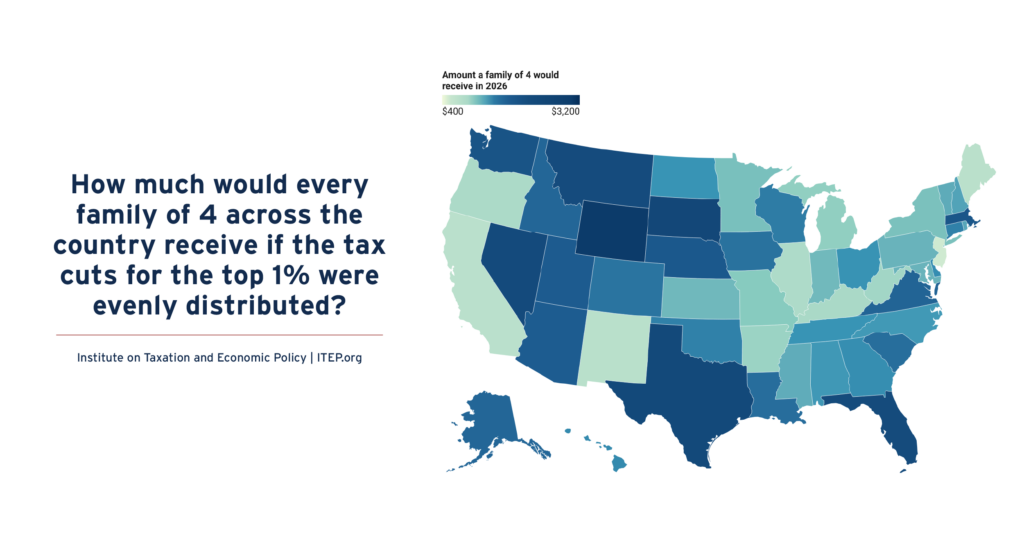
If instead of giving $117 billion to the richest 1 percent, that money had been evenly divided among all Americans, we'd each get $343 - or nearly $1,400 for a family of four.
Analysis of Tax Provisions in the Trump Megabill as Signed into Law: National and State Level Estimates
July 7, 2025 • By Steve Wamhoff, Carl Davis, Joe Hughes, Jessica Vela

President Trump has signed into law the tax and spending “megabill” that largely favors the richest taxpayers and provides working-class Americans with relatively small tax cuts that will in many cases be more than offset by Trump's tariffs.

The endlessly debated cap on deductions for state and local taxes (SALT) has emerged in the GOP megabill largely unscathed—despite the efforts of Republican lawmakers from “blue” states. Those lawmakers are correct that the cap reduces the bill’s tax cuts for their wealthy constituents more than for those in other states. The megabill, however, is so loaded up with other provisions that result in a dramatic tax cut for the richest 1 percent in every state.
Trump Megabill Will Give $117 Billion in Tax Cuts to the Top 1% in 2026. How Much In Your State?
June 30, 2025 • By Michael Ettlinger

The predominant feature of the tax and spending bill working its way through Congress is a massive tax cut for the richest 1 percent — a $114 billion benefit to the wealthiest people in the country in 2026 alone.
How Much Do the Top 1% in Each State Get from the Trump Megabill?
June 30, 2025 • By Carl Davis

The Senate tax bill under debate right now would bring very large tax cuts to very high-income people. In total, the richest 1 percent would receive $114 billion in tax cuts next year alone. That would amount to nearly $61,000 for each of these affluent households.
New Jersey Policy Perspective: Course Correction: Preserving Senior Housing Affordability While Cutting Costs
June 18, 2025
Renters also have significantly less wealth than their home-owning peers, and nearly 1 in 4 senior renters in New Jersey report it is “very likely” they will lose their home to eviction. Read more.
Analysis of Tax Provisions in the House Reconciliation Bill: National and State Level Estimates
May 22, 2025 • By Carl Davis, Jessica Vela, Joe Hughes, Steve Wamhoff
The poorest fifth of Americans would receive 1 percent of the House reconciliation bill's net tax cuts in 2026 while the richest fifth of Americans would receive two-thirds of the tax cuts. The richest 5 percent alone would receive a little less than half of the net tax cuts that year.
New Jersey Policy Perspective: The Economic and Fiscal Impacts of Mass Deportation: What’s at Risk in New Jersey
May 21, 2025
In 2022, people who are undocumented paid an estimated $1.3 billion in New Jersey state and local taxes.[3]
Want to know more about the tax and spending megabill that President Trump recently signed into law? We've got you covered.
IRS Cooperation with ICE Will Damage Public Trust, Putting Tax Revenues in Jeopardy
April 10, 2025 • By Marco Guzman

Attempts by the Department of Homeland Security to secure private information from the IRS on people who file taxes with an Individual Taxpayer Identification Number is a violation of federal privacy laws that protect taxpayers. It is also a change that could seriously damage public trust in the IRS, which could jeopardize billions of dollars in tax payments by hardworking immigrant families.
