
New Mexico
State Tax Watch 2026
March 9, 2026 • By ITEP Staff
ITEP tracks tax discussions in legislatures across the country and uses our unique data capacity to analyze the revenue, distributional, and racial and ethnic impacts of many of these proposals. State Tax Watch offers the latest news and movement from each state.
Governor Should Put New Mexico’s Tax Interests First
March 6, 2026 • By Amy Hanauer, Amber Wallin

By decoupling from three misguided federal corporate income tax cuts under the One Big Beautiful Bill, plus taking steps to curb unfair corporate tax avoidance, SB 151 would raise and safeguard more than $120 million annually.
State Rundown 1/22: Cautious Tone Noticeable in Most Statehouses
January 22, 2026 • By ITEP Staff
Most states are adopting a very cautious approach so far this year as legislators begin their sessions and governors make their annual addresses, thanks to ongoing economic uncertainty and federal retrenchment.
State Rundown 1/7: New Year, New Opportunities for Progressive Revenue
January 7, 2026 • By ITEP Staff
As we kick off a new year, several states are facing revenue shortfalls. Some lawmakers are approaching the challenge with sustainable and equitable solutions.
Despite being an off-year election, voters made a call for shared public investments at the polls.
The Wealth Proceeds Tax: A Simple Way for States to Tax the Wealthy
October 30, 2025 • By Sarah Austin, Carl Davis

Taxing the proceeds generated by wealth through a new Wealth Proceeds Tax is a simple way for states to raise billions in new revenue and improve the fairness of their tax systems.
Governing: Free Child Care for All is Impossible? Don’t Tell New Mexico.
September 30, 2025
The only state with such a program didn’t get there overnight. Years of action at the state Capitol and the ballot box set the stage. It’s a lesson for lawmakers in other states facing the fiscal challenges of providing services families need amid diminishing federal aid. Read more.
State Earned Income Tax Credits Support Families and Workers in 2025
September 11, 2025 • By Neva Butkus

Nearly two-thirds of states now have an Earned Income Tax Credit (EITC). Momentum continues to build on these credits that boost low-paid workers’ incomes and offset some of the taxes they pay, helping lower-income families achieve greater economic security.
State Child Tax Credits Boosted Financial Security for Families and Children in 2025
September 11, 2025 • By Neva Butkus

Child Tax Credits (CTCs) are effective tools to bolster the economic security of low- and middle-income families and position the next generation for success.
Trump’s Tax Law Clobbers State Budgets. Now’s the Time to Prepare.
August 13, 2025 • By ITEP Staff

The Trump megabill hands the richest 1% a trillion-dollar windfall while gutting funding for health care, education, and disaster relief — leaving communities to pick up the pieces. State and local leaders must step up, tax the wealthiest fairly, and safeguard the essentials that keep America healthy, educated, and safe.
Santa Fe New Mexican: New Mexico’s Tax-Free Holiday Offers Back-to-School Shoppers a Break This Weekend
July 24, 2025
Many observers seem split on whether the state’s annual three-day hiatus on collecting tax on many items provides enough economic benefits to justify its costs.
Sales Tax Holidays Miss the Mark When it Comes to Effective Sales Tax Reform
July 17, 2025 • By Miles Trinidad

Sales tax holidays are often marketed as relief for everyday families, but they do little to address the deeper inequities of regressive sales taxes. In 2025, 18 states offer these holidays at a collective cost of $1.3 billion.
How Much Would Every Family in Every State Get if the Megabill’s Tax Cuts Given to the Rich Had Instead Been Evenly Divided?
July 14, 2025 • By Michael Ettlinger
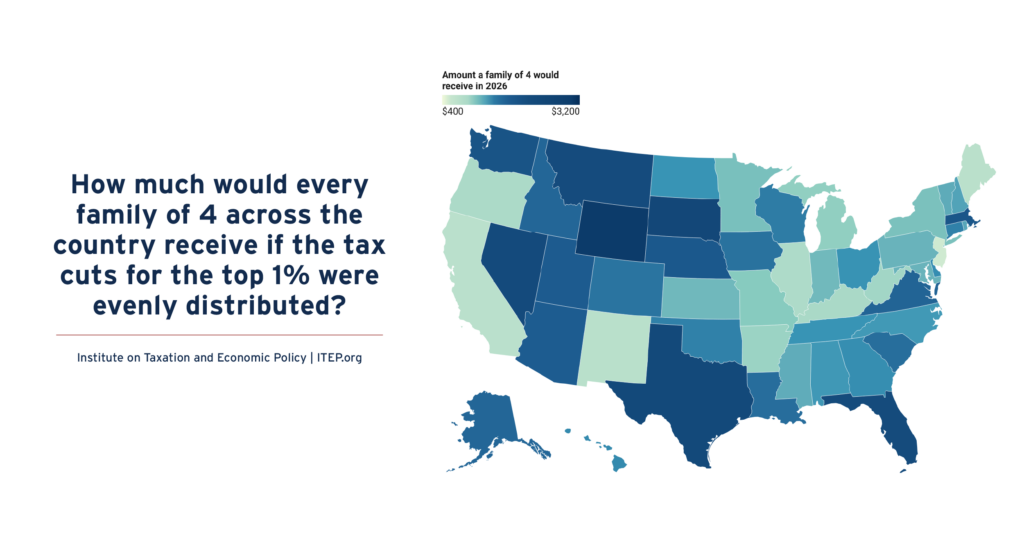
If instead of giving $117 billion to the richest 1 percent, that money had been evenly divided among all Americans, we'd each get $343 - or nearly $1,400 for a family of four.
Analysis of Tax Provisions in the Trump Megabill as Signed into Law: National and State Level Estimates
July 7, 2025 • By Steve Wamhoff, Carl Davis, Joe Hughes, Jessica Vela

President Trump has signed into law the tax and spending “megabill” that largely favors the richest taxpayers and provides working-class Americans with relatively small tax cuts that will in many cases be more than offset by Trump's tariffs.
Trump Megabill Will Give $117 Billion in Tax Cuts to the Top 1% in 2026. How Much In Your State?
June 30, 2025 • By Michael Ettlinger

The predominant feature of the tax and spending bill working its way through Congress is a massive tax cut for the richest 1 percent — a $114 billion benefit to the wealthiest people in the country in 2026 alone.
How Much Do the Top 1% in Each State Get from the Trump Megabill?
June 30, 2025 • By Carl Davis

The Senate tax bill under debate right now would bring very large tax cuts to very high-income people. In total, the richest 1 percent would receive $114 billion in tax cuts next year alone. That would amount to nearly $61,000 for each of these affluent households.
Analysis of Tax Provisions in the House Reconciliation Bill: National and State Level Estimates
May 22, 2025 • By Carl Davis, Jessica Vela, Joe Hughes, Steve Wamhoff
The poorest fifth of Americans would receive 1 percent of the House reconciliation bill's net tax cuts in 2026 while the richest fifth of Americans would receive two-thirds of the tax cuts. The richest 5 percent alone would receive a little less than half of the net tax cuts that year.
Want to know more about the tax and spending megabill that President Trump recently signed into law? We've got you covered.
State Rundown 4/16: No Vacation from Spring Tax Breaks as Bills Advance
April 16, 2025 • By ITEP Staff
While students and families are enjoying spring break vacations, legislative sessions are still in full swing. And some are poised for a spring tax break season as proposals advance with major implications for the sustainability of state budgets.
IRS Cooperation with ICE Will Damage Public Trust, Putting Tax Revenues in Jeopardy
April 10, 2025 • By Marco Guzman

Attempts by the Department of Homeland Security to secure private information from the IRS on people who file taxes with an Individual Taxpayer Identification Number is a violation of federal privacy laws that protect taxpayers. It is also a change that could seriously damage public trust in the IRS, which could jeopardize billions of dollars in tax payments by hardworking immigrant families.
Sharp Turn in Federal Policy Brings Significant Risks for State Tax Revenues
April 9, 2025 • By Carl Davis

Summary The new presidential administration and Congress have indicated that they intend to bring about a dramatic federal retreat in funding for health care, food assistance, education, and other services that will push more of the responsibility for providing these essential services to the states. Meeting these new obligations would be a challenging task for […]

This week, we celebrate 50 years of the federal Earned Income Tax Credit (EITC) and the impact it's had on millions of workers and families. In 2023 alone, the latest year of available data, the federal EITC alongside the refundable portion of the Child Tax Credit lifted 6.4 million people and 3.4 million children out of poverty.
State Rundown 3/26: Lawmakers Navigate Shortfalls, Potholes, and Pitfalls
March 26, 2025 • By ITEP Staff
State lawmakers around the country are navigating a range of potential hazards this week. Leaders in Maryland and Washington are facing budget holes but are smartly working to get out of them through progressive taxes on those with the most ability to pay. Both North Dakota and Washington state are looking to fill literal potholes […]
Below is a list of tax expenditure reports published in the states.
In the face of immense uncertainty around looming federal tax and budget decisions, many of which could threaten state budgets, state lawmakers have an opportunity to show up for their constituents by raising and protecting the revenue needed to fund shared priorities. Lawmakers have a choice: advance tax policies that improve equity and help communities thrive, or push tax policies that disproportionately benefit the wealthy, drain funding for critical public services, and make it harder for most families to get ahead.
