
Ohio
State Rundown 1/10: States Should Resolve to Pursue Equitable Tax Options
January 10, 2019 • By ITEP Staff
This week we released a handy guide of policy options for Moving Toward More Equitable State Tax Systems, and are pleased to report that many state lawmakers are promoting policies that are in line with our recommendations. For example, Puerto Rico lawmakers recently enacted a targeted EITC-like credit for working families, and leaders in Virginia and elsewhere are working toward similar improvements. Arkansas residents also saw their tax code improve as laws reducing regressive consumption taxes and enhancing income tax progressivity just went into effect. And there is still time for governors and legislators pushing for regressive income tax cuts…
The American Prospect: The 2018 Economy in 12 Graphs
December 21, 2018
Thanks to some bold number crunching by the nerds at the Institute for Taxation and Economic Policy, the figure compares a regressive, supply-side tax cut, like the one we got last year, to a highly progressive expansion of the Earned Income Tax Credit, the GAIN Act, proposed by Ohio Senator Sherrod Brown and California Representative […]
State Rundown 12/5: Familiar Questions Returning to Fore as 2019 Approaches
December 5, 2018 • By ITEP Staff
State lawmakers are preparing their agendas for 2019 and looking at all sorts of tax and budget policies in the process, raising many familiar questions. Oregon legislators, for example, will try to fill in the blanks in a proposal to boost investments in education that left out detail on how to fund them, while their counterparts in Texas face the inverse problem of a proposed property tax cut that fails to clarify how schools could be protected from cuts. Similar school finance debates will play out in many other states. Alabama, Kansas, and Louisiana will look at gas tax updates,…
GM Announcement Confirms Tax Cuts Don’t Prevent, May Encourage Layoffs
November 27, 2018 • By Matthew Gardner

GM’s most recent quarterly financial report reveals the company has saved more than $150 million so far this year due to last year’s corporate tax cuts. So the layoffs announcement may seem especially jarring to anyone who believed President Trump’s claim that his tax cuts would spur job creation—including the Ohio residents Trump told directly “don’t sell your homes” because lost auto-making jobs “are all coming back.”
State Rundown 10/31: Trick or Treat Advice to Savor for Tonight
October 31, 2018 • By ITEP Staff
Look out for potholes if you’re out trick-or-treating in Alabama tonight, where crumbling infrastructure figures to be a dominant debate in the coming legislative session. And be prepared to share the streets with disgruntled teachers if you‘re in Louisiana, where teachers are walking out to protest regressive tax policies that are sucking the lifeblood from the state’s schools. Meanwhile, Wisconsin residents are sharing scary stories of grotesquely large business tax subsidies and the “dark store” tax loophole they’ll be voting on next week. And you better expect the unexpected if you’re in Delaware, where Gov. John Carney shocked everyone by vetoing two broadly supported tax bills last week.
Beacon Journal/Ohio.Com Editorial Board: A Taxing Matter Goes Missing in the Governor’s Race
October 22, 2018
It follows that low- and middle-income Ohioans pay a higher share than the national average, and wealthy Ohioans pay a lower share. To a degree, that is expected in view of the vastly larger incomes of wealthy Ohioans. At the same time, the state would be well served by altering the shares to make the state and local system more fair, to reflect how new income in recent years, even decades, has flowed largely to households at the highest income rungs.
Ohio: Who Pays? 6th Edition
October 17, 2018 • By ITEP Staff
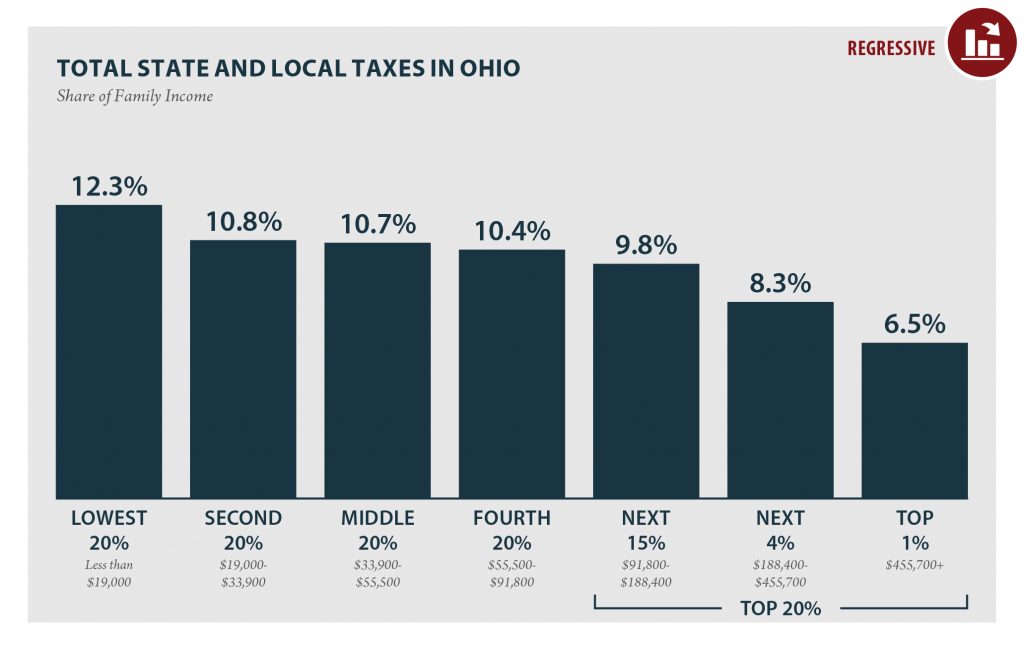
OHIO Read as PDF OHIO STATE AND LOCAL TAXES Taxes as Share of Family Income Top 20% Income Group Lowest 20% Second 20% Middle 20% Fourth 20% Next 15% Next 4% Top 1% Income Range Less than $19,000 $19,000 to $33,900 $33,900 to $55,500 $55,500 to $91,800 $91,800 to $188,400 $188,400 to $455,700 over $455,700 […]
State Rundown 10/12: Local Jurisdictions Fighting for Revenues, Independence
October 12, 2018 • By ITEP Staff
Voters all around the country are educating themselves for the upcoming elections, notably this week around ballot initiatives in Arizona and Colorado and competing gubernatorial tax proposals in Georgia and Illinois. But not all eyes are on the elections, as the relationship between state and local policy made news in Delaware, Idaho, North Dakota, and Ohio.
Tax Cuts 2.0 – Ohio
September 26, 2018 • By ITEP Staff
The $2 trillion 2017 Tax Cuts and Jobs Act (TCJA) includes several provisions set to expire at the end of 2025. Now, GOP leaders have introduced a bill informally called “Tax Cuts 2.0” or “Tax Reform 2.0,” which would make the temporary provisions permanent. And they falsely claim that making these provisions permanent will benefit […]
State Tax Codes as Poverty Fighting Tools: 2018 Update on Four Key Policies in All 50 States
September 17, 2018 • By Aidan Davis, Misha Hill
This report presents a comprehensive overview of anti-poverty tax policies, surveys tax policy decisions made in the states in 2018, and offers recommendations that every state should consider to help families rise out of poverty. States can jumpstart their anti-poverty efforts by enacting one or more of four proven and effective tax strategies to reduce the share of taxes paid by low- and moderate-income families: state Earned Income Tax Credits, property tax circuit breakers, targeted low-income credits, and child-related tax credits.
Rewarding Work Through State Earned Income Tax Credits in 2018
September 17, 2018 • By ITEP Staff

The Earned Income Tax Credit (EITC) is a policy designed to bolster the earnings of low-wage workers and offset some of the taxes they pay, providing the opportunity for struggling families to step up and out of poverty toward meaningful economic security. The federal EITC has kept millions of Americans out of poverty since its enactment in the mid-1970s. Over the past several decades, the effectiveness of the EITC has been magnified as many states have enacted and later expanded their own credits. The effectiveness of the EITC as an anti-poverty policy can be increased by expanding the credit at…
Consumers’ growing interest in online shopping and “gig economy” services like Uber and Airbnb has forced states and localities to revisit their sales taxes, for instance. Meanwhile new evidence on the dangers and causes of obesity has led to rising interest in soda taxes, but the soda industry is fighting back. Carbon taxes are being discussed as a tool for combatting climate change. And changing attitudes toward cannabis use have spurred some states to move away from outright prohibition in favor of legalization, regulation and taxation.
The Columbus Dispatch: Ohio’s tax-free shopping weekend is Friday through Sunday
August 1, 2018
But the tax holiday isn’t necessarily as much of a plus for everyone as its proponents say, said Dylan Grundman of the Institute on Taxation and Economic Policy, a nonprofit, nonpartisan think tank that works on state and federal tax policy issues. “One of the key problems is, the benefits are so dispersed beyond the […]
State Rundown 7/19: Wayfair Fallout and Ballot Preparation Dominate State Tax Talk
July 19, 2018 • By ITEP Staff
In the wake of the U.S. Supreme Court's recent Wayfair decision authorizing states to collect taxes owed on online sales, Utah lawmakers held a one-day special session that included (among other tax topics) legislation to ensure the state will be ready to collect those taxes, and a Nebraska lawmaker began pushing for a special session for the same reason. Voters in Colorado and Montana got more clarity on tax-related items they'll see on the ballot in November. And Massachusetts moves closer toward becoming the final state to enact a budget for the new fiscal year that started July 1 in…
Understanding and Fixing the New International Corporate Tax System
July 17, 2018 • By Richard Phillips

The Tax Cuts and Jobs Act (TCJA) radically changed the international tax system. It slashed taxes on corporate income, both domestic and foreign. It encouraged U.S. multinational corporations to shift jobs, profits, and tangible property abroad, and keep intangibles home. This report describes the new international tax system—and its many gaps—and also provides a road map for how to fix these gaps and surveys recent legislative approaches.
Cleveland.com: Changes Needed in Ohio’s Tax Policy (Opinion)
July 15, 2018
The Institute on Taxation & Economic Policy has examined the major state tax changes since 2005. For the top 1 percent, who make at least $480,000 a year, the tax cuts average $40,790 annually. Middle-income Ohioans on average have not received a cut, while those in the poorest fifth, earning less than $22,000, got an average increase of $140.
Sales Tax Holidays: An Ineffective Alternative to Real Sales Tax Reform
July 12, 2018 • By Dylan Grundman O'Neill
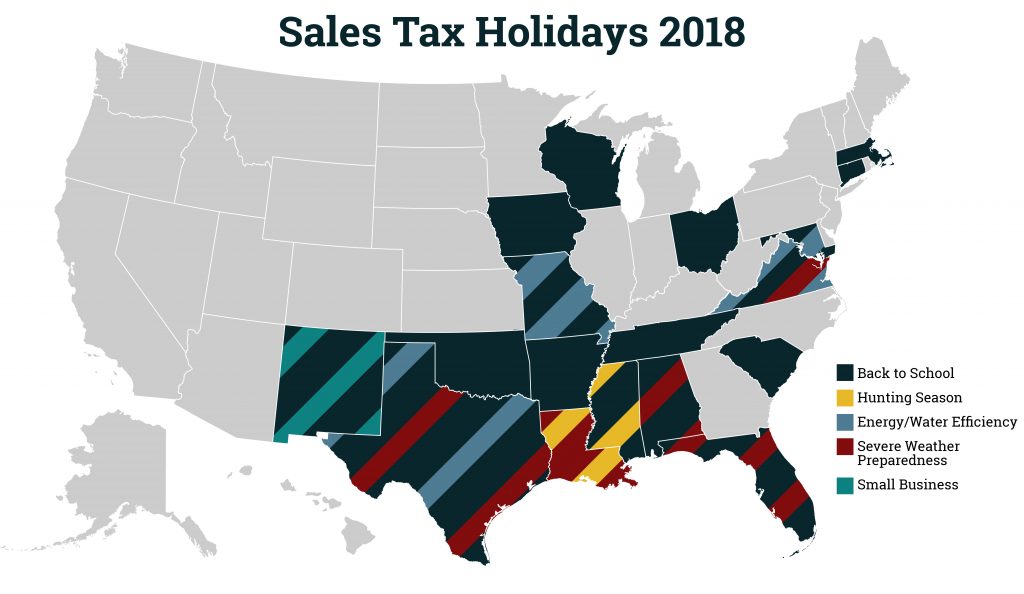
An updated version of this brief for 2019 is available here. Read this report in PDF. Overview Sales taxes are an important revenue source, composing close to half of all state tax revenues.[1] But sales taxes are also inherently regressive because the lower a family’s income, the more the family must spend on goods and […]
New Jersey avoided a second consecutive shutdown and proved that even against staunch opposition, progressive solutions to states' fiscal issues are attainable, and Arizona voters will likely have a chance to solve their education funding crisis in a similar way. Budget and tax debates remain to be resolved, however, in Maine and Massachusetts. Meanwhile, voters are gaining a clearer picture of what questions they will be asked on ballots this fall as signature drives conclude in several states.
Scene: Policy Matters Ohio Proposes State Income Tax Overhaul to Help Low- and Middle-Income Ohioans
June 26, 2018
After presenting the recommendations contained within a new report Tuesday morning, Policy Matters Ohio researcher director (and the report's lead author) Zach Schiller was asked whether or not Ohio, a "center-right state," would realistically support a tax code overhaul that proposed taxing Ohio's wealthiest at a higher rate.
Policy Matters Ohio: Overhaul: A plan to rebalance Ohio’s income tax
June 25, 2018
Policy Matters proposes the following changes to the state income tax […] This would generate almost $2.6 billion a year, including the cost of expanding the EITC, according to analysis by the Institute on Taxation and Economic Policy (ITEP). Read more here
State Rundown 5/9: Iowa Digs a New Hole as Other States Try to Avoid or Climb Out of Theirs
May 9, 2018 • By ITEP Staff
This week we have news of a destructive tax cut plan finally approved in Iowa just as one was narrowly avoided in Kansas. Tax debates in Minnesota and Missouri will go down to the wire. And residents of Arizona and Colorado are considering progressive revenue solutions to their states' education funding crises.
Beacon Journal/Ohio.Com Editorial Board: Agenda For The Governor’s Race
April 30, 2018
In one week, Democratic and Republican voters will choose their candidates for the November election. That includes the selections for governor, the job coming open after eight years with John Kasich. The governor has his achievements, most notably, the Medicaid expansion. His tenure also frames a worthy debate for this campaign. Fortunately, Innovation Ohio and Policy Matters Ohio, two think tanks, highlighted that discussion last week in unveiling their report “A Winning Economic Agenda for Ohio’s Working Families.”
Trends We’re Watching in 2018, Part 5: 21st Century Consumption Taxes
April 20, 2018 • By Misha Hill
We're highlighting the progress of a few newer trends in consumption taxation. This includes using the tax code to discourage consumption of everything from plastic bags to carbon and collecting revenue from emerging industries like ride sharing services and legalized cannabis sales.
Washington Post: Behind Oklahoma’s Teacher Strike: Years of Tax Cuts and an Energy Slump
April 12, 2018
Some states that have also recently pushed through big income tax cuts, including North Carolina and Ohio, did so while also broadening their tax base, according to Meg Wiehe of the Institute on Taxation and Economic Policy. But until this year, Oklahoma did very little to balance rate reductions with increases in the tax base. Oklahoma raised […]
State Rundown 3/22: Some Spring State Tax Debates in Full Bloom, Others Just Now Surfacing
March 22, 2018 • By ITEP Staff
The onset of spring this week proved to be fertile ground for state fiscal policy debates. A teacher strike came to an end in West Virginia as another seems ready to begin in Oklahoma. Budgets were finalized in Florida, West Virginia, and Wyoming, are set to awaken from hibernation in Missouri and Virginia, and are being hotly debated in several other states. Meanwhile Idaho, Iowa, Maryland, and Minnesota continued to grapple with implications of the federal tax-cut bill. And our What We're Reading section includes coverage of how states are attempting to further public priorities by taxing carbon, online gambling,…
