
Recent Work
2178 items
Federal Tax Law Will Have Mixed Effect on Taxpayers’ State Tax Bills and States’ Revenue
January 26, 2018 • By Meg Wiehe

Most states piggyback on federal law to some extent for their own taxes, especially personal and corporate income taxes. These states in particular must understand what the federal changes mean for their own tax codes and decide whether to remain “coupled” to changes in the tax bill, decouple from them or take other action in response.
What the Tax Cuts and Jobs Act Means for States – A Guide to Impacts and Options
January 26, 2018 • By ITEP Staff
The recently enacted Tax Cuts and Jobs Act (TCJA) has major implications for budgets and taxes in every state, ranging from immediate to long-term, from automatic to optional, from straightforward to indirect, from certain to unknown, and from revenue positive to negative. And every state can expect reduced federal investments in shared public priorities like health care, education, public safety, and basic infrastructure, as well as a reduced federal commitment to reducing economic inequality and slowing the concentration of wealth. This report provides detail that state residents and lawmakers can use to better understand the implications of the TCJA for…
Key Lessons for States as They Determine Responses to the Federal Tax Bill
January 26, 2018 • By ITEP Staff
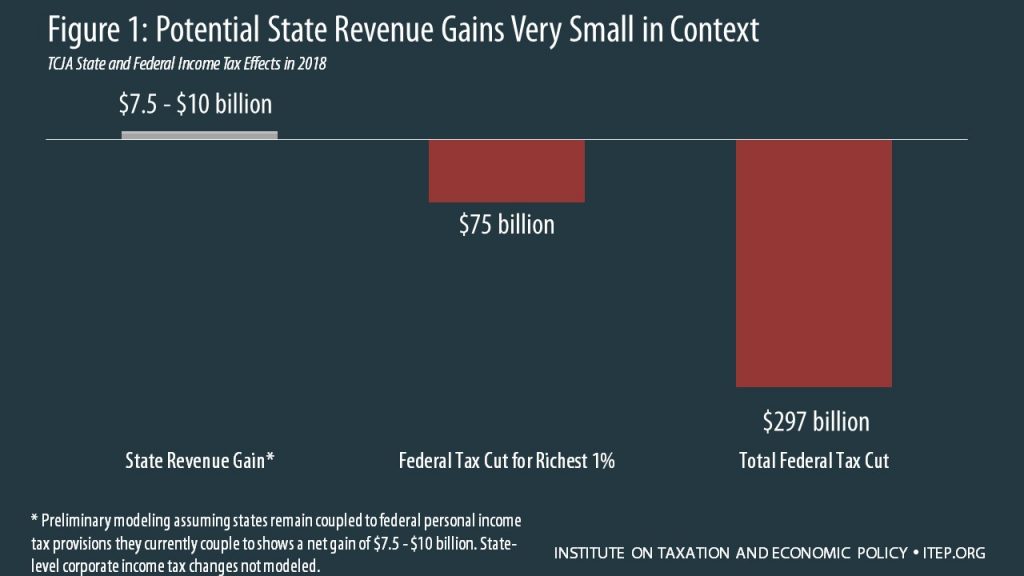
The Tax Cuts and Jobs Act (TCJA) was enacted just weeks before many state legislatures began their sessions, leaving state lawmakers, tax officials, and the public scrambling to understand how the bill affects their states and how they should react. The TCJA has many important implications for both the fairness and adequacy of state tax codes and this report aims to summarize those implications and provide guidance on the key decisions facing state policymakers going forward.

States’ attempts to work around the new federal tax law and ensure their residents continue to maximally benefit from state and local tax (SALT) deductions have been in the news since the beginning of the year. At a panel discussion for tax professionals in Washington Thursday, Thomas West, tax legislative counsel at the Treasury Department, cast doubt on proposed work-around schemes that would convert state income tax payments into “charitable contributions.”
State Rundown 1/25: States Begin Tax Debates while Still Racing to Understand Federal Bill
January 25, 2018 • By ITEP Staff

State legislative sessions are in full swing this week as states grapple with revenue shortfalls and the ramifications of the federal tax cut bill. Lawmakers in Alaska and Louisiana, for example, are debating how to handle their revenue shortfalls, and a tax cut proposal in Idaho has been received tepidly. And be sure to peruse our "What We're Reading" section for helpful perspectives on how states are affected by the federal tax cut bill.

The Walt Disney Corporation announced this week that in the wake of the new tax bill’s passage, it will spend $125 million on one-time bonuses and $50 million on an education program for some employees, all in 2018. This $175 million spending commitment is notable for two reasons: it’s temporary, and it’s a drop in the bucket for a company that’s likely to see annual tax savings of $1.2 billion a year and has already committed to a $50 billion-plus corporate acquisition of 21st Century Fox’s assets.
Olympics-like Bidding for Amazon’s HQ2 Is a PR Stunt Meant to Extract Tax Subsidies
January 19, 2018 • By Guest Blogger

By Greg LeRoy Amazon.com’s announcement of a 20-site “short list” for its second headquarters, or “HQ2” location, is provoking a public backlash that could reshape how economic development is done in the United States. In one sense, Amazon is continuing to behave as predicted, staging a public-relations stunt apparently to extract the largest possible subsidies […]
Apple Gambled on Congressional Spinelessness on Tax Policy— and Won
January 18, 2018 • By Matthew Gardner

Now, Apple Inc. would like the American public to know that it has “a deep sense of responsibility to give back to our country” a small fraction of its multi-billion-dollar tax cut haul. However, the company’s splashy press release is devoid of any specifics on the jobs it will create as a result of the tax bill. Like other corporate announcements, the company’s recent proclamation of newfound patriotism should be viewed as a public relations ploy designed to convince a skeptical public that working families will see some trickle-down benefit from this historic corporate giveaway.
State Rundown 1/17: Budget Deficits, Online Sales Tax, and More
January 17, 2018 • By ITEP Staff
The big news this week in state tax law is that the U.S. Supreme Court has agreed to take on the issue of online sales, nexus, and sales tax collection. States have increasingly lost out on sales tax revenues as more transactions have shifted online from brick-and-mortar stores and the laws determining who is required to collect and remit sales taxes haven't kept up. This is potentially good news for states—25 of which National Association of State Budget Officers (NASBO) reports started the new year with budgetary deficits. In other news, grappling with the local impact of federal tax reform…
Repealing, or Working Around, the Cap on State and Local Tax Deductions Would Make the Trump-GOP Tax Law Even More Unfair
January 17, 2018 • By Steve Wamhoff

A bipartisan proposal in Congress to eliminate the new $10,000 cap on federal deductions for state and local taxes (SALT) would cost more than $86 billion in 2019 alone and two-thirds of the benefits would go to the richest 1 percent of households. Unfortunately, “work around” proposals in some states to allow their residents to avoid the new federal cap would likely have the same regressive effect on the overall tax code.

Last week, a federal court judge in California ruled that the Trump administration cannot end DACA (Deferred Action for Childhood Arrivals) while the case works its way through the courts. Although this is reassuring news for the roughly 685,000 young people currently enrolled or seeking renewals for their DACA status it does not extend protections to new applicants, and it does not lessen the need for congressional action to protect Dreamers.
The Problems with State Workarounds to the Federal SALT Deduction
January 12, 2018 • By Alan Essig
From the outset, states—particularly wealthier states—objected to the GOP’s proposal to limit SALT deductions in part because it reduces the amount of state and local taxes that the federal government essentially picks up for taxpayers (by allowing a SALT deduction, the federal government is, in effect, paying part of taxpayers’ state and local tax bill), which could hinder states’ ability to raise revenue. Simply focusing on SALT, though, misses the bigger picture. The fact remains that the overall tax bill disproportionately benefits higher-income taxpayers even with the $10,000 SALT cap in place. Responding to federal tax cuts that disproportionately benefit…
The Walmart Smiley Face Is Lying: Corporate Tax Cuts Are Not Causing Pay Raises and Bonuses
January 12, 2018 • By Steve Wamhoff

Last night, Yahoo reported that 81 corporations had announced pay raises and bonuses that they claim result from the Trump-GOP tax law’s reduction in the official corporate tax rate from 35 percent to 21 percent. Of these 81 corporations, 13 were included in ITEP’s most recent corporate tax study, which focuses on the Fortune 500 companies that were profitable every year from 2008 through 2015. These 13 companies had a combined effective tax rate of just 19.1 percent, which undermines the idea that the federal corporate tax rate was holding back their ability to pay workers.
State Rundown 1/12: Tax Cut Tunnel Vision Threatens to Bore State Budget Holes Even Deeper
January 12, 2018 • By ITEP Staff
As states continue to sift through wreckage of the federal tax cut bill to try to determine how they will be affected, two things should be clear to everyone: the richest people in every state just got a massive federal tax cut, and federal funding for shared priorities like education and health care is certain to continue to decline. State leaders who care about those priorities should consider asking those wealthy beneficiaries of the federal cuts to pay more to the state in order to minimize the damage of the looming federal funding cuts, but so far policymakers in Idaho,…
Walmart’s Minimum Wage Hike: Did the Tax System Make Them Do It?
January 12, 2018 • By Matthew Gardner

The Walmart corporation announced this week that it will increase its minimum wage to $11 an hour, in a move that the company attributed to the major corporate tax cut signed into law by President Trump last month. The $300 million the company will spend on the wage boost is just a fraction of the more than $2 billion a year ITEP estimates Walmart could net from the corporate tax rate cuts that took effect January 1—but even so, the company felt the need to make the wage boost more affordable by simultaneously closing 63 Sam’s Club stores and laying…

Institute on Taxation
and Economic Policy
ITEP is a non-profit, non-partisan tax policy organization. We conduct rigorous analyses of tax and economic proposals and provide data-driven recommendations to shape equitable and sustainable tax systems.
Subscribe to ITEP Emails
Tax research and policy news in your inbox.
Promote Fair Tax Policy
Your gift to ITEP promotes tax justice. With your help, we do research that supports taxing millionaires and billionaires, taxing big corporations and raising revenue for the things our people, our communities and our planet need.
Together, we can create a country with more economic justice, more racial justice, more climate justice… and more tax justice.