Missouri voters are facing a major decision at the ballot box next week on Amendment 5, which would amend the state constitution to allow lawmakers to eliminate the individual income tax and expand the state’s sales tax on any good or service to make up for lost revenue. If the measure is approved, it would be a major boon for the rich while raising taxes on seniors and the working class to pay for it, giving the top 1 percent an average tax cut of almost $40,000 while middle-class Missourians with incomes between $50,000 and $80,000 would pay an average of $535 in additional taxes.
Major State Tax Proposals and Developments
- A bill approved by the House Oversight Committee would block the DISTRICT OF COLUMBIA from raising taxes or fees without approval from Congress, effectively saying D.C. shouldn’t be allowed to run its own tax system. Under current law, Congress has the power to veto changes to D.C.’s tax code within a 30-day review period before it becomes law, but the new proposal would require Congress to approve all D.C. taxes and fees within a 60-day period or they will not take effect. The move comes after Congress failed to override D.C.’s decoupling from federal tax changes within the current 30-day window. If passed, the bill would significantly reduce D.C.’s local control and fiscal autonomy. – MILES TRINIDAD
- MISSOURI voters will decide next week if they want to authorize tax hikes on the middle class to cut taxes for the rich. The measure—placed in the lower turnout August election—would allow the legislature to expand the sales tax to more goods or services and increase the rate without the state’s usual restrictions on tax increases. Instead of being spent, the funds raised would be directed to cut the state’s income tax with the goal of eventual elimination. The amendment has drawn controversy for being regressive, its links to out-of-state interest groups, and damage to existing credits. The measure would harm working families in order to help the wealthiest. – ELI BYERLY-DUKE
State Roundup
- ALASKA’s legislature continues to debate tax breaks for the Alaska LNG project as Gov. Mike Dunleavy called lawmakers back for a third special session on the issue. The latest draft advanced by a conference committee would exempt income from the project from the state’s expanded corporate income tax. Dunleavy threatened to veto the legislation after it also included a controversial provision subjecting some private oil and gas companies to the state’s corporate income tax.
- FLORIDA Gov. Ron DeSantis signed conformity legislation that decouples from OBBBA’s changes to bonus depreciation, research and experimental expenditures, business interest expenses, small business expensing, and business meals.
- Meanwhile, FLORIDA’s proposed constitutional amendment to phase-out non-school property taxes for homesteads faces legal challenges. While some lawsuits have been filed over misleading language, other lawsuits object that the ballot language fails to convey the impact to local government budgets.
- MASSACHUSETTS lawmakers tabled a bill that would have increased the share of a type of supposedly foreign corporate earnings (Global Intangible Low-Taxed Income, or GILTI) from 5 to 50 percent. Instead, the legislature authorized an investigatory hearing on the proposal alongside several other tax measures.
- MICHIGAN Gov. Gretchen Whitmer announced a data center plan having developers pledge to ensure affordable and responsible data center growth while protecting residents from higher energy costs. The plan, however, falls short of a moratorium that some lawmakers have called for and other states, such as New York, have implemented.
- Lawmakers in MONTANA are backing Gov. Greg Gianforte’s proposal to make the state’s income tax have only a single rate instead of a progressive structure. The change would cost about $130 million a year and take the state’s tax code further towards a system where the wealthiest pay the lowest rates.
- NEBRASKA lawmakers’ failure to address their structural budget deficit, combined with four consecutive months of revenues coming in below forecasts, have brought the total shortfall they must address in the upcoming session up over $1 billion over the current and upcoming biennia.
- NEW YORK Gov. Kathy Hochul would like to exclude data centers from state tax subsidies, joining a trend of states with similar limits and others placing moratoriums on constructing the centers altogether.
- Frustration builds in TEXAS over data center tax exemptions as the Comptroller’s Office sounded the alarm over audit noncompliance from the corporations building the data centers. Of 138 qualified data centers currently receiving the state’s data center-specific sales tax exemption, only 20 have been audited. Six of the 20 have been found to be noncompliant with the terms of the exemption. Texas expects to lose $3.2 billion in sales tax revenue over the next two years from the data center sales tax exemption.
- WASHINGTON residents will vote on the state’s new millionaires’ tax this year now that an initiative to repeal it has gathered enough signatures to qualify for the November ballot.
What We’re Reading
- The California Budget and Policy Center breaks down the state’s ballot measure to maintain the current top rate. They describe the billions of dollars already raised from the highest income Californians for schools and other state programs, which would be lost of the measure fails.
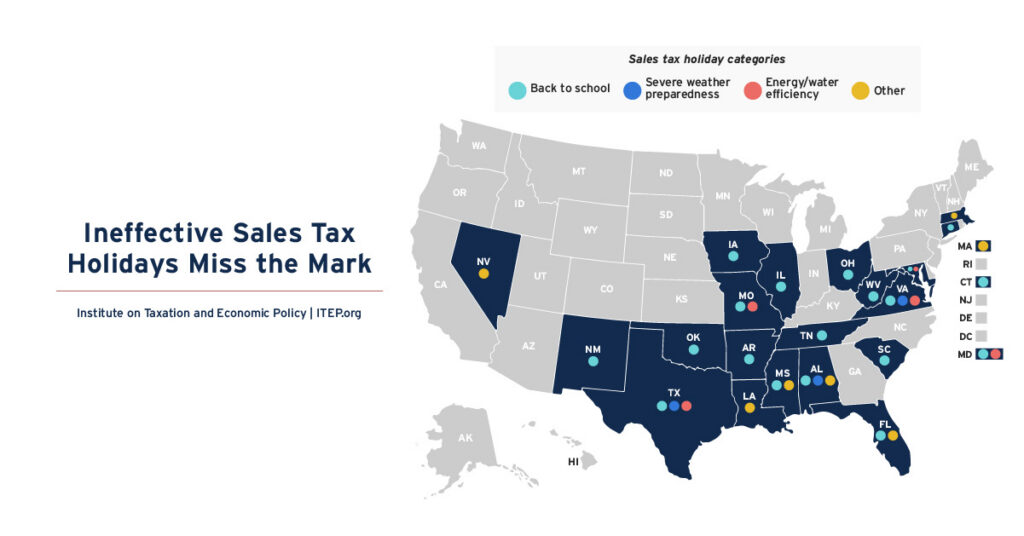
- As back-to-school sales tax holidays kick into gear across the country, a new ITEP brief flags where they are in effect and highlights how they miss the mark, and what alternatives could look like.
- The Kentucky Center for Economic Policy’s Jason Bailey lays out the potentially enormous cost of tax subsidies for data center construction in Kentucky. On the topic of data centers, a recent New York Times’ piece details the closed-door deals behind Meta’s new massive data center in Richland Parish, Louisiana. And an Idaho State Rep. makes the case against giving data centers enormous tax breaks while taxing family grocery bills. Although big tech lobbyists claimed that data centers would create tax cuts, the state’s own Tax Commission instead has found the opposite because of the state’s enormous subsidies.
If you like what you are seeing in the Rundown (or even if you don’t) please send any feedback or tips for future posts to Aidan Davis at aidan@itep.org. Click here to sign up to receive the Rundown via email.