
Corporate Taxes

Meta is claiming the research tax credit – a tax break meant to encourage innovation and experimentation – to pay for the equipment it uses in data centers to power its AI activities. ITEP described how Meta paid just 3.5% of its profits in federal corporate income taxes in 2025.
Big Tech Is Raking in Enormous Tax Breaks for AI Development
September 17, 2026 • By Matthew Gardner

OBBBA’s expensing provision is becoming especially lucrative for the companies building out AI infrastructure right now. There is no evidence whatsoever that tax breaks are necessary to encourage their construction.

TurboTax maker Intuit reported nearly $6 billion in U.S. profits in 2025 and paid no federal income tax. Instead, the company received a refund, thanks in part to new tax breaks from OBBBA.
State Rundown 9/10: States Brace for (and in Some Cases Embrace) Ballots and Budgets
September 10, 2026 • By ITEP Staff
States across the country will consider a host of ballot measures that could reshape the fairness and adequacy of their states’ tax systems, while other states are receiving budget forecasts that could further shape upcoming policy debates.

This fall, voters across the country will consider a host of ballot measures that could reshape the fairness and adequacy of their states’ tax systems. Here’s some of what we’re following.
The Biggest Winners from Trump’s Tariff Refunds are Big Corporations
September 3, 2026 • By Matthew Gardner

The Trump administration has been forced to pay out over $100 billion from illegal tariffs, and the biggest winners from these tariff refunds have been big corporations.
Maryland Digital Advertising Ruling Shouldn’t Stop Other States from Considering Ad Taxes
August 26, 2026 • By Nick Johnson

Consumers are increasingly bombarded with advertisements based on our personal data. This explosion in targeted advertising is leading state policymakers to revisit the tax treatment of advertising, which has long been exempt from sales tax.
The Trump Administration Slashed Taxes for H&R Block and Raised Costs for Tax Filers
August 20, 2026 • By Joe Hughes

Tax-prep giant H&R Block paid no federal taxes on its U.S. income in 2025. It also made a public disclosure, required by the European Union, characterizing one-third of its global profits as earned in Ireland, a low-tax country where the company offers no tax services and has only 15 employees.
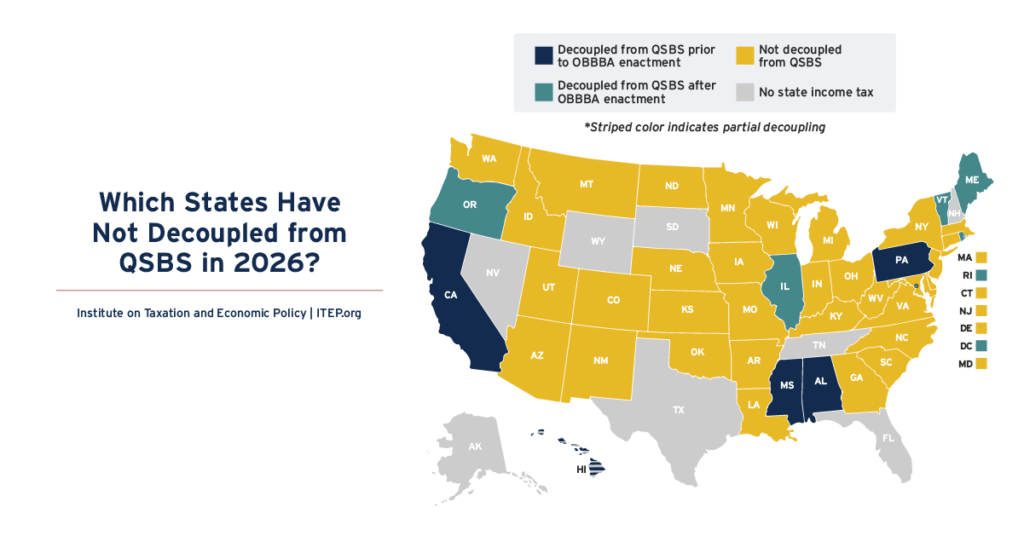
QSBS allows millionaire investors to pay zero income tax on their profits.
Six Companies Reaped $83 Billion in Federal Tax Breaks in 2025
August 14, 2026 • By Sarah Buttikofer, Matthew Gardner

Six companies alone accounted for $83 billion of federal tax breaks disclosed by publicly traded U.S companies so far for 2025. Microsoft received a record high for single-year federal tax breaks for one publicly traded company, followed by Alphabet, Amazon, Meta, JPMorgan Chase, and Nvidia.
In a win for Missouri workers and families, voters overwhelmingly rejected a proposed amendment that would have allowed lawmakers to replace the state's income tax with increased or expanded sales taxes.
How Federal Tax Policy Can Address AI
August 10, 2026 • By Steve Wamhoff, Joe Hughes, Erika Frankel

Congress could use its taxing power to ensure a fairer distribution of the fruits of labor, innovation and investment, address the specific harms (the negative externalities) of AI specifically, and acquire a public stake in the companies that are driving the AI revolution.
Trump Says Exxon and Chevron Are Ripping Off Americans, But His Own Policies Are to Blame
August 4, 2026 • By Matthew Gardner

President Trump lashed out at ExxonMobil and Chevron for “making too much money." These companies are reporting enormous profits right now, partly the result of Trump’s war in Iran but also due to the corporate tax policies he's passed during his time in office.
Bloomberg News: Microsoft’s US Taxes Drop, Revenue Jumps After Trump Cuts
August 3, 2026
"We know that Microsoft in particular and tech sector more generally are spending huge amounts of money in the last year, especially the last six or last three months, on artificial intelligence," said Matthew Gardner, a senior fellow at the left-leaning Institute on Taxation and Economic Policy. "It's super clear that data center capex is eligible for depreciation."
Microsoft Reports a 2.44 Percent Federal Tax Rate on a Record $101 Billion in Profits
July 29, 2026 • By Matthew Gardner

Microsoft avoided federal income tax on almost all of its U.S. income for fiscal year 2026. The company’s 2.44 percent federal tax rate on over $100 billion of U.S. income is largely attributable to tax breaks that were either created or expanded by Republican tax cuts enacted at the behest of President Donald Trump in 2017 and 2025.
State Rundown 7/29: The Misguided, Miserly Missouri Amendment to Eliminate the Income Tax
July 29, 2026 • By ITEP Staff
Missouri voters are facing a major decision at the ballot box next week on Amendment 5, which would amend the state constitution to allow lawmakers to eliminate the individual income tax and expand the state’s sales tax on any good or service to make up for lost revenue.
Flying Under the Tax Radar: How Profitable Airlines Avoided Federal Income Taxes in 2025
July 27, 2026 • By Sarah Buttikofer, Spandan Marasini

Corporate tax disclosures reveal that five profitable airlines paid almost nothing in federal income tax last year. In 2025, the effective federal income tax rates of these airlines ranged from 1.07 percent to below zero.

Many states have repeatedly cut top personal and corporate income tax rates in recent years, sometimes while approving increased sales tax rates to push tax systems in a more regressive direction. Other states, however, have charted a very different course and have moved to increase taxes on higher income households to fund public services.
New Legislation Would Require Big Multinationals to Tell Shareholders Where They’re Hiding Offshore Profits
July 16, 2026 • By Matthew Gardner

Sen. Chris Van Hollen introduced legislation requiring big multinational corporations to tell shareholders and the public what they’re already telling tax authorities behind closed doors: how much income they’re booking in specific offshore tax havens and how little tax they’re paying to these jurisdictions.
Trump Administration Says Shining Light on Corporate Tax Avoidance is ‘Very Dangerous’
July 14, 2026 • By Matthew Gardner

Administration officials appear far more concerned about the public knowing too much about how U.S. corporations shift their income into offshore tax havens.
New EU Disclosure Requirements Are Helping Identify Corporate Tax Avoiders
June 30, 2026 • By Matthew Gardner
Microsoft reports a huge share of its worldwide profit in low-tax Ireland and is achieving this despite having a very small share of its employees there. As other companies make similar disclosures between now and the end of calendar year 2026, investors and the public will likely get a much clearer sense of how much profit corporations are hiding offshore—and how much tax they’re avoiding by doing so.
2026 Sessions in Review: States Move to Tax the Rich and Corporations
June 29, 2026 • By Aidan Davis

This year several states raised income tax rates on high-income people to fund crucial services and make progress toward remedying the regressive tilt of their tax codes.
It's the first official week of summer, and while many of us are planning vacations, state lawmakers remain busy finalizing and debating tax proposals.

Corporate tax reforms could be more resilient than proposals to tax wealth or unrealized capital gains while achieving the same goal of more adequately taxing the income of billionaires.

If Juneteenth is to mean anything beyond symbolism, it must also be a call to confront the policies that continue to shape racial inequities today. One of the most powerful drivers of that inequity is our tax system.

Institute on Taxation
and Economic Policy
ITEP is a non-profit, non-partisan tax policy organization. We conduct rigorous analyses of tax and economic proposals and provide data-driven recommendations to shape equitable and sustainable tax systems.
Subscribe to ITEP Emails
Tax research and policy news in your inbox.
Promote Fair Tax Policy
Your gift to ITEP promotes tax justice. With your help, we do research that supports taxing millionaires and billionaires, taxing big corporations and raising revenue for the things our people, our communities and our planet need.
Together, we can create a country with more economic justice, more racial justice, more climate justice… and more tax justice.