
District of Columbia
Testimony: ITEP’s Matt Gardner Discusses How to Improve Maryland’s Tax Code at House Ways & Means Committee Hearing
February 27, 2025
ITEP Senior Fellow Matt Gardner submitted the written testimony below to Maryland’s House Ways & Means Committee on February 20, 2025. Video of his oral testimony is at the bottom of this post. Thank you for the opportunity to submit written testimony. My name is Matthew Gardner. I am a senior fellow at the Institute […]
Revenue Effect of Mandatory Worldwide Combined Reporting by State
February 21, 2025 • By ITEP Staff
Universal adoption of mandatory worldwide combined reporting (WWCR) in states with corporate income taxes would boost state tax revenue by $18.7 billion per year. The revenue effects of mandatory WWCR would vary across states. We estimate that 38 states and the District of Columbia would experience revenue increases totaling $19.1 billion. The top 10 states […]
A Revenue Analysis of Worldwide Combined Reporting in the States
February 20, 2025 • By Carl Davis, Matthew Gardner, Michael Mazerov

Universal adoption of mandatory worldwide combined reporting would boost state corporate income tax revenues by roughly 14 percent. Thirty-eight states and the District of Columbia would experience revenue increases totaling $19.1 billion.
Turning IRS Agents to Deportation Will Reduce Public Revenues
February 11, 2025 • By Carl Davis, Jon Whiten
The Trump Administration’s plan to turn IRS agents into deportation agents will result in lower tax collections in addition to the harm done to the families and communities directly affected by deportations.

Local income taxes can be an important progressive revenue raiser, as they ask more of higher-income households and are connected to ability to pay. They can raise substantial revenue to fund key public services to make cities and regions better off.
Maryland Gov. Wes Moore’s Tax Plan Boosts Revenue, Increases Fairness
January 30, 2025 • By Miles Trinidad, Nick Johnson

Maryland’s Gov. Wes Moore put forward a tax reform plan that would make the tax system fairer, simpler, and better able to meet the state’s needs. The proposed changes to the income tax ask more of those at the top and provide an average tax cut for those earning less.
Maryland’s Tax Reform Likely Won’t Cause Millionaire Migration
January 30, 2025 • By Nick Johnson

The moment Gov. Wes Moore announced his proposal to reform Maryland’s tax system, in part, by raising income tax rates on high-income households, opponents began predicting that wealthy people would respond by leaving. Experience from other states says that’s not the case.
Nick Johnson
January 15, 2025 • By ITEP Staff

Nick serves as a Senior Fellow with ITEP’s state and local policy teams. He brings three decades of expertise in state and local tax policy to advance economic justice and sustainable public finance. Most recently, he led the District of Columbia Tax Revision Commission as Executive Director, where he guided the independent, decennial commission’s comprehensive […]

As we close out 2024, we want to lift up the tax charts we published this year that received the most engagement from readers. Covering federal, state, and local tax work, here are our top charts of 2024.
State Tax Policy Should Adopt the Principles of ‘Black Women Best’
November 20, 2024 • By Brakeyshia Samms

Focusing policy analysis on Black women illustrates how Black women have long shouldered the shortcomings of the economy and clearly points to solutions that work for all. Black women are at their best when they are financially secure, healthy, and free – and our economy is at its best when all people can thrive and benefit.
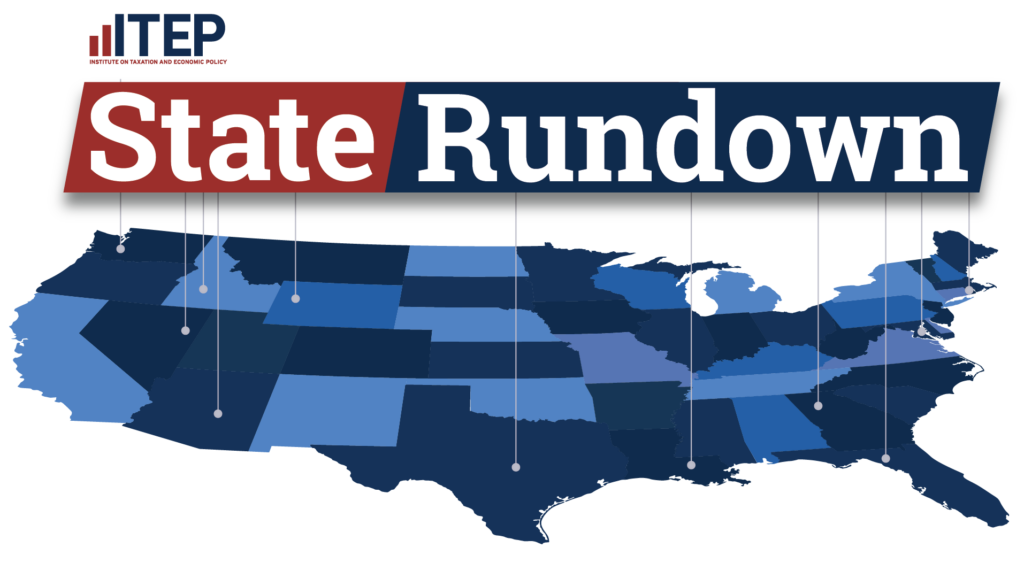
Louisiana Gov. Jeff Landry is proposing a regressive tax reform package that would enact a flat personal and corporate income tax while expanding the state’s sales tax base and eliminating certain exemptions to make up for a portion of the lost revenue. West Virginia continues to chip away at its personal income tax, one of the state’s few progressive revenue options. And advocates in New York are rallying around a package of progressive tax legislation that would tax capital gains at higher rates, enact higher income tax brackets on multi-millionaires, and tax unrealized capital gains of billionaires.
State Earned Income Tax Credits Support Families and Workers in 2024
September 12, 2024 • By Neva Butkus
Nearly two-thirds of states (31 plus the District of Columbia and Puerto Rico) have an Earned Income Tax Credit. These credits boost low-paid workers’ incomes and offset some of the taxes they pay, helping lower-income families achieve greater economic security.
State Child Tax Credits Boosted Financial Security for Families and Children in 2024
September 12, 2024 • By Neva Butkus
Fifteen states plus the District of Columbia provide Child Tax Credits to reduce poverty, boost economic security, and invest in children. This year alone, lawmakers in three states – Colorado, New York, and Utah – expanded their Child Tax Credits while lawmakers in the District of Columbia created a new credit that will take effect in 2025.
Sales Tax Holidays Miss the Mark When it Comes to Effective Sales Tax Reform
August 6, 2024 • By Marco Guzman

Nineteen states have sales tax holidays on the books in 2024. These suspensions combined will cost states and localities over $1.3 billion in lost revenue this year. Sales tax holidays are poorly targeted and too temporary to meaningfully change the regressive nature of a state’s tax system.

Undocumented immigrants paid $96.7 billion in federal, state, and local taxes in 2022. Providing access to work authorization for undocumented immigrants would increase their tax contributions both because their wages would rise and because their rates of tax compliance would increase.
Four states expanded or boosted refundable tax credits for children and families, and the District of Columbia is poised to create a new Child Tax Credit. These actions — in Colorado, Illinois, New York, Utah, and D.C. — continue the recent trend of improving the well-being of children and families with refundable tax credits.
State Rundown 7/25: Summertime Hits Different in Different States
July 25, 2024 • By ITEP Staff
State lawmakers will have a lot to discuss when they compare notes on how they spent their summer vacations this year...

Major tax cuts were largely rejected this year, but states continue to chip away at income taxes. And while property tax cuts were a hot topic across the country, many states failed to deliver effective solutions to affordability issues.
Improving Refundable Tax Credits by Making Them Immigrant-Inclusive
July 17, 2024 • By Emma Sifre, Marco Guzman
Undocumented immigrants who work and pay taxes but don't have a valid Social Security number for either themselves or their children are excluded from federal EITC and CTC benefits. Fortunately, several states have stepped in to ensure undocumented immigrants are not left behind by the gaps in the federal EITC and CTC. State lawmakers should continue to ensure that immigrants who are otherwise eligible for these tax credits receive them.
While Massachusetts legislators recently dropped a real estate transfer tax from their major housing bill, the District of Columbia council sent a budget to the mayor that includes a mansion tax that would increase the tax rate on properties valued over $2.5 million. Meanwhile, lawmakers in New Jersey and South Carolina continue to, respectively, raise and reduce needed revenues.
States Should Enact, Expand Mansion Taxes to Advance Fairness and Shared Prosperity
June 26, 2024 • By Carl Davis, Erika Frankel

The report was produced in partnership with the Center on Budget and Policy Priorities and co-authored by CBPP’s Deputy Director of State Policy Research Samantha Waxman.[1] Click here to use our State Mansion Tax Estimator A historically large share of the nation’s wealth is concentrated in the hands of a few, a reality glaring in […]
Property Tax Circuit Breakers Can Help States Create More Equitable Tax Codes
June 24, 2024 • By Brakeyshia Samms
Well-designed property tax circuit breaker programs allow states to reduce the impact that property taxes have on the upside-down tilt of their tax codes.
State Rundown 6/13: Decisions are falling into place, but some states will come back for more
June 13, 2024 • By ITEP Staff
State budgets are falling into place as lawmakers near the end of their legislative sessions...
Legislative sessions across the country are still very much in for summer, which means more pencils, more budgets, and more tax plans...

There are a variety of factors that affect teacher pay. But one often overlooked factor is progressive tax policies that allow states to raise and provide the funding educators and their students deserve.

Institute on Taxation
and Economic Policy
ITEP is a non-profit, non-partisan tax policy organization. We conduct rigorous analyses of tax and economic proposals and provide data-driven recommendations to shape equitable and sustainable tax systems.
Subscribe to ITEP Emails
Tax research and policy news in your inbox.
Promote Fair Tax Policy
Your gift to ITEP promotes tax justice. With your help, we do research that supports taxing millionaires and billionaires, taxing big corporations and raising revenue for the things our people, our communities and our planet need.
Together, we can create a country with more economic justice, more racial justice, more climate justice… and more tax justice.