
Georgia
States Could Raise $19 Billion a Year with One Policy Change Targeting Corporate Tax Avoidance
February 20, 2025 • By ITEP Staff
Worldwide combined reporting negates the tax benefits of shifting corporate income offshore Public polling has consistently shown for decades that most people believe big multinational corporations are paying too little in taxes. Closing the loopholes these corporations use to avoid taxes is one of the most effective – and popular – solutions to this problem. […]
A Revenue Analysis of Worldwide Combined Reporting in the States
February 20, 2025 • By Carl Davis, Matthew Gardner, Michael Mazerov

Universal adoption of mandatory worldwide combined reporting would boost state corporate income tax revenues by roughly 14 percent. Thirty-eight states and the District of Columbia would experience revenue increases totaling $19.1 billion.
Turning IRS Agents to Deportation Will Reduce Public Revenues
February 11, 2025 • By Carl Davis, Jon Whiten
The Trump Administration’s plan to turn IRS agents into deportation agents will result in lower tax collections in addition to the harm done to the families and communities directly affected by deportations.
Tax changes have been proposed or are nearing the finish line in many states. Kentucky is poised to enact an income tax cut as a bill heads to the governor’s desk. In Pennsylvania, Gov. Josh Shapiro’s budget proposal called to accelerate existing corporate tax cuts while closing corporate tax loopholes by enacting combined reporting. Ohio Gov. Mike DeWine proposed a new credit for children of working parents. And Virginia Democrats countered Gov. Glenn Youngkin’s proposed tax cuts with a plan of their own that includes an increase to the state’s Earned Income Tax Credit (EITC) and a one-time, nonrefundable tax…

Local income taxes can be an important progressive revenue raiser, as they ask more of higher-income households and are connected to ability to pay. They can raise substantial revenue to fund key public services to make cities and regions better off.
More details on this year’s batch of major tax proposals are emerging from statehouses - and some revenue cuts look like they could be steep. A governor-backed and House-passed plan in Mississippi would phase out the personal income tax, while a recent tax cut proposal out of Idaho is anchored by a $253 million dollar income tax cut.
State Rundown 1/22: Tax Policy, Affordability, and Where It Misses the Mark
January 22, 2025 • By ITEP Staff
As state legislative sessions ramp up many lawmakers discuss their prioritization of affordability of necessities like food and housing as they craft their legislative agendas. Arkansas, Mississippi and Utah are looking to reduce or fully exempt groceries from their state sales taxes. Meanwhile, multiple proposals to reduce property taxes are making their way around state […]
Policymakers Unwisely Propose Cutting Property Taxes in Favor of Sales Taxes
January 14, 2025 • By Rita Jefferson

Lawmakers across the country are taking aim at property taxes with a new strategy: raising sales taxes instead. Doing so would create a regressive tax shift that puts unfair burdens on renters and reduces the strength of local government revenues.
Trump’s Plan to Extend His 2017 Tax Provisions: Updated National and State-by-State Estimates
January 8, 2025 • By Steve Wamhoff
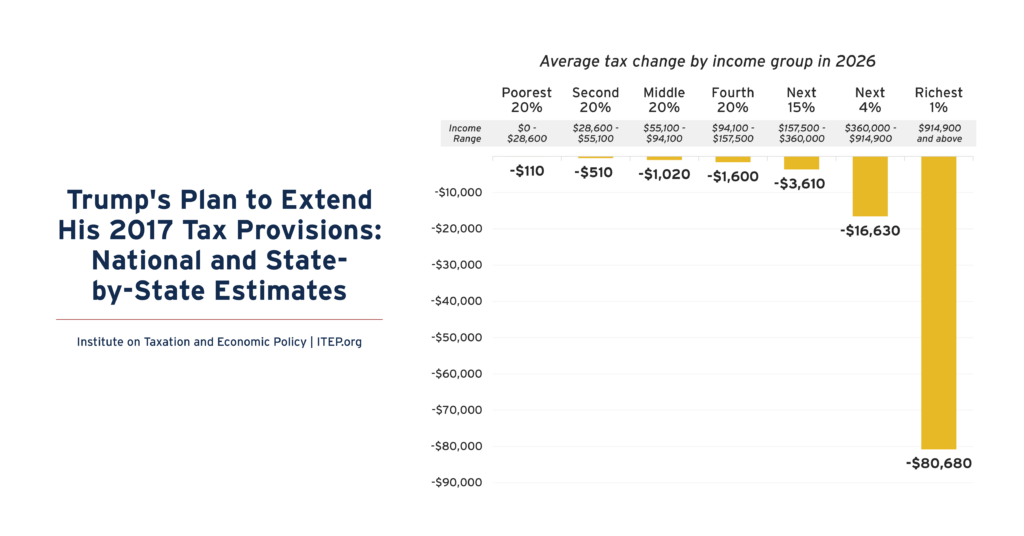
Trump’s plan to make most of the temporary provisions of his 2017 tax law permanent would disproportionately benefit the richest Americans. This includes all major provisions except the $10,000 cap on deductions for state and local taxes (SALT) paid.
Georgia Budget & Policy Institute: From Barriers to Bridges: How Fines and Fees Reform Can Help Boost Economic Security
December 22, 2024
Excessive local government reliance on fines and fees is tied to persistent barriers to economic security. Policies that lift these barriers could open gateways for more Georgians to achieve workforce mobility free from criminal legal system entanglement. Read more.
Tax policy results are mixed across the country as many voters weigh in on state and local ballot measures. For example, Washington state voted to maintain its new progressive tax on capital gains; Georgia voters capped growth in property tax assessments; Illinois voters approved a call for a millionaires’ tax; North Dakota voters rejected property […]
Louisiana Gov. Jeff Landry is proposing a regressive tax reform package that would enact a flat personal and corporate income tax while expanding the state’s sales tax base and eliminating certain exemptions to make up for a portion of the lost revenue. West Virginia continues to chip away at its personal income tax, one of the state’s few progressive revenue options. And advocates in New York are rallying around a package of progressive tax legislation that would tax capital gains at higher rates, enact higher income tax brackets on multi-millionaires, and tax unrealized capital gains of billionaires.
2024 State Tax Ballot Questions: Voters to Weigh in on Tax Changes Big and Small
October 17, 2024 • By Jon Whiten

As we approach November’s election, voters in several states will be weighing in on tax policy changes. The outcomes will impact the equity of state and local tax systems and the adequacy of the revenue those systems are able to raise to fund public services.
Trump’s Plan to Vaporize the Economy Through Mass Deportation
September 16, 2024 • By Michael Ettlinger

This op-ed originally appeared in the Boston Globe. What would happen if 22 percent of America’s farmworkers vanished from the workforce? Would workers from across the country flock to the cotton fields of Texas, the sugar fields of Florida, and the peanut farms of Georgia to take low-paying jobs in the blazing heat? Or would […]
Extending Temporary Provisions of the 2017 Trump Tax Law: Updated National and State-by-State Estimates
September 13, 2024 • By Steve Wamhoff

The TCJA Permanency Act would make permanent the provisions of the Tax Cuts and Jobs Act of 2017 that are set to expire at the end of 2025. The legislation would disproportionately benefit the richest Americans. Below are graphics for each state that show the effects of making TCJA permanent across income groups. See ITEP’s […]
Sales Tax Holidays Miss the Mark When it Comes to Effective Sales Tax Reform
August 6, 2024 • By Marco Guzman

Nineteen states have sales tax holidays on the books in 2024. These suspensions combined will cost states and localities over $1.3 billion in lost revenue this year. Sales tax holidays are poorly targeted and too temporary to meaningfully change the regressive nature of a state’s tax system.

Undocumented immigrants paid $96.7 billion in federal, state, and local taxes in 2022. Providing access to work authorization for undocumented immigrants would increase their tax contributions both because their wages would rise and because their rates of tax compliance would increase.

Major tax cuts were largely rejected this year, but states continue to chip away at income taxes. And while property tax cuts were a hot topic across the country, many states failed to deliver effective solutions to affordability issues.
Improving Refundable Tax Credits by Making Them Immigrant-Inclusive
July 17, 2024 • By Emma Sifre, Marco Guzman

Undocumented immigrants who work and pay taxes but don't have a valid Social Security number for either themselves or their children are excluded from federal EITC and CTC benefits. Fortunately, several states have stepped in to ensure undocumented immigrants are not left behind by the gaps in the federal EITC and CTC. State lawmakers should continue to ensure that immigrants who are otherwise eligible for these tax credits receive them.
States Should Enact, Expand Mansion Taxes to Advance Fairness and Shared Prosperity
June 26, 2024 • By Carl Davis, Erika Frankel

The report was produced in partnership with the Center on Budget and Policy Priorities and co-authored by CBPP’s Deputy Director of State Policy Research Samantha Waxman.[1] Click here to use our State Mansion Tax Estimator A historically large share of the nation’s wealth is concentrated in the hands of a few, a reality glaring in […]
Fairness Matters: A Chart Book on Who Pays State and Local Taxes
April 11, 2024 • By ITEP Staff
State and local tax codes can do a lot to reduce inequality. But they add to the nation’s growing income inequality problem when they capture a greater share of income from low- or moderate-income taxpayers. These regressive tax codes also result in higher tax rates on communities of color, further worsening racial income and wealth divides.
State Rundown 4/3: Some States Buck the Trend on Foolish Tax Policy
April 3, 2024 • By ITEP Staff
This week tax cuts were debated across the upper Midwest...
Over the past week Utah continued its slow march toward a more inequitable tax code...
State legislative sessions are in full swing with New Jersey and Oklahoma both particularly active this week...
State Rundown 2/22: Some Top-Heavy Tax Cut Proposals are Getting the Chop
February 22, 2024 • By ITEP Staff
With many state legislatures now in full swing with activity heating up, some tax cut proposals have lost steam...

Institute on Taxation
and Economic Policy
ITEP is a non-profit, non-partisan tax policy organization. We conduct rigorous analyses of tax and economic proposals and provide data-driven recommendations to shape equitable and sustainable tax systems.
Subscribe to ITEP Emails
Tax research and policy news in your inbox.
Promote Fair Tax Policy
Your gift to ITEP promotes tax justice. With your help, we do research that supports taxing millionaires and billionaires, taxing big corporations and raising revenue for the things our people, our communities and our planet need.
Together, we can create a country with more economic justice, more racial justice, more climate justice… and more tax justice.