
Blog
As we head into summer, many state legislatures are in the final stretches of their sessions. Rhode Island moved another step closer to joining the ranks of Washington, Maine, and Hawai’i in enacting a new high-income surcharge this year.
As many legislative sessions end, lawmakers are revealing their priorities.
State Rundown 4/8: Budget and Tax Packages Take Shape as Sine Die Approaches in Many States
April 8, 2026 • By ITEP Staff
State legislative sessions are wrapping up, and final tax and budget packages are making their way to governors’ desks.
State Rundown 4/1: No Fooling Around Anymore in Washington, But Cruel Pranks in South Carolina
April 1, 2026 • By ITEP Staff
In Washington, Gov. Bob Ferguson and lawmakers decided to stop fooling around with one of the nation’s most upside-down tax codes and finally brought to life a new millionaires’ tax, the first new income tax created in a state since 1991.
State Rundown 3/26: Sobering Revenue Projections Keep States on Their Toes
March 26, 2026 • By ITEP Staff
This week, troubling revenue projections are making headlines, with many lawmakers scrambling to determine how the tax changes at the federal level, plus price hikes driven by national policy decisions, will impact their states.
State Rundown 3/12: Washington Lawmakers Pass Millionaires’ Tax, Expand Working Families Tax Credit
March 12, 2026 • By ITEP Staff
Washington is on its way to making history after the legislature approved the “millionaires’ tax,” a 9.9 percent tax on income over $1 million. The bill, which is expected to raise more than $3 billion a year, making significant investments in public education and childcare, will also expand the Working Families Tax Credit – the […]
As many state legislative sessions near or cross the halfway point, lawmakers are facing tough choices.
National Sausage Month isn’t until October, but now is the time of year when state lawmakers are really diving into their sausage-making processes, as separate legislative houses and oftentimes political parties send competing bills, budgets, and visions back and forth to grind out their differences.
State Rundown 2/19: Necktie (NCTI) Offers a Way Out of a Knotty Situation
February 19, 2026 • By ITEP Staff
State lawmakers are grappling with a range of challenges as their fiscal outlooks deteriorate, federal tax enforcement wanes (after the Trump administration cut the IRS workforce by 25 percent), and a rewritten federal tax code sends states scrambling to decide what changes they might want to make in their own codes.
State Rundown 2/11: This Valentine’s Day, Conscious Decoupling Is Our Love Language
February 11, 2026 • By ITEP Staff
While some may be excited for a romantic Valentine’s Day this weekend, many state lawmakers are breaking up and decoupling from recent federal tax changes that are poised to leave states with revenue shortfalls – much like a bad date who forgets their wallet and asks you to pick up the tab.
What Did 2025 State Tax Changes Mean for Racial and Economic Equity?
February 9, 2026 • By Brakeyshia Samms

The results are a mixed bag, with some states enacting promising policies that will improve tax equity and others going in the opposite direction.
Despite wintry conditions across much of the country, that hasn’t stopped state lawmakers from debating major tax policy changes.
As state legislative sessions ramp up across the country, property taxes are one of many issues dominating tax policy conversations in statehouses.
State Rundown 1/22: Cautious Tone Noticeable in Most Statehouses
January 22, 2026 • By ITEP Staff
Most states are adopting a very cautious approach so far this year as legislators begin their sessions and governors make their annual addresses, thanks to ongoing economic uncertainty and federal retrenchment.
Local Governments Are Increasingly Strapped: 2026 Will Bring New Challenges and New Opportunities
January 21, 2026 • By Kamolika Das

2025 saw an intensification of state and local tax fights across the country, as well as growing experimentation with local-option taxes, levies, fees, and tourism taxes aimed at keeping budgets afloat while also navigating political constraints imposed by state legislatures.
State Rundown 1/7: New Year, New Opportunities for Progressive Revenue
January 7, 2026 • By ITEP Staff
As we kick off a new year, several states are facing revenue shortfalls. Some lawmakers are approaching the challenge with sustainable and equitable solutions.
Not-So-Free Kick: How the 2026 FIFA World Cup Will Cost Cities Millions
December 5, 2025 • By Page Gray

FIFA demanded sales tax breaks on World Cup Tickets. That means millions in lost revenue for host cities already shouldering the costs on providing infrastructure, security and logistics.
State Rundown 11/24: States Say ‘No Thank You’ to Federal Tax Cuts Reducing State Revenue
November 24, 2025 • By ITEP Staff
Lawmakers in two more states have wisely said “no thank you” to federal tax cuts that would have flowed through to their state tax codes and undermined funding for their priorities
State Rundown 9/4: Colorado Tackles Offshore Corporate Tax Avoidance, Paves Way for State Conformity Best Practices
September 4, 2025 • By ITEP Staff
Despite an increasingly bleak state revenue outlook, state lawmakers across the country continue to prioritize regressive tax cuts.
As states prepare for the revenue loss and disruption resulting from the federal tax bill, tax policy is being considered in legislatures across the country.
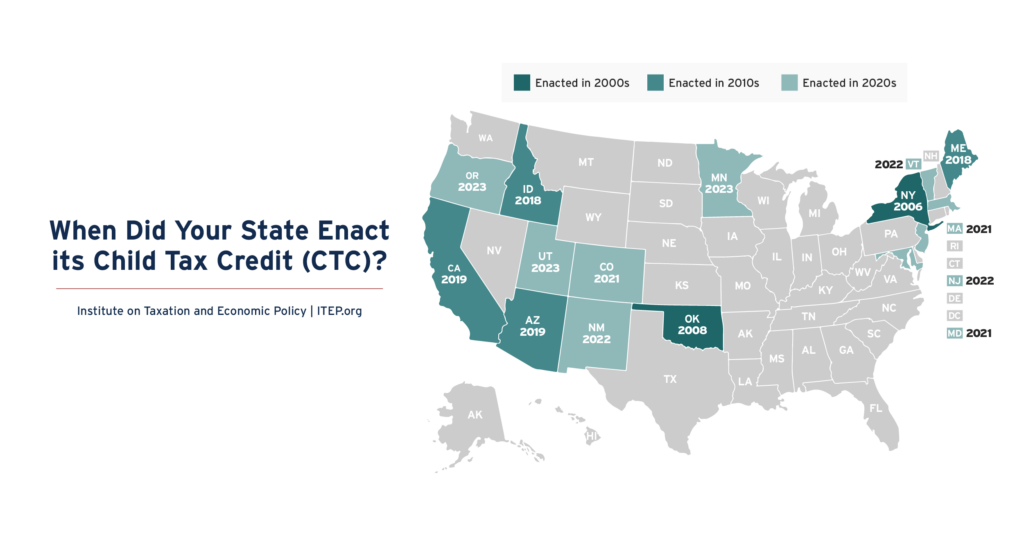
The Child Tax Credit (CTC) is an important tool to fight child poverty and help families make ends meet. When designed well, it can also make tax systems less regressive. As of 2020, only six states had CTCs. Today, 15 states have CTCs, with many credits exceeding $1,000 per qualifying child.
State Tax Action in 2025: Amid Uncertainty, Tax Cuts and New Revenue
July 28, 2025 • By Aidan Davis, Neva Butkus, Marco Guzman

Federal policy choices on tariffs, taxes, and spending cuts will be deeply felt by all states, which will have less money available to fund key priorities. This year some states raised revenue to ensure that their coffers were well-funded, some proceeded with warranted caution, and many others passed large regressive tax cuts that pile on to the massive tax cuts the wealthiest just received under the federal megabill.

Refundable tax credits were a big part of state tax policy conversations this year. In 2025, nine states improved or created Child Tax Credits or Earned Income Tax Credits.
State Rundown 7/24: States Begin Preparing for Federal Megabill Fallout
July 24, 2025 • By ITEP Staff
All eyes in statehouses in recent weeks have been on federal budget negotiations, and now that the “megabill” has passed, they are focused in on their own budgets in search of ways to cope with the enormous consequences coming their way. All states will see fewer federal dollars flowing through their coffers, higher needs due […]
How Much Would Every Family in Every State Get if the Megabill’s Tax Cuts Given to the Rich Had Instead Been Evenly Divided?
July 14, 2025 • By Michael Ettlinger
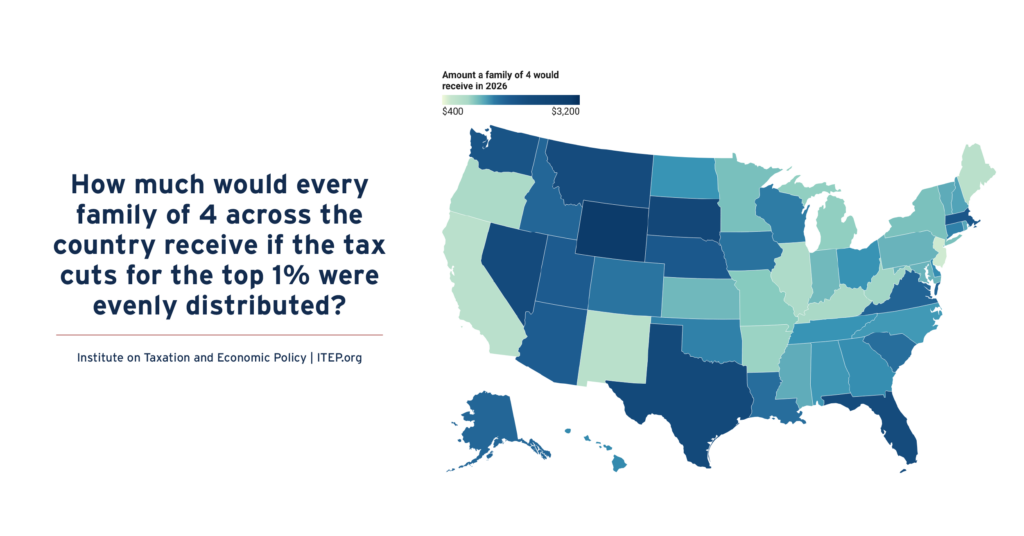
If instead of giving $117 billion to the richest 1 percent, that money had been evenly divided among all Americans, we'd each get $343 - or nearly $1,400 for a family of four.

Institute on Taxation
and Economic Policy
ITEP is a non-profit, non-partisan tax policy organization. We conduct rigorous analyses of tax and economic proposals and provide data-driven recommendations to shape equitable and sustainable tax systems.
Subscribe to ITEP Emails
Tax research and policy news in your inbox.
Promote Fair Tax Policy
Your gift to ITEP promotes tax justice. With your help, we do research that supports taxing millionaires and billionaires, taxing big corporations and raising revenue for the things our people, our communities and our planet need.
Together, we can create a country with more economic justice, more racial justice, more climate justice… and more tax justice.