
Maryland

How Much Do the Top 1% in Each State Get from the Trump Megabill?
• By Carl Davis
The Senate tax bill under debate right now would bring very large tax cuts to very high-income people. In total, the richest 1 percent would receive $114 billion in tax cuts next year alone. That would amount to nearly $61,000 for each of these affluent households.

D.C.’s Budget Crisis Demands Fairer Business Tax System
• By Nick Johnson
As the Washington, D.C. region heads toward a likely recession, local policymakers will need to look to new revenue sources to help lessen the pain. In D.C., lawmakers ought to adopt a simple reform that would raise substantial revenue and make the District’s business tax system fairer.

Analysis of Tax Provisions in the House Reconciliation Bill: National and State Level Estimates
• By Carl Davis, Jessica Vela, Joe Hughes, Steve Wamhoff
The poorest fifth of Americans would receive 1 percent of the House reconciliation bill's net tax cuts in 2026 while the richest fifth of Americans would receive two-thirds of the tax cuts. The richest 5 percent alone would receive a little less than half of the net tax cuts that year.
State Rundown 5/7: As Budget Season Heats Up, Tax Proposals Are Getting Serious
• By ITEP Staff
With spring in full bloom ,many state lawmakers are reaching tax policy agreements. Out west, lawmakers in North Dakota and Texas have moved major property tax cuts. Meanwhile, in the east and south, Vermont appears likely to pass an expansion to its Child Tax Credit and Earned Income Tax Credit, and South Carolina lawmakers are aiming to make deep, drastic cuts to the state’s income tax.
Maryland’s New Budget Boosts Tax Revenue and Equity
• By Miles Trinidad
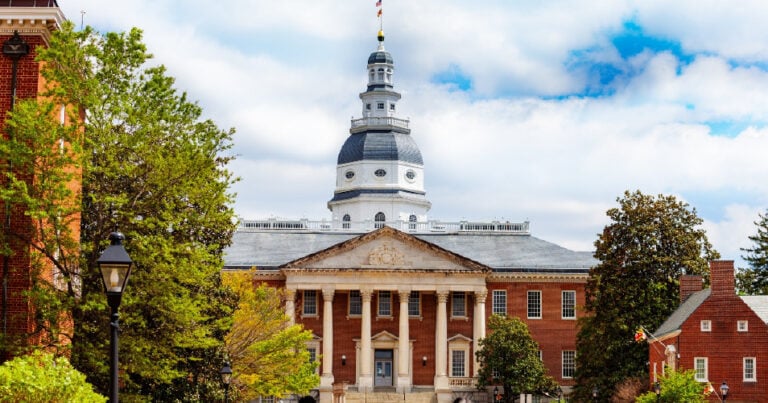
The final budget adopted by the Maryland General Assembly shows progress in advancing tax equity in the state while boosting state revenues to address the state’s budget deficit. To help close a $3.3 billion budget deficit, Maryland legislators enacted much-needed tax reforms and progressive revenue raisers that help meet the state’s needs while making the […]

Trump 2025 Tax Law: Research and Resources
• By ITEP Staff
Want to know more about the tax and spending megabill that President Trump recently signed into law? We've got you covered.

IRS Cooperation with ICE Will Damage Public Trust, Putting Tax Revenues in Jeopardy
• By Marco Guzman
Attempts by the Department of Homeland Security to secure private information from the IRS on people who file taxes with an Individual Taxpayer Identification Number is a violation of federal privacy laws that protect taxpayers. It is also a change that could seriously damage public trust in the IRS, which could jeopardize billions of dollars in tax payments by hardworking immigrant families.

State Rundown 4/9: A Progressive Pushback
• By ITEP Staff
Residents and state lawmakers across the country are pushing back against anti-tax measures and are looking for ways to protect revenue and advance proposals that would raise revenue in progressive ways. This comes at a time when federal policy brings significant risks for state tax revenue.

Sharp Turn in Federal Policy Brings Significant Risks for State Tax Revenues
• By Carl Davis
Summary The new presidential administration and Congress have indicated that they intend to bring about a dramatic federal retreat in funding for health care, food assistance, education, and other services that will push more of the responsibility for providing these essential services to the states. Meeting these new obligations would be a challenging task for […]
State Rundown 4/3: Amidst Tariff Uncertainty, State Lawmakers Talk Taxes
• By ITEP Staff
While all eyes are on the Trump administration’s tariffs on foreign imports, state lawmakers are moving forward with a mix of deep, regressive tax cuts and progressive revenue raisers.
When Did Your State Enact an Earned Income Tax Credit (EITC)?
• By ITEP Staff
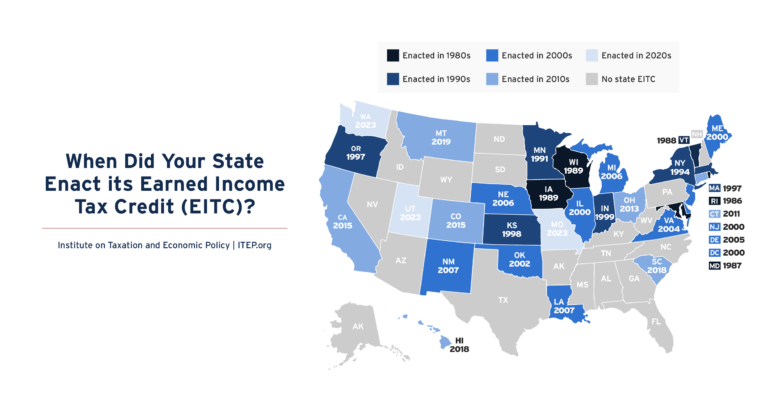
The Earned Income Tax Credit (EITC) supports millions of workers and families and continues to grow in states and localities across the country. Today, 31 states plus the District of Columbia and Puerto Rico offer EITCs. Local EITCs can also now be found in Montgomery County, Maryland, New York City, and San Francisco, where they benefited 700,000 households in 2023.

Celebrating 50 Years of the Earned Income Tax Credit
• By Neva Butkus
This week, we celebrate 50 years of the federal Earned Income Tax Credit (EITC) and the impact it's had on millions of workers and families. In 2023 alone, the latest year of available data, the federal EITC alongside the refundable portion of the Child Tax Credit lifted 6.4 million people and 3.4 million children out of poverty.
State Rundown 3/26: Lawmakers Navigate Shortfalls, Potholes, and Pitfalls
• By ITEP Staff
State lawmakers around the country are navigating a range of potential hazards this week. Leaders in Maryland and Washington are facing budget holes but are smartly working to get out of them through progressive taxes on those with the most ability to pay. Both North Dakota and Washington state are looking to fill literal potholes […]
State Rundown 3/20: It’s March, Welcome to Tax Policy Madness
• By ITEP Staff
March Madness kicks off today and the pressure is on as many states’ legislative sessions are nearing the final buzzer. Some state lawmakers are seemingly competing for the title of most regressive state tax policies while others are looking to lift up best practices for more equitable outcomes. The Mississippi legislature landed on a […]
Audio: ITEP’s Matt Gardner Discusses Maryland’s Tax and Budget Debate on WYPR
March 17, 2025
As the 2025 General Assembly reaches its midway point, the most pressing issue facing lawmakers is the state’s budget deficit. ITEP Senior Fellow Matt Gardner joined Midday to share the details of Gov. Wes Moore’s budget proposal. Listen to the full audio here.
State Rundown 3/12: Last-Minute Tax Cut Mayhem and New Progressive Revenue Raisers
• By ITEP Staff
A bevy of tax cut proposals sprung to life this week while others were signed into law. In Kentucky, lawmakers are working to make it easier for the legislature to enact income and business tax cuts. The governor in Idaho signed into law a personal and corporate income tax cut.
State Approaches to Global Intangible Low-Taxed Income (GILTI)
• By ITEP Staff
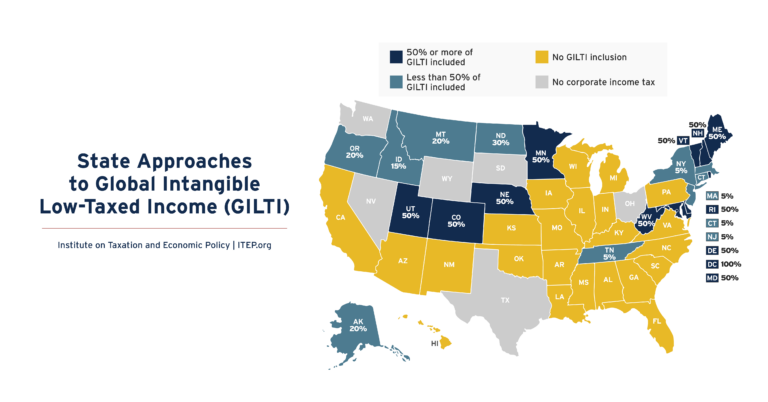
Many states with corporate income taxes include some amount of federally defined Global Intangible Low-Taxed Income (GILTI) in their tax bases. Twenty-one states plus D.C. include some amount of GILTI in their tax calculations in 2025.
Center on Budget and Policy Priorities: Maryland’s Tax Loophole for Billionaire Corporations Must End as Federal Cuts Loom for Working Families
• By ITEP Staff
Conservative revenue estimates released last month by the Institute on Taxation and Economic Policy (ITEP) project more than $700 million annually in new revenues for Maryland once you close the loophole that allows a small group of the world’s most aggressive global giants to dodge their responsibility to the people of Maryland.[10] These funds will help Maryland close its budget gap, respond effectively to the federal government’s financial threats, and enable important public investments in good…
State Rundown 3/6: In the Shadow of Chaotic Federal Policymaking States Seek to Tax the Top, Cut Taxes
• By ITEP Staff
Proposals from governors in both New Jersey and Wisconsin include provisions to tax high-income earners. Meanwhile, several major tax proposals are advancing in the great plains, with Iowa considering a major cut to unemployment taxes, North Dakota advancing new benefits for private schools, and Wyoming cutting property taxes. The District of Columbia is facing a more than a $1 billion revenue shortfall over the next three years, compared to previous estimates, and a mild recession due…
Testimony: ITEP’s Miles Trinidad on Maryland’s Budget Reconciliation Act of 2025
• By Miles Trinidad
This testimony was delivered to a joint session of Maryland’s House Appropriations and Ways and Means Committees on February 27, 2025. Thank you for the opportunity to provide testimony on the Budget Reconciliation Act of 2025. My name is Miles Trinidad, and I’m a state analyst with the Institute on Taxation and Economic Policy, a […]

High-Rent, Low-Wealth: Addressing the Racial Wealth Gap through a Federal Renter Credit
• By Brakeyshia Samms, Emma Sifre, Joe Hughes
While the federal tax code has some policies focused on raising income of low earners, it contains fewer provisions designed specifically to address wealth inequality. A renter tax credit offers a simple, administratively practical means of reaching low-wealth populations through the federal tax code without requiring a comprehensive measurement of every household’s wealth.
Testimony: ITEP’s Matt Gardner Discusses How to Improve Maryland’s Tax Code at House Ways & Means Committee Hearing
• By Matthew Gardner
ITEP Senior Fellow Matt Gardner submitted the written testimony below to Maryland’s House Ways & Means Committee on February 20, 2025. Video of his oral testimony is at the bottom of this post. Thank you for the opportunity to submit written testimony. My name is Matthew Gardner. I am a senior fellow at the Institute […]
Center on Budget and Policy Priorities: Let’s End Corporate Tax Avoidance in Maryland by Enacting Worldwide Combined Reporting
• By ITEP Staff
Conservative revenue estimates released this week by the Institute on Taxation and Economic Policy (ITEP) project hundreds of millions of dollars in new revenues for Maryland once you close the loophole that allows a small group of the world’s most aggressive global giants to dodge their responsibility to the people of Maryland. Read more.
Revenue Effect of Mandatory Worldwide Combined Reporting by State
• By ITEP Staff
Universal adoption of mandatory worldwide combined reporting (WWCR) in states with corporate income taxes would boost state tax revenue by $18.7 billion per year. The revenue effects of mandatory WWCR would vary across states. We estimate that 38 states and the District of Columbia would experience revenue increases totaling $19.1 billion. The top 10 states […]

Wide-Ranging 2025 State Tax Debates Come into Focus
• By Aidan Davis
In the face of immense uncertainty around looming federal tax and budget decisions, many of which could threaten state budgets, state lawmakers have an opportunity to show up for their constituents by raising and protecting the revenue needed to fund shared priorities. Lawmakers have a choice: advance tax policies that improve equity and help communities thrive, or push tax policies that disproportionately benefit the wealthy, drain funding for critical public services, and make it harder…

Institute on Taxation
and Economic Policy
ITEP is a non-profit, non-partisan tax policy organization. We conduct rigorous analyses of tax and economic proposals and provide data-driven recommendations to shape equitable and sustainable tax systems.
Subscribe to ITEP Emails
Tax research and policy news in your inbox.
Promote Fair Tax Policy
Your gift to ITEP promotes tax justice. With your help, we do research that supports taxing millionaires and billionaires, taxing big corporations and raising revenue for the things our people, our communities and our planet need.
Together, we can create a country with more economic justice, more racial justice, more climate justice… and more tax justice.