
Nebraska
State Rundown 9/4: Colorado Tackles Offshore Corporate Tax Avoidance, Paves Way for State Conformity Best Practices
September 4, 2025 • By ITEP Staff
Despite an increasingly bleak state revenue outlook, state lawmakers across the country continue to prioritize regressive tax cuts.
State Rundown 8/20: States to Face Serious Conformity, Revenue Issues as Summer Ends
August 20, 2025 • By ITEP Staff
While tax news has slowed as summer comes to an end, there are rumblings beneath the surface that could be an inauspicious sign of the times ahead for states and state budgets.
State Rundown 7/24: States Begin Preparing for Federal Megabill Fallout
July 24, 2025 • By ITEP Staff
All eyes in statehouses in recent weeks have been on federal budget negotiations, and now that the “megabill” has passed, they are focused in on their own budgets in search of ways to cope with the enormous consequences coming their way. All states will see fewer federal dollars flowing through their coffers, higher needs due […]
Two in Three Americans Live in States with Variable-Rate Gas Taxes
July 16, 2025 • By Carl Davis

As inflation and fuel efficiency undercut traditional gas tax revenue, many states are rethinking how they fund transportation. Lawmakers across the country are beginning to modernize outdated gas tax systems to keep pace with rising infrastructure costs and changing driving habits.
How Much Would Every Family in Every State Get if the Megabill’s Tax Cuts Given to the Rich Had Instead Been Evenly Divided?
July 14, 2025 • By Michael Ettlinger
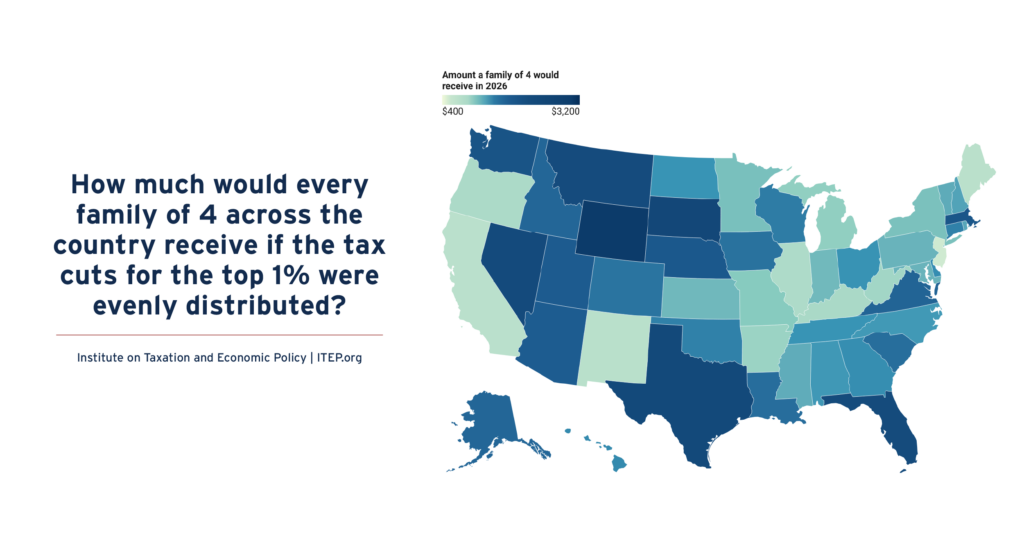
If instead of giving $117 billion to the richest 1 percent, that money had been evenly divided among all Americans, we'd each get $343 - or nearly $1,400 for a family of four.
State Rundown 7/8: State Tax Cuts Continue Despite Federal Megabill Passing
July 8, 2025 • By ITEP Staff
The last states are wrapping up legislative sessions, and some are crossing the finish line with major income tax cuts.
Analysis of Tax Provisions in the Trump Megabill as Signed into Law: National and State Level Estimates
July 7, 2025 • By Steve Wamhoff, Carl Davis, Joe Hughes, Jessica Vela

President Trump has signed into law the tax and spending “megabill” that largely favors the richest taxpayers and provides working-class Americans with relatively small tax cuts that will in many cases be more than offset by Trump's tariffs.
Megabill Takes Cap Off Unprecedented Private School Voucher Tax Credit, Potentially Raising Cost by Tens of Billions Relative to Earlier Version
July 2, 2025 • By Carl Davis

It is clear that this tax credit has the potential to come with an enormous cost if private school groups are successful in convincing their supporters to participate. In these times of very high debt and deficits, this is reason for all of us to be uneasy.
Trump Megabill Will Give $117 Billion in Tax Cuts to the Top 1% in 2026. How Much In Your State?
June 30, 2025 • By Michael Ettlinger

The predominant feature of the tax and spending bill working its way through Congress is a massive tax cut for the richest 1 percent — a $114 billion benefit to the wealthiest people in the country in 2026 alone.
How Much Do the Top 1% in Each State Get from the Trump Megabill?
June 30, 2025 • By Carl Davis

The Senate tax bill under debate right now would bring very large tax cuts to very high-income people. In total, the richest 1 percent would receive $114 billion in tax cuts next year alone. That would amount to nearly $61,000 for each of these affluent households.
Many states are reaching their end-of-June budget deadlines, and major tax policy changes look to have big implications as states are forced, per federal policy, to do more with less.
Nebraska Legislature: Poverty Elimination Action Plan
June 25, 2025 • By Aidan Davis, Neva Butkus
The COVID-19 pandemic spurred temporary expansions to existing anti-poverty programs, which had a profound impact on poverty rates…Key programs during this period included SNAP, the refundable Child Tax Credit, and increased funding for TANF. As federal pandemic relief has expired, several states have enacted state-level replacements. Read more.
State Rundown 6/20: Federal tax policy heats up, states wrap sessions and weigh impacts
June 18, 2025 • By ITEP Staff
As state legislative sessions come to a close, decisions on tax policy are being made. Several southern states have cut taxes, while the northeast is making some more measured reforms.
The ‘Big, Beautiful’ Bill Creates a $5 Billion Tax Shelter for Private School Donors
June 9, 2025 • By Amy Hanauer

On May 22, Congress passed the House reconciliation bill or “One Big Beautiful Bill Act” by a one-vote margin. The bill’s dozens of destructive tax provisions would supercharge inequality and force devastating cuts to health and food aid that have been bedrocks of the American safety net since the 1960s.
State Rundown 6/5: States Wrap Sessions, Some Prepare for Fiscal Uncertainty
June 5, 2025 • By ITEP Staff
States use the final hours of their legislative sessions to address deficits and preserve revenue in preparation for the times ahead.
Analysis of Tax Provisions in the House Reconciliation Bill: National and State Level Estimates
May 22, 2025 • By Carl Davis, Jessica Vela, Joe Hughes, Steve Wamhoff
The poorest fifth of Americans would receive 1 percent of the House reconciliation bill's net tax cuts in 2026 while the richest fifth of Americans would receive two-thirds of the tax cuts. The richest 5 percent alone would receive a little less than half of the net tax cuts that year.
State Rundown 5/21: Big and Not-So Beautiful Tax Cut Bills Abound in States
May 21, 2025 • By ITEP Staff
As a sprawling, regressive tax bill continues to take shape at the federal level, many states are moving forward with major tax cut proposals of their own.
State Rundown 5/7: As Budget Season Heats Up, Tax Proposals Are Getting Serious
May 7, 2025 • By ITEP Staff
With spring in full bloom ,many state lawmakers are reaching tax policy agreements. Out west, lawmakers in North Dakota and Texas have moved major property tax cuts. Meanwhile, in the east and south, Vermont appears likely to pass an expansion to its Child Tax Credit and Earned Income Tax Credit, and South Carolina lawmakers are aiming to make deep, drastic cuts to the state’s income tax.
America Has Left the Building: U.S. Loses from Our Global Tax Policy Choices, Others Could Gain
May 5, 2025 • By Amy Hanauer

Countries that once looked to the U.S. for direction on tax policy have concluded they need to form alliances without us. If so, it will often be to the benefit of other people around the globe and to the deficit of U.S. communities.
Want to know more about the tax and spending megabill that President Trump recently signed into law? We've got you covered.
State Rundown 5/1: State Tax Debates Wrapping Up, and Just Beginning
May 1, 2025 • By ITEP Staff
The rampant uncertainty this year extends far beyond the national economy and federal policy, as many state legislatures are declaring their tax and budget debates finished, and just getting started, sometimes in the same breath.
State Rundown 4/24: States Push Tax Cuts Despite Fiscal Uncertainty
April 24, 2025 • By ITEP Staff
While some states are preparing for uncertainty – slowing revenue growth, chaos from unpredictable tariffs, cuts to federal programs, etc. – others continue to move forward with plans for deep tax cuts. For instance, Georgia Gov. Brian Kemp signed legislation accelerating the cut to the personal income tax rate, which is currently phasing down. […]
State Rundown 4/16: No Vacation from Spring Tax Breaks as Bills Advance
April 16, 2025 • By ITEP Staff
While students and families are enjoying spring break vacations, legislative sessions are still in full swing. And some are poised for a spring tax break season as proposals advance with major implications for the sustainability of state budgets.
IRS Cooperation with ICE Will Damage Public Trust, Putting Tax Revenues in Jeopardy
April 10, 2025 • By Marco Guzman

Attempts by the Department of Homeland Security to secure private information from the IRS on people who file taxes with an Individual Taxpayer Identification Number is a violation of federal privacy laws that protect taxpayers. It is also a change that could seriously damage public trust in the IRS, which could jeopardize billions of dollars in tax payments by hardworking immigrant families.
State Rundown 4/3: Amidst Tariff Uncertainty, State Lawmakers Talk Taxes
April 3, 2025 • By ITEP Staff
While all eyes are on the Trump administration’s tariffs on foreign imports, state lawmakers are moving forward with a mix of deep, regressive tax cuts and progressive revenue raisers.

Institute on Taxation
and Economic Policy
ITEP is a non-profit, non-partisan tax policy organization. We conduct rigorous analyses of tax and economic proposals and provide data-driven recommendations to shape equitable and sustainable tax systems.
Subscribe to ITEP Emails
Tax research and policy news in your inbox.
Promote Fair Tax Policy
Your gift to ITEP promotes tax justice. With your help, we do research that supports taxing millionaires and billionaires, taxing big corporations and raising revenue for the things our people, our communities and our planet need.
Together, we can create a country with more economic justice, more racial justice, more climate justice… and more tax justice.