Budgeting decisions involve tradeoffs, and the public deserves to know how tax-cutting efforts will ultimately affect their quality of life. In recent years, lawmakers have been quick to push for phased-in tax cuts or cuts attached to trigger mechanisms.
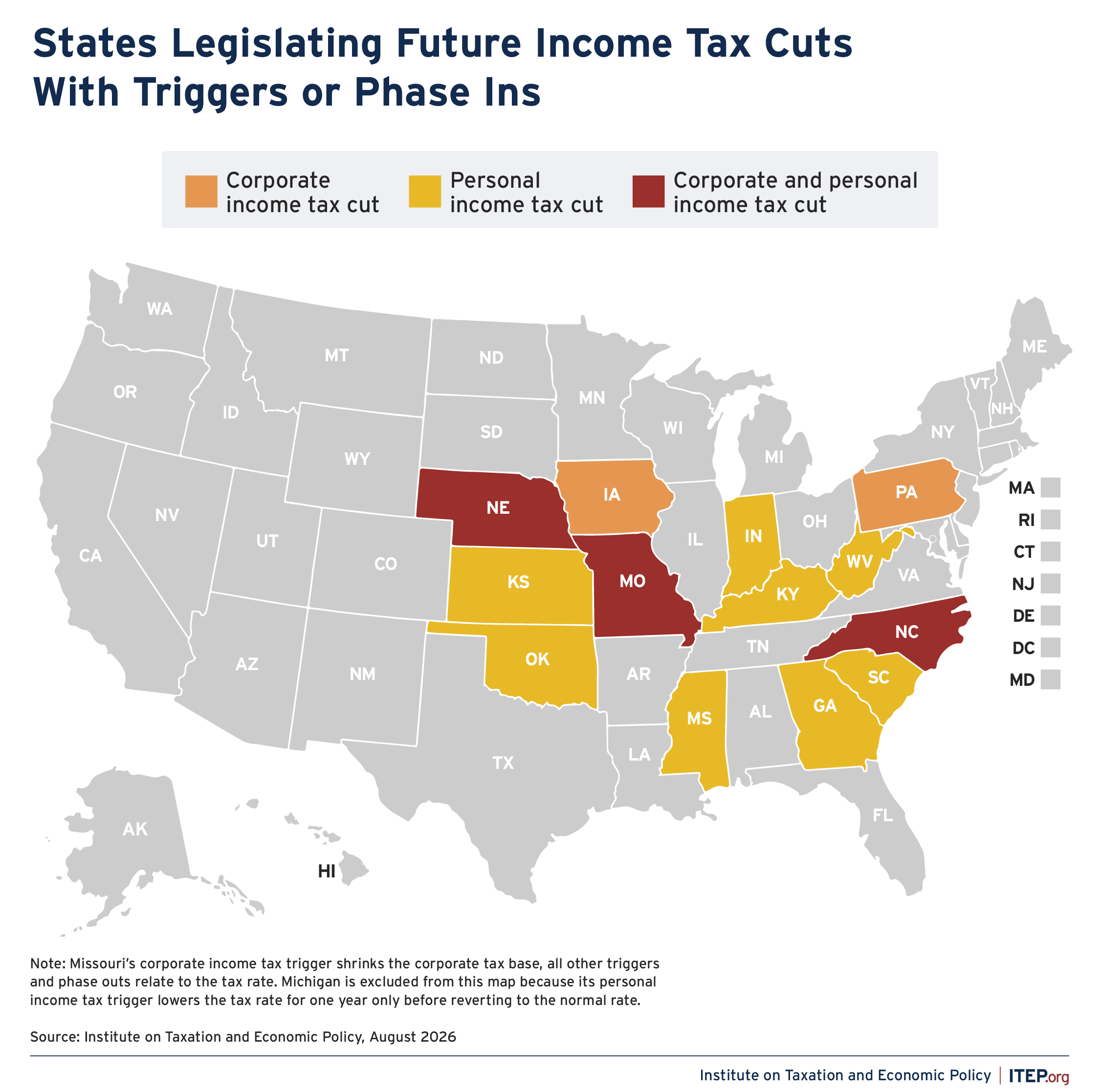
Last year, for example, Oklahoma started on a path to eliminate its personal income tax, whittling the tax rate down each year specific conditions are met until the rate drops to zero. As of August 2026, 13 states have active provisions on the books that will lower their personal or corporate income tax rates through an automatic phase-in or a trigger mechanism, and six of these states, Kentucky, Mississippi, North Carolina, Oklahoma, South Carolina, and West Virginia, have legislated complete elimination of their personal or corporate income tax through these mechanisms. These policy tools push the implementation of tax cuts outside of the current budget window with a predetermined phase-in schedule or a mathematical formula tied to state revenue trends.
Figure 1
These approaches are often touted as fiscally responsible given that they structure tax cuts to go into place over multiple years, or in some cases decades. However, this framing around responsibility is questionable, at best. By putting off the real impact of tax cuts, lawmakers limit their real-time decision-making power by locking in cuts before all the facts are known, while in many cases depicting tax cuts as costless without any downsides. The reality is that tax cuts reduce revenue for public investments that benefit us all – like education, healthcare, and our infrastructure networks. Further, time and time again, lawmakers are quick to flip the script on their stated goals of fiscal responsibility by speeding up scheduled or triggered tax cuts as we’ve seen in states like North Carolina and West Virginia.