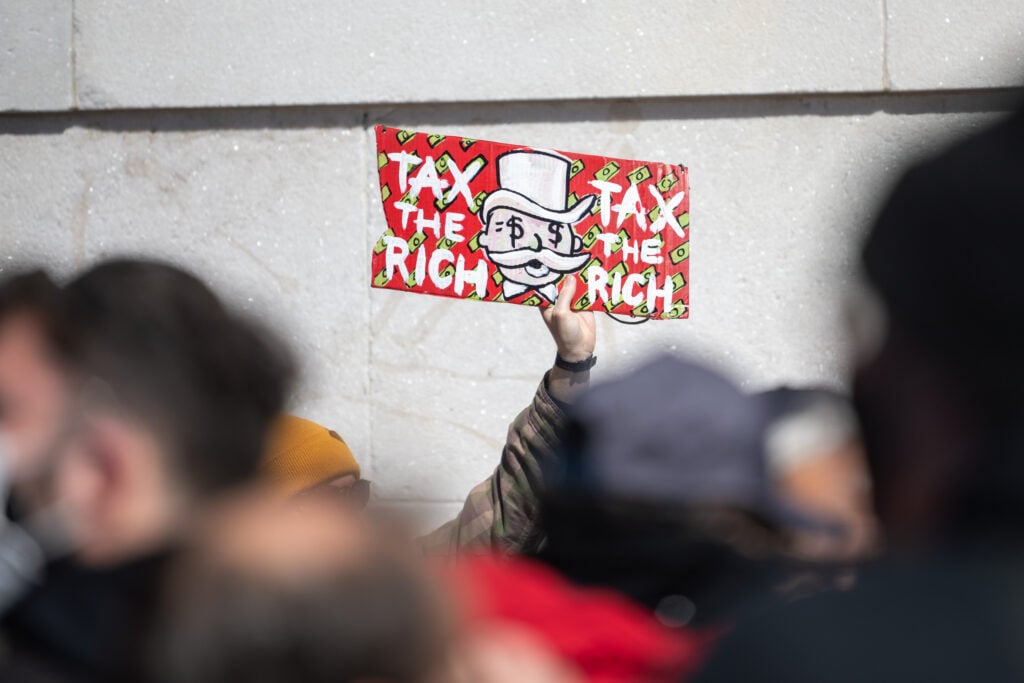
As more states move to raise revenue and tax the rich, anti-tax lobbyists and lawmakers are hard at work to undo that progress. In the latest iteration: Montana lawmakers sued over the state’s second-home tax, which raised property taxes on vacation homes and short-term rentals while using that revenue to lower property taxes for Montana residents. And in Washington, voters will soon determine whether to maintain their newly passed tax on millionaires and whether to prohibit future income taxes.
Despite pushback, important conversations around needed revenue continue. Just last week, the D.C. Council discussed how a Wealth Proceeds Tax, second home taxes, and other taxes on high earners could help sustain revenue for public services. And as we head into November, Coloradans and Californians are weighing in on measures that would ask more of the wealthy and profitable corporations to fund healthcare, education, and childcare costs.
Major State Tax Proposals and Developments
- The Council of the DISTRICT OF COLUMBIA held a hearing on potential new taxes to maintain funding for city services as it faces a weakening revenue forecast amid federal job losses. The testimony of ITEP’s Nick Johnson is available here. Proposals up for discussion included a Wealth Proceeds Tax, business activity tax, a pied-à-terre tax on second homes valued at more than $2.5 million, an increase on income taxes on wealthier residents, an increase to the sales tax rate, an increase to property taxes, and splitting the property tax to tax land separately from improvements on the land. – MILES TRINIDAD
- President of the PUERTO RICO Senate Thomas Rivera Schatz proposed a measure changing the state’s tax breaks for physicians. His measure would increase the tax rate on physician’s qualified income from 4 to 12 percent (compared to a typical top rate of 33 percent) and limit eligibility. – ELI BYERLY-DUKE
State Roundup
- New reporting on CALIFORNIA’s Prop 40 explains how the measure seeks to address a real shortcoming in current tax codes, while moving the needle on inequality. The measure is estimated to raise $103 billion in new revenue to make up for federal cuts to healthcare and food assistance. Many other important tax measures will also appear on the ballot.
- A judge ruled this week that COLORADO Amendment 87, to raise taxes on the state’s wealthiest by replacing the state’s flat individual and corporate income tax rates with graduated structures, may remain on the ballot when a lawsuit seeking to invalidate the gathered signatures was tossed out. If passed, the measure is estimated to raise $2 billion a year.
- COLORADO’s Family Affordability Tax Credit, which acts as a supplement to the state’s Child Tax Credit, lifted 22,500 children out of poverty in 2024, according to a new report. Unfortunately, the credit, as currently designed, only goes into effect only in good budget years, dependent on a formula.
- Also in COLORADO: the Supreme Court will hear a case about Breckenridge’s fee on short-term rentals. Opponents of the fee argue the referendum runs afoul of the state’s Taxpayer Bill of Rights (TABOR), though two lower courts have dismissed the case
- Local governments in FLORIDA continue to raise concerns about how Amendment 3 would impact their budgets. Commissioners in Lee County said the ballot measure would reduce revenue by 20 percent and would likely result in increasing the property tax rate to make up the difference, potentially by 40 percent. Other county leaders are raising alarms about the potential need to cut important services, delay infrastructure projects, and raise fees to make up the difference.
- A new report from INDIANA’s Office of Fiscal and Management Analysis showed tax abatements for large corporations and data centers did little to incentivize their growth in the state.
- After repeated tax cuts without replacement funding, IOWA’s updated forecast again warns of billion-dollar deficits. Meanwhile Amendment 1, the coming ballot initiative to require legislative supermajorities for any future personal income tax increases, could exacerbate these fiscal challenges. If and when the state runs out of cash and needs to raise revenue, the ballot measure may push the state towards regressive sales tax hikes instead of income tax increases that ask more of those with the most ability to pay.
- LOUISIANA voters will consider multiple constitutional amendments on property taxes in November. The amendments under consideration would give additional property tax cuts to veterans and their spouses, seniors, blighted properties, and would provide local governments authority to change assessment cycles.
- All three MAINE gubernatorial candidates are promising property tax cuts ahead of the upcoming election. However, questions remain as to how the proposals would be funded and how households would be impacted. Republican candidate Bobby Charles recently unveiled a plan to increase the homestead exemption from $25,000 to $100,000 over the next few years. Democratic candidate Hannah Pingree proposed doubling the homestead exemption. And independent candidate Rick Bennett proposed increasing the homestead exemption for homeowners aged 65 and older to half the median home value in the state.
- The MASSACHUSETTS legislature has rejected a proposal by the governor to freeze the state’s gas tax. many lawmakers are discussing gas tax holidays to mitigate the pain drivers are feeling at the pump, these holidays are largely symbolic and, in practice, will put money in the pocket of the oil industry, give little to people struggling with rising prices, and reduce funding for infrastructure projects that directly benefit drivers.
- MICHIGAN Gov. Gretchen Whitmer declared a statewide energy emergency and suspended taxes on diesel for farm and forestry vehicles. The declaration is set to last until the end of the year.
- Several MONTANA state senators have sued over the state’s tax on second homes, arguing that the measure is unconstitutional under the state’s uniformity clause. Gov. Greg Gianforte’s office is defending the measure in court and the change overall.
- NEBRASKA lawmakers will soon have additional information from two sources that will have significant influence on the 2027 legislative session: the state’s School Financing Review Commission has completed a draft report containing 18 school funding recommendations that will be finalized by the end of the month, and the state’s (recently politicized) revenue forecasting board will convene for the final time this year on October 30.
- NEVADA’s economic and revenue forecasting body met recently and are preliminarily projecting an increase of about $1 billion or more for the state’s upcoming two-year budget cycle compared to the current budget. Some reasons flagged for the revenue growth are inflation and higher insurance premiums.
- NEW MEXICO gubernatorial candidate Gregg Hull proposed eliminating the state’s income tax. His plan would seek to replace the revenue with proceeds from the state’s sovereign wealth fund.
- PENNSYLVANIA lawmakers failed to reach a deal to legalize skill game machines, which is estimated to cost the state hundreds of millions of dollars in potential tax revenue, after a court ruling took effect on October 14. Gov. Josh Shapiro originally proposed a 52 percent levy on gross revenue, which was estimated to raise about $2 billion annually. s, which resemble slot machines but feature elements of memory and player participation, have proliferated across the state over the last decade after operating in a legal grey area until the state’s Supreme Court ruled earlier this year that the machines in small businesses and private clubs were unlicensed slot machines and illegal.
- As WASHINGTON state voters prepare to head to the polls to decide the fate of the state’s millionaires’ tax, news outlets are providing resources in the form of a thorough voter guide, an exploration of the arguments made by both sides, and a moderated debate between prominent proponents and opponents.
- WYOMING Gov. Mark Gordon is campaigning against Proposition 1, which would exempt a large portion of homes from the state’s property tax. Gordon insists the change would be too expensive for local governments to continue providing existing local services, and that targeted cuts would be better.
What We’re Reading
- Policy Matters Ohio warns that a bill to eliminate state and local taxes on capital gains would primarily benefit high-income households while draining over $600 million a year from the state budget.
- The DC Fiscal Policy Institute examines how a Wealth Proceeds Tax could raise nearly $200 million from the District’s wealthiest households to help solve its growing budget crisis.
- Politico explores the emerging property tax revolt and how the movement has transcended the usual partisan talking points around taxes.
- The Institute for the Public Good published a report detailing how progressive local income, local corporate taxes on the largest companies, and reforms to the electricity tax can improve Chicago’s fiscal condition while also making taxes more progressive at the local level.
- The Center on Budget and Policy Priorities’ new report examines upcoming state ballot measures that would reduce state lawmakers’ ability to raise revenue, reduce local government taxing autonomy, and limit voters’ ability to directly enact policies through citizen initiatives.
If you like what you are seeing in the Rundown (or even if you don’t) please send any feedback or tips for future posts to Aidan Davis at aidan@itep.org. Click here to sign up to receive the Rundown via email.