
Child Tax Credit
State Rundown 10/22: Despite Obstacles, Progressive Taxes Define 2026
• By ITEP Staff
As more states move to raise revenue and tax the rich, anti-tax lobbyists and lawmakers are hard at work to undo that progress. Despite pushback, important conversations around needed revenue continue.

New Census Data Show Importance of Refundable Tax Credits and Need for Improvements
• By Joe Hughes
The Child Tax Credit actually moved fewer children out of poverty in 2025 than it did in 2024 prior to Congress passing the so-called "One Big Beautiful Bill Act" (OBBBA).

State Child Tax Credits Will Boost Financial Security for Families and Children in 2027
• By Neva Butkus
Sixteen states provide Child Tax Credits to reduce poverty, boost economic security, and invest in children. State lawmakers have several options to maximize the impact of Child Tax Credits.

State Action on Child Tax Credits and Earned Income Tax Credits Since 2021
• By Neva Butkus
Since 2021, there has been a flurry of new and expanded state Child Tax Credits and Earned Income Tax Credits. This continued momentum speaks to the power and popularity of these credits and the need to boost the financial security of families and children across the country.

The Impact of Proposed New Tax Credit Restrictions for Immigrant Filers: An Updated Analysis of the DACA Recipient Population
• By Carl Davis, Erika Frankel, Emma Sifre
New Treasury Department public regulations would drastically reduce tax credit claims by DACA recipients and their families, among others. We find that 158,000 people in households with at least one DACA recipient will suffer financial harm, and that more than half of the impacted individuals are U.S. citizens.

Child Tax Credits and Child and Dependent Care Credits: What’s the Difference?
• By Maddie Brown Shirley
Three popular state tax credits support families with children: the Child Tax Credit (CTC, or child credit), the Child and Dependent Care Tax Credit (CDCTC, or dependent care credit), and the Earned Income Credit (EITC). While the EITC is intended to boost wages for low- and moderate-income workers and families, the CTC and CDCTC are […]
Ineffective Sales Tax Holidays Miss the Mark
• By Miles Trinidad
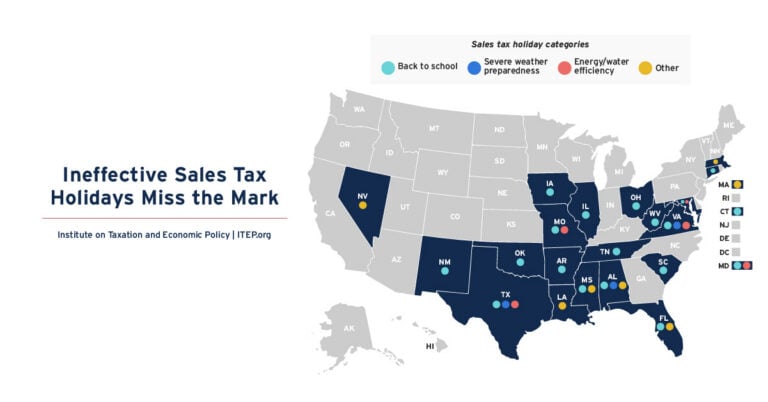
Twenty states have sales tax holidays in 2026. These sales tax holidays will cost states and localities nearly $600 million in lost revenue this year, and they're poorly targeted and too temporary to meaningfully change the regressive nature of a state’s tax system.

2026 Sessions in Review: States Fund Tax Credits by Preserving, Raising Revenue
• By Aidan Davis
In a year of cautious uncertainty around current and ongoing revenues, many state lawmakers strengthened their tax credits for families and children.
State Rundown 6/25: Trending This Summer? New Revenue!
• By ITEP Staff
It's the first official week of summer, and while many of us are planning vacations, state lawmakers remain busy finalizing and debating tax proposals.
The Impact of Proposed New Tax Credit Restrictions for Immigrant Filers: An Analysis of the DACA Recipient Population
• By Carl Davis, Erika Frankel, Emma Sifre
We find that 337,000 people in households with at least one DACA recipient will suffer financial harm, and that nearly two-thirds (66 percent) of the impacted individuals are U.S. citizens.
The Impact of Proposed New Tax Credit Restrictions for Immigrant Filers: An Analysis of State EITCs
• By Neva Butkus
Immigrants and their families in as many as 30 states are at risk of seeing their state tax credits such as the Earned Income Tax Credit (EITC) and Child Tax Credit (CTC) reduced unless state lawmakers act.

Rhode Island Budget Bets on Tax Fairness with Millionaires’ Tax and New Child Tax Credit
• By Miles Trinidad
The spending plan, signed into law by Gov. Dan McKee today, features a new millionaires’ tax, the state’s first permanent child tax credit, expanded eligibility for its Social Security exemption , and strategic decoupling from federal business tax provisions.
State Rundown 6/4: Fiscal Flowers and Weeds Bloom in June
• By ITEP Staff
A veritable superbloom of tax and budget policies occurred over these last few weeks, including both flowers worth admiring and weeds worth fighting back.

While States Debate New Trump Tax Changes, Equity Must Be at the Core
• By Brakeyshia Samms
States continue to debate whether and how to link their state tax codes to the 2025 federal tax law. This is not just a technical debate.
State Rundown 4/1: No Fooling Around Anymore in Washington, But Cruel Pranks in South Carolina
• By ITEP Staff
In Washington, Gov. Bob Ferguson and lawmakers decided to stop fooling around with one of the nation’s most upside-down tax codes and finally brought to life a new millionaires’ tax, the first new income tax created in a state since 1991.
State Rundown 3/18: New Mexico Enacts Most Significant Corporate Tax Reform of the Year
• By ITEP Staff
As states lawmakers continue to weigh their linkages to the federal tax code in light of the recent federal tax law, New Mexico provides a blueprint for limiting multinational corporate tax avoidance.

Analysis of Sen. Chris Van Hollen’s Approach to Tax Policy
• By Steve Wamhoff
Sen. Chris Van Hollen has recently introduced the Working Americans’ Tax Cut Act, which offers a generous middle-class tax cut paid for with a new tax on millionaires.

Washington Millionaires’ Tax, Expanded Working Families Tax Credit Make Tax Code Fairer
• By Marco Guzman, Dylan Grundman O'Neill
The Washington legislature has approved a new "millionaires' tax," a 9.9 percent tax on income over $1 million. The bill, which makes significant investments in public education and child care, will also expand the Working Families Tax Credit – the state’s EITC – to reach an additional 460,000 households.

The Child Tax Credit Leaves Out Millions of Children in 2026. There Are Better Alternatives.
• By Joe Hughes
The 2025 Trump tax law slightly increased the Child Tax Credit in a way that benefits virtually none of the children who most need help.
State Rundown 2/11: This Valentine’s Day, Conscious Decoupling Is Our Love Language
• By ITEP Staff
While some may be excited for a romantic Valentine’s Day this weekend, many state lawmakers are breaking up and decoupling from recent federal tax changes that are poised to leave states with revenue shortfalls – much like a bad date who forgets their wallet and asks you to pick up the tab.

What Did 2025 State Tax Changes Mean for Racial and Economic Equity?
• By Brakeyshia Samms
The results are a mixed bag, with some states enacting promising policies that will improve tax equity and others going in the opposite direction.

D.C.’s Fiscal Autonomy is at Stake, District’s Conformity Decisions Should Stand
• By Kamolika Das
Federal lawmakers passed a bill along party lines that would force the District of Columbia to override the decision of local elected officials and implement all of the costly and inequitable federal tax cuts passed under the “One Big Beautiful Bill Act” (OBBBA).
State Rundown 2/5: Icy Roads Do Not Slow Tax Policy Debates
• By ITEP Staff
Despite wintry conditions across much of the country, that hasn’t stopped state lawmakers from debating major tax policy changes.
State Rundown 1/22: Cautious Tone Noticeable in Most Statehouses
• By ITEP Staff
Most states are adopting a very cautious approach so far this year as legislators begin their sessions and governors make their annual addresses, thanks to ongoing economic uncertainty and federal retrenchment.
State Rundown 1/14: New Year Brings New Resolutions for Funding Key Priorities
• By ITEP Staff
State governors are beginning to lay out their top priorities as legislatures reconvene in statehouses around the country.

Institute on Taxation
and Economic Policy
ITEP is a non-profit, non-partisan tax policy organization. We conduct rigorous analyses of tax and economic proposals and provide data-driven recommendations to shape equitable and sustainable tax systems.
Subscribe to ITEP Emails
Tax research and policy news in your inbox.
Promote Fair Tax Policy
Your gift to ITEP promotes tax justice. With your help, we do research that supports taxing millionaires and billionaires, taxing big corporations and raising revenue for the things our people, our communities and our planet need.
Together, we can create a country with more economic justice, more racial justice, more climate justice… and more tax justice.