Key Findings
- New estimates show that the federal Section 1202 capital gains exclusion, also misleadingly named the Qualified Small Business Stock (QSBS) exclusion, will cause 33 states plus the District of Columbia to lose $4.1 billion in tax revenue over the next five years. This number grows to $4.4 billion if you include the losses borne by local governments.
- The tax break provides up to a 100 percent capital gains exclusion and does very little to help small businesses. Nationally, 94 percent of the exclusion goes to households with annual income over $1 million.
- The 2025 law expanded this tax subsidy, burdening states that remain coupled to it with mounting costs as they also struggle to fill the gaps left by that same bill’s cuts to federal funding of healthcare and food assistance.
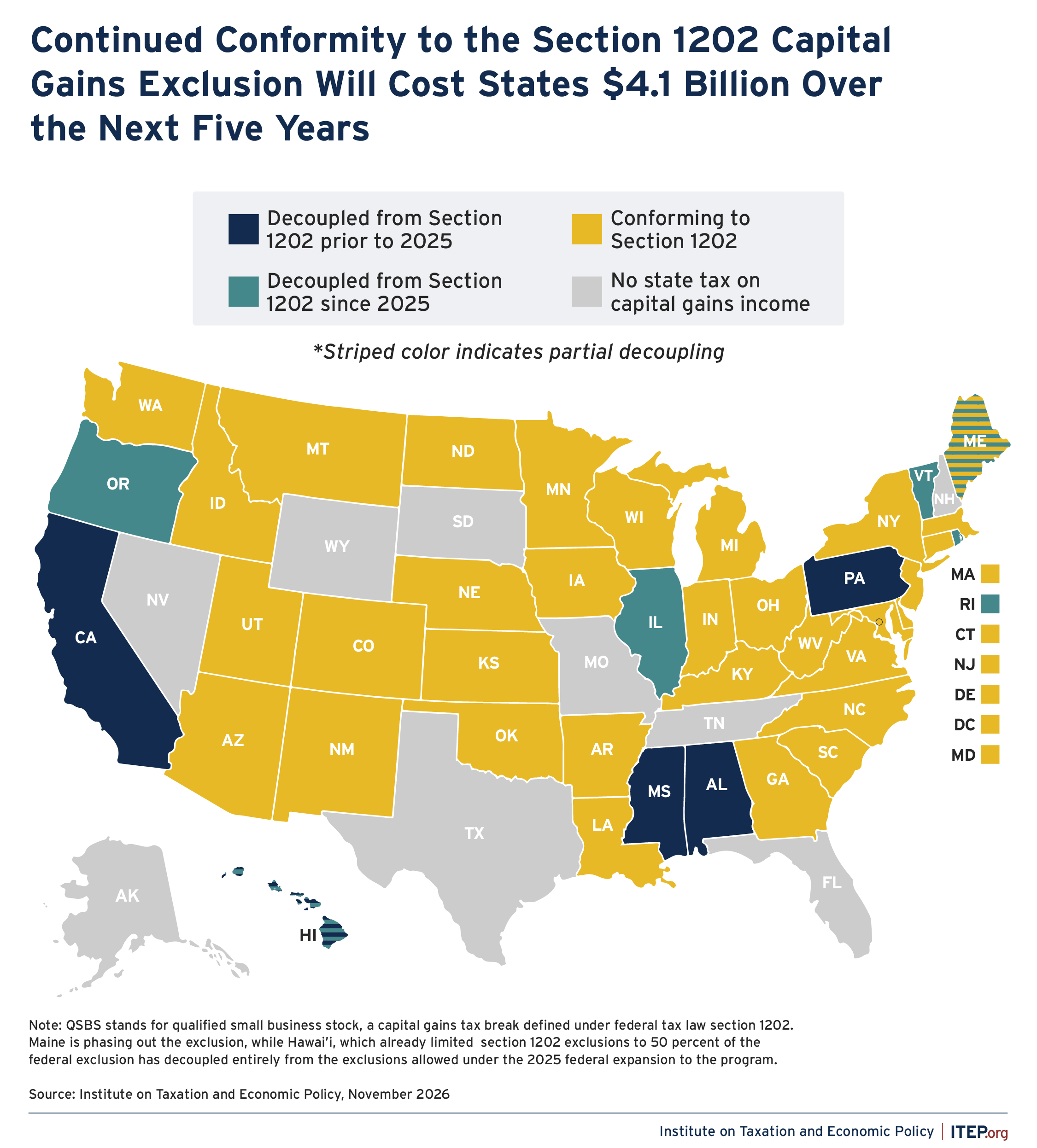
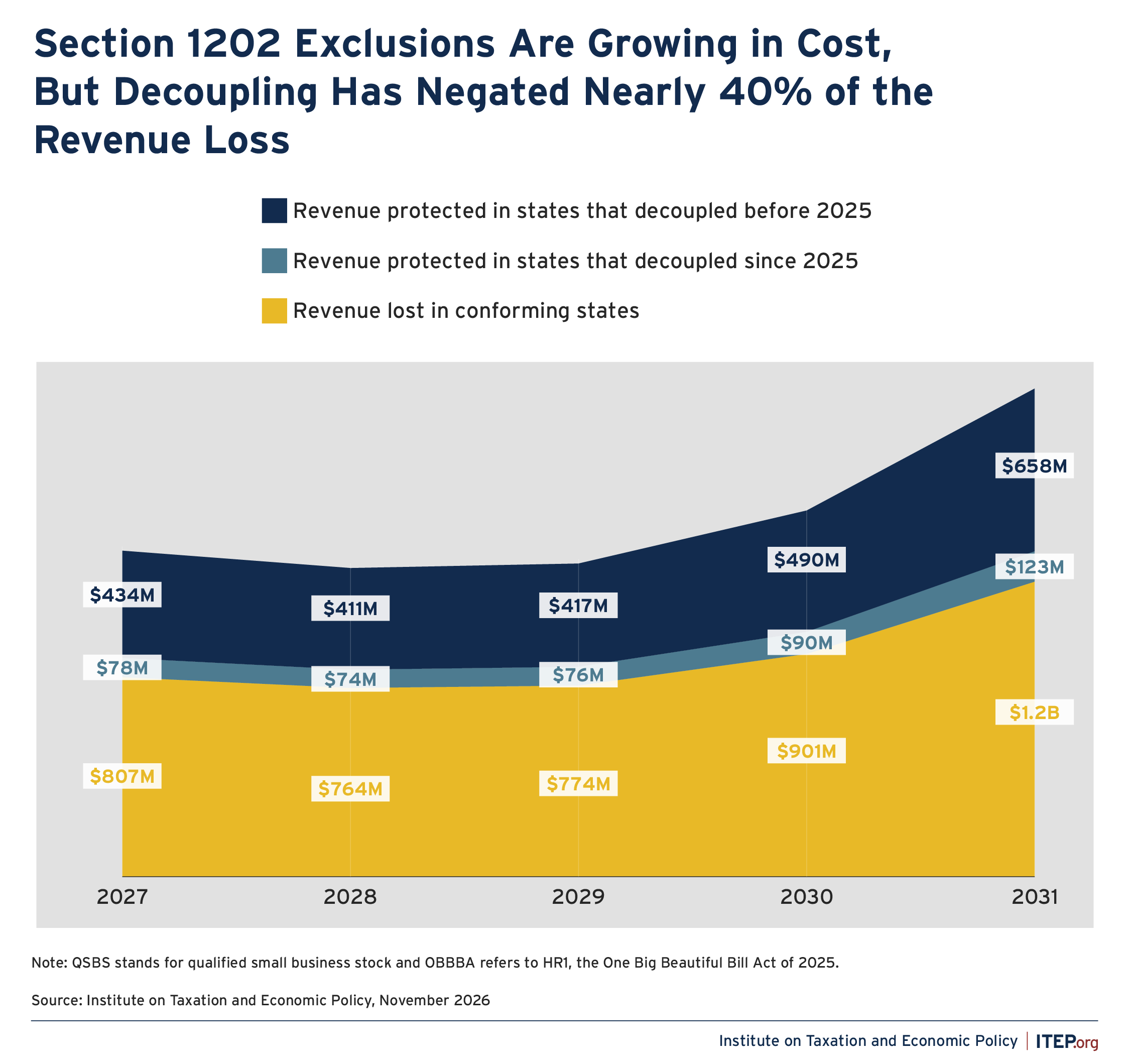
- The number of states fully or partly disallowing this tax subsidy doubled in the last year as Illinois, Maine, Oregon, Rhode Island, and Vermont chose to fully or partially decouple in the wake of the new federal law. Hawai’i, which already partly disallowed the exclusion, also decoupled from the newest federal changes, while D.C. decoupled temporarily for part of 2025 before restoring the exclusion. Altogether, 10 states disallowing or limiting QSBS exclusions are slated to protect $2.8 billion in public revenue over the next five years because of the disallowance.
- States can opt out of this tax break with a simple change to their tax laws, thereby preserving revenue for public services.
Summary
Thirty-three states plus the District of Columbia will soon be losing $1.2 billion in annual state and local tax revenue that otherwise could be helping pay for education, healthcare, and other services, thanks to a tax break mostly benefiting multimillionaire and billionaire venture capitalists. Tax experts across the political spectrum have derided this tax break as wasteful and regressive.
Fortunately, any state can erase or limit this tax break with a simple statutory change, as five states have done in the last year. In so doing, these states and five others that were already fully or partially disregarding this provision have kept resources in-state and are protecting $2.8 billion in revenues over the next five years.
The culprit is an arcane provision of the federal income tax code, Section 1202, that has existed for decades but is now exploding in cost. This provision allows wealthy venture capitalists and others to receive a 100 percent tax exemption when they cash out their early-stage investments in corporations that have soared in value. Lawmakers named the provision the Qualified Small Business Stock (QSBS) exclusion, but the law doesn’t limit investments to small businesses by any conventional measure.
The explosion in lost tax revenue due to Section 1202 is occurring because tax lawyers have found creative ways to exploit it, because Congress has now expanded it, and because tax-favored capital gains are making very wealthy people even wealthier at a growing rate. Individual QSBS claims reached over $42 billion in 2021 alone, an amount exceeding 2.5 percent of all individual capital gains realizations that year, according to U.S. Treasury Department research. Trusts and estates claimed another $9 billion in QSBS exclusions. The same research found that nearly 94 percent of Section 1202 exclusions are claimed by people with more than $1 million in annual non-QSBS or QSBS income.
Despite this provision’s increasing cost and regressive tilt, the 2025 federal tax law loosened the rules to allow even more wealthy investors to qualify for it, further increasing the cost. According to our estimates, this expansion is the main force behind an expected 48 percent increase in the cost of the exclusion to states by 2031.
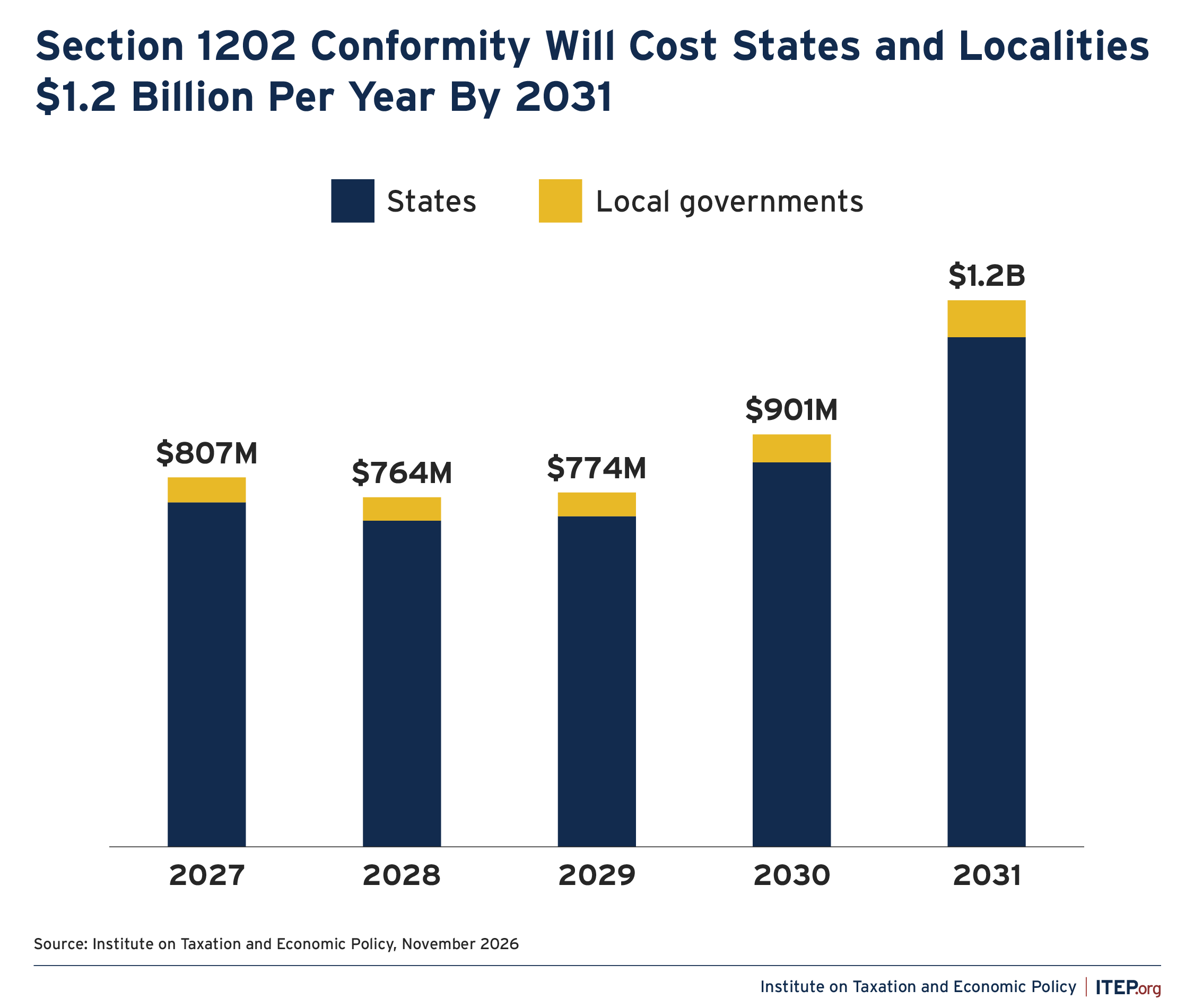
If states fail to act, this tax break for wealthy investors will cost them a combined $750 million in 2027, rising to $1.1 billion in 2031. Until 2026, only a few states — most notably, California, home to many of the nation’s wealthiest venture capitalists, as well as Alabama, Mississippi, and Pennsylvania — disallowed the Section 1202 exclusion.
But with its cost rising so rapidly and state budgets already under pressure due to federal cuts, four more states joined that list in 2026: Illinois, Oregon, Rhode Island, and Vermont. Maine also acted to begin phasing out the exclusion, while Hawai’i, which already limited QSBS exclusions to 50 percent of the federal exclusion chose to decouple entirely from newly eligible QSBS exclusions allowed under the 2025 federal expansion to the program.
Eliminating the exclusion is a simple statutory change that, as California’s example shows, will not have a discernable impact on small businesses or capital investment in the state but will preserve funding for schools, hospitals, and other important public services.
Figure 1
The rapidly growing cost and regressivity of Section 1202
The federal Section 1202 exclusion was enacted in the 1990s and given the QSBS moniker with the stated intent of sparking investment in emerging companies, especially in the then-fledgling tech industry. It was initially much narrower and was largely ignored until the early 2010s, when a series of federal changes made it much more lucrative and law firms pioneered new strategies to exploit it for their wealthy clients. Because the exclusion required a five-year holding period, it then took several years for these changes to start affecting federal tax revenue.
In 2012, federal QSBS realizations amounted to only about one-quarter of 1 percent of capital gains realized that year. By the early 2020s, that proportion had grown to 2.6 percent of all realized capital gains — a 10-fold increase. News reports and emerging research suggest that it has been particularly lucrative for investors who have accumulated wealth in technology companies, particularly venture capitalists putting money into business expansions.
This cost explosion was documented in a January 2025 study by a team of U.S. Treasury economists. They reviewed tax returns from 2012 through 2022 and discovered that the subsidy was ballooning in cost and that its benefits were highly concentrated among very well-off investors.
Figure 2
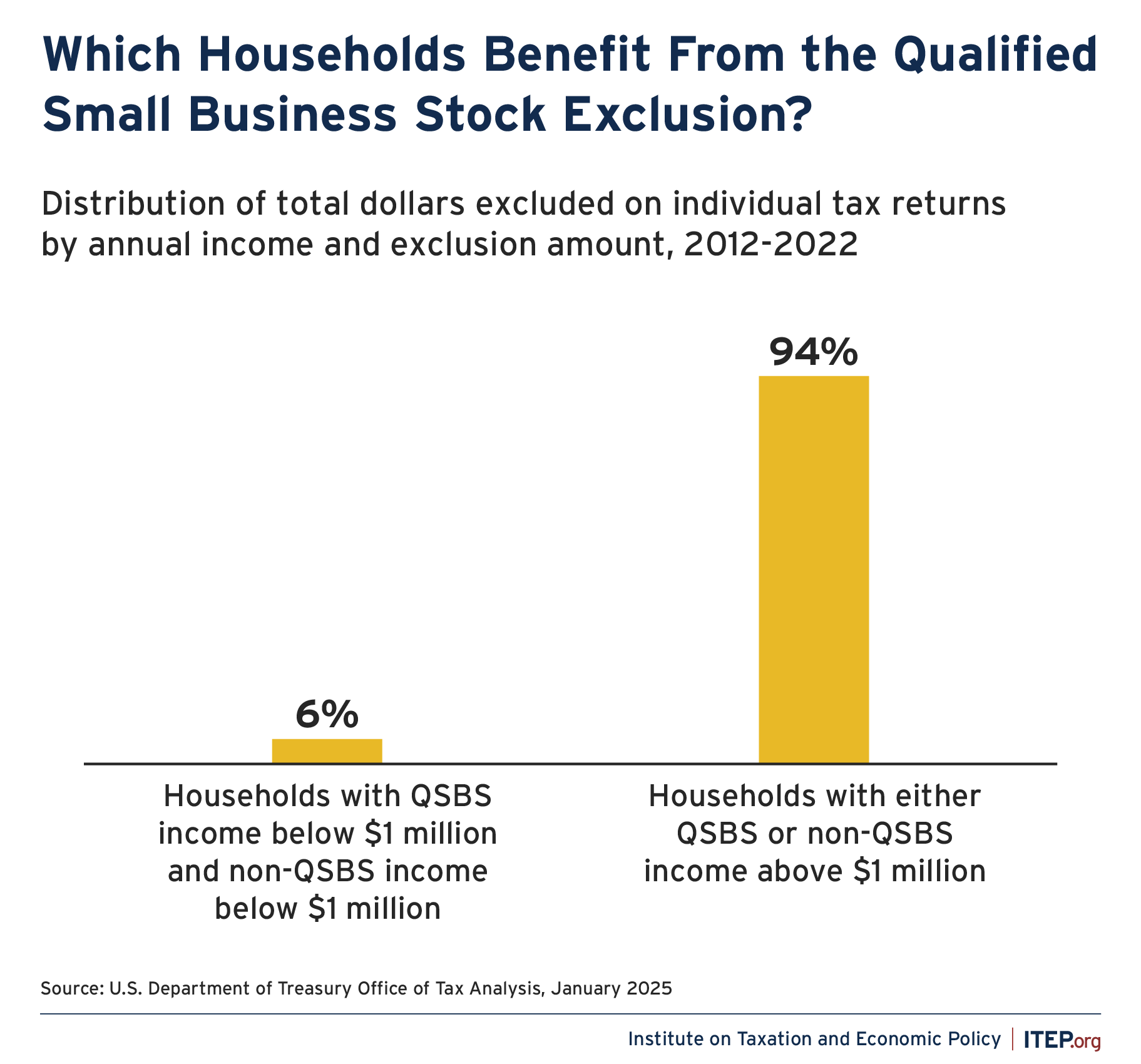
They found that 90 percent of QSBS exclusions were for capital gains exceeding $1 million. Another 4 percent of exclusions were less than $1 million but were claimed by households with annual income from other sources of $1 million or more. Taken together, these findings mean that 94 percent of Section 1202 exclusions were claimed by households whose total annual income — from QSBS and from other sources — exceeded $1 million. Very few U.S. households, fewer than 0.5 percent of all tax filers, have incomes at this level. These data make clear that the QSBS tax carveout is even more concentrated among the very wealthy than capital gains realizations more generally.
Congress loosened the Section 1202 rules further in the tax and spending legislation — the so-called “One Big Beautiful Bill Act” (OBBBA) — that President Trump signed into law in July 2025. OBBBA increased the amount of QSBS capital gain on an investment that each investor can shield from tax, shortened the time investors must hold onto the stock before selling, and increased the asset size of eligible corporations, meaning that even larger investments and larger corporations can now participate — and can do so more quickly.
The Joint Committee on Taxation estimated the expansion of Section 1202 will cost the federal government $3.5 billion in 2031 and $4.5 billion in 2034. These figures imply expansions of QSBS exclusions equal to 1 percent of capital gains in 2031 and 1.2 percent of capital gains in 2034, respectively. This will bring the total amount of excluded gains under the program to 2.8 percent of capital gains in 2031 and 3 percent by 2034, a roughly 12-fold increase since the early 2010s.
Section 1202 is a Policy Designed to Further Enrich the Wealthy
QSBS exclusions are skewed to the wealthy in part because beneficiaries must meet a slate of requirements that most ordinary small business owners and people investing for retirement will never meet. There are stipulations around which businesses an individual can invest in under the program, what stocks from a qualifying business are eligible for the benefit, and how much an individual can claim. Wealthy investors have built these criteria into their strategic planning so that when they win big on a successful investment, they don’t have to pay a cent of income tax on it.
Under Section 1202, an investor selling qualified stock is allowed to pay zero taxes on investment returns up to 10 times their initial investment or up to $15 million dollars, whichever is greater, for each eligible business they invest in. Prior to OBBBA’s passage, the dollar limit was $10 million. The qualifying stocks can be spread among family members if an investor is worried about bumping against their limit, creating an option known as “stacking” for bequeathing tens or hundreds of millions of dollars tax-free during a wealthy person’s lifetime.
Wealthy investors and their lawyers have so exploited Section 1202 for tax savings that the Trump administration’s top tax official in May 2026 threatened to issue new regulations to address “stacking,” but none have yet emerged. In any event, any new rules will only curtail the most extreme abuses, not fix what is fundamentally a flawed program.
There are other provisions of the law that limit its use, but the new federal law loosened some of them. For an investment gain to qualify for Section 1202, the investor must have held the investment for five or more years to pay no taxes, four years to pay taxes on only 25 percent of the gains, and three years to pay taxes on only 50 percent of the gains. Before mid-2025, there was no tax break available unless the investment was held at least five years.
The stock must be an original issuance from the company, but stock sold through intermediaries and exchanges are ineligible. For example, a startup founder may pay themselves in company stock as they are building the business, or investors putting up capital for a startup or business expansion can do so in exchange for qualifying stocks, and both would be able to take advantage of the QSBS tax exclusion. By contrast, a person investing their IRA in a small capital fund that prioritizes small, high-growth companies would not benefit from QSBS because the stock is not issued directly by the company.
To issue qualifying stock, businesses must be C corporations, have gross assets under $75 million at all times leading up to issuing the stock (the asset limit was $50 million until last year), and not fall into a number of industries that are barred from the benefit (see box below).
These rules exclude most small businesses. Most small businesses organize themselves as Limited Liability Companies or similar pass-through entities, not as C Corporations. By contrast, companies organize themselves as C corporations only if they are trying to attract venture capital investments and/or eventually become publicly held. Nor is a business with $75 million in assets “small” under any standard definition.
C corporation status has been in decline as more businesses have chosen to structure themselves as LLCs and S corporations; fewer than 5 percent of businesses now incorporate with this status. The vast majority of small businesses do not choose a C corporation structure, meaning most small business owners will not benefit from this tax break, and the additional restrictions on industry further restrict the universe of eligible business owners.
What Types of Investments Are Ineligible for QSBS Exclusion?
Investments in some businesses are ineligible for the QSBS exclusion. Ineligible investments, according to the Internal Revenue Code, include:
(A) any trade or business involving the performance of services in the fields of health, law, engineering, architecture, accounting, actuarial science, performing arts, consulting, athletics, financial services, brokerage services, or any trade or business where the principal asset of such trade or business is the reputation or skill of 1 or more of its employees
(B) any banking, insurance, financing, leasing, investing, or similar business
(C) any farming business (including the business of raising or harvesting trees)
(D) any business involving the production or extraction of products of a character with respect to which a deduction is allowable under [IRC] section 613 or 613A [involving oil and gas extraction]
(E) any business of operating a hotel, motel, restaurant, or similar business
States Overlooked Section 1202 for Many Years, But the Stakes are Now Too High to Ignore
Thirty-three states plus the District of Columbia are set to lose revenue over the next several years because they conform to Section 1202. They include:
- 30 states plus the District of Columbia that tax most capital gains realizations through their income taxes but allow the full QSBS exclusion
- Hawai’i, which allows a 50 percent 1202 exclusion for QSBS but limits eligible exclusions to those investments that would have been allowed under the pre-OBBBA program
- Maine, which is phasing its program out and disallows exclusion of any QSBS stock issued after passage of OBBBA
- Washington, which levies a capital gains excise tax that excludes QSBS gains
On the other hand, as of 2026, eight states — up from just four states a year ago — have income taxes but do not allow the QSBS exclusion at all. The remaining nine states have no income tax or (in the case of Missouri) no income tax on capital gains.
We estimate that states that conform in whole or in part to QSBS exclusions will lose over $4 billion in revenues between 2027 and 2031. Over this time frame, the annual costs to states will increase by 48 percent, mostly because of the massive expansion to this program that OBBBA put in place.
Figure 3
By contrast, states that have decoupled fully or partially are saving a lot. Nationwide, these states have protected about half a billion dollars in revenue a year in the short term and will save a total of $2.8 billion across tax years 2027 through 2031. Overall, decoupling from section 1202 is now safeguarding states that tax capital gains from nearly 40 percent of the revenue loss they would have experienced if instead all states conformed to the provision.
Section 1202 is also reducing local government revenues in five of the six states where cities and/or counties tax capital gains income. Localities in Indiana, Iowa, Maryland, Michigan, and New York are losing over $50 million annually in combined revenue from QSBS conformity, most of that in New York City. In Oregon, on the other hand, state Section 1202 decoupling legislation that passes through to local income taxes is protecting around $2 million a year to help fund preschool and supportive housing.
Figure 4
The appendix to this report contains detailed tables with 50-state plus D.C. estimates of costs and savings to states and localities from QSBS conformity policy for 2027-2031 and a discussion of the methods used to arrive at those estimates.
Our estimates fill an important gap in policymakers’ understanding of their own tax systems, because many states have failed to acknowledge explicitly that they have incorporated this tax break into their own tax codes. Most states didn’t enact the QSBS tax break, but they have lost revenue nonetheless because it has reduced the measure of taxable income most states use as the starting point for their own tax calculations. Only a few states — Georgia, Massachusetts, Minnesota, New Jersey, North Carolina, Oregon, Rhode Island, and Wisconsin, plus the District of Columbia — acknowledged in their most recent tax expenditure reports that QSBS is costing them revenue. Two of those states, Oregon and Rhode Island, have since eliminated the exclusion.
QSBS is a Poor Strategy for Boosting Small Businesses or State Economies
Some states may be tempted to retain the QSBS exemption on economic development grounds, perhaps imagining that the “small business” allusion in the name is based on something reasonable. In fact, most truly small businesses cannot access the benefits of QSBS investments. That’s because QSBS is only available to C Corporations, while most small businesses — those structured as partnerships, LLCs, S corporations, or sole proprietorships — are barred from benefiting. A 2021 investigation identified investments in big corporations like Uber, Lyft, Airbnb, Zoom, Pinterest, and DoorDash as benefiting from the exemption. Investors receiving the tax break have included partners in mammoth investment firms like Andreessen Horowitz, the investigation found.
At a national level, QSBS is turning out to be an ineffective way to support investment in emerging companies. As the Washington Center for Equitable Growth wrote in a recent review:
The original intent of the QSBS exclusion was to encourage investment in small businesses that might otherwise have difficulty attracting capital. Limited research suggests that the exclusion results in a modest increase in early-stage funding but at a relatively high cost…
The dramatic expansion of the venture capital sector in recent years draws into question whether the conditions that led to the enactment of the exclusion still apply today. Some researchers argue that there is now a “glut” of venture capital available and that investable funds exceed quality investments. These critics charge that the QSBS exclusion provides a costly windfall that narrowly benefits extraordinarily wealthy investors.
Conservative tax economists are also highly critical of QSBS. The corporation-backed Tax Foundation calls it “Quite the Skewed Business Subsidy” because it favors some types of investments over others. Kyle Pomerleau of the conservative American Enterprise Institute teamed up with David Mitchell of the Washington Center for Equitable Growth to slam the policy as “particularly troubling [because it is] inefficient, complex, and unfair.”
Tax Economists Agree: Section 1202 Is Deeply Flawed
Kyle Pomerleau of the conservative American Enterprise Institute and David Mitchell of the Washington Center for Equitable Growth describe themselves as “two tax experts from opposite ends of the ideological spectrum [who] don’t often agree on economic policy,” but they agree QSBS is fatally flawed. They explain:
“Tax policy should be simple, efficient, and equitable.
A simple tax code minimizes complexity and compliance burdens. A complex tax code requires both taxpayers and tax authorities to devote limited resources to complying with and enforcing existing tax laws.
An efficient tax code seeks to raise revenue while minimizing the extent to which it unnecessarily distorts economic decision-making. Poorly structured taxes can encourage economically wasteful behavior that otherwise would not occur.
An equitable tax code seeks to treat similarly situated taxpayers the same. Reasonable people can disagree over how progressive a tax code should be — we certainly do — but taxpayers with similar levels of income should be treated similarly.
The QSBS exclusion gets failing marks in all three areas.”
Source: David S. Mitchell and Kyle Pomerleau, “Congress Should Have Eliminated, Not Expanded, the QSBS Exclusion,” Tax Notes Today Federal, October 10, 2025.
Even if QSBS were an effective strategy at the national level, it wouldn’t be so at the state level. That’s because QSBS investments don’t have to be in-state to qualify for the state tax break, and venture capital firms regularly invest across state lines. A Georgia-based venture capitalist, for example, might claim QSBS exemptions on their investments in startups in other states, reducing revenue for the Georgia state treasury while providing no economic benefit to anyone in Georgia other than themselves.
States seeking to accelerate investment in startup companies have much better tools at their disposal than QSBS. States can invest in STEM education and research universities, strengthen their transportation infrastructure, or support community loan funds. Studies consistently show that factors like talent availability, university partnerships, and infrastructure quality matter far more than tax rates for innovation-based economic development.
A Georgia-based venture capitalist, for example, might claim QSBS exemptions on their investments in startups in other states, reducing revenue for the Georgia state treasury while providing no economic benefit to anyone in Georgia other than themselves.
California provides an instructive example of an alternative path forward. California enacted rules in 2008 for Section 1202 that allowed California-based investors to claim the exclusion on their state income tax returns only for investments that created in-state jobs. A court ruled in 2012 that those rules were discriminatory under the Commerce Clause of the U.S. Constitution. So California did away with the exclusion altogether.
The state’s decision to abandon Section 1202 does not appear to have harmed Californians’ willingness to provide venture capital for startups. California remains the nation’s biggest source of venture capital dollars as well as the state with the largest number of venture-capital investments.
Although the state eliminated QSBS benefits in 2013 and taxes capital gains through its personal income tax at rates up to 13.3 percent, California companies still attract more venture capital investment than the rest of the country put together, California-based venture capital funds raise more than six times as much money as those in the next highest state (New York), and California taxpayers report more capital gains than anywhere else.
In fact, eliminating QSBS is probably helping California’s economy. We estimate that California is protecting about $400 million in annual revenue by taxing QSBS gains as regular income — an amount that will grow in future years as the latest QSBS expansion phases in. These revenues, in turn, are helping California ensure that its public-school teachers are adequately paid, its community colleges are affordable, and its research universities are strong — all key ingredients to a thriving innovation economy.
The California example should provide reassurance that a state decoupling from the federal QSBS exemption will not harm its attractiveness to venture capital.
Decoupling from Section 1202 as a Tax Fairness Strategy
Decoupling from the QSBS exclusion can be a part of a broader strategy to improve how states tax income from wealth. It is only one of the ways that states extend favorable tax treatment to capital gains. States don’t tax capital gains until they are realized, that is, until an asset is sold. And if an asset is never sold but rather bequeathed as part of an estate, it may never be taxed. The result is that ordinary wage income is taxed at a higher level than income from wealth.
To address these broader issues, some states are enacting or considering new taxes on capital gains income or investment income more broadly. Minnesota in 2023 enacted a Net Investment Income Tax (also called a Wealth Proceeds Tax), while Maryland enacted a surcharge on capital gains realizations in 2025. Other states have considered similar measures, and New York and California have clamped down on their wealthy residents avoiding taxes through sheltering income in tax haven states.
Broader taxes on investment income and other measures aimed at asking more of wealthy households, including sensible policies to prevent tax avoidance by the wealthy and corporations, are likely to raise much more revenue than repealing the QSBS exemption. In this context, QSBS decoupling should be seen as one part of a broader strategy to improve state tax treatment of income from wealth and bolster state services.
Appendix C: Methods
To estimate the revenue states could preserve by eliminating the Section 1202 exclusion, we first develop a projection of nationwide federal QSBS exclusions for 2027 and 2031, setting aside for the moment the expansions to the program enacted in the 2025 federal tax law.
We project a base for our estimates using data from the U.S. Treasury on QSBS exclusions as a percent of total net capital gains, and the Congressional Budget Office (CBO) projection of capital gains realizations. Full QSBS exclusions, equal to 100 percent of the gain, became available for the first time for shares sold in September 2015, so we use the average of 2016 to 2022 data from the Treasury, expressed as a share of net capital gains, to project exclusions for 2027 through 2031 using the CBO forecast.
Given that CBO’s projection for growth in capital gains is relatively flat for these years, so too are our Section 1202 projections. These calculations produce estimates of nationwide pre-OBBBA QSBS exclusions of $29.0 billion and $27.6 billion for 2027 and 2031, respectively.
Separately, we calculate the additional increment of qualifying realizations created by the 2025 OBBBA expansion.
To do this, we use the U.S. Joint Committee on Taxation (JCT) estimate of the increase in QSBS cost under the new law and divide it by the marginal federal capital gains rate (which CBO estimates is 21.2 percent) to compute the change in QSBS realizations.
For 2027, the JCT score shows a trivial federal revenue gain from the QSBS change equal to approximately 1 percent of the total size of the previous Section 1202 program. The cause of this gain is not apparent in the legislation, and it is unclear whether this is a direct result of changes in the expected volume of stock sales categorized as QSBS, or whether it is attributable to an indirect behavioral effect. Given this uncertainty, its distribution across states is highly speculative and potentially subject to variation in direction. We therefore do not include this minor effect in our estimates. Revenue effects from the expanded portion of the program begin to accumulate in 2029 and swell the cost of the program by 59 percent in 2031, relative to its cost if OBBBA’s Section 1202 expansion had not been enacted.
Then we construct a calculation for state and local income tax revenues from decoupling from QSBS.
To estimate the net change in state and local revenues from decoupling from Section 1202, we use an equation preferred by the Congressional Research Service (CRS) as described in its detailed review of empirical studies of investor responses to changes in capital gains taxes. The equation is used to estimate revenue impacts of changes to capital gains tax rates, accounting for behavioral responses and current combined federal, state, and local marginal capital gains tax rates on QSBS realizations in each state. We use a realization coefficient of 2.28, which is the midpoint of the coefficients found in CRS’s review of the economic literature. This adjustment produces nationwide revenue estimates 18 percent lower than a static revenue estimate that does not account for behavioral responses to the tax rate, but individual states vary in the degree to which they experience this effect.
Next, we apportion these realizations across states based on their share of national capital gains realizations.
Because the IRS does not report QSBS realizations at the state level (or even nationally), we start by using the ITEP Microsimulation Tax Model’s estimates of capital gains realizations across states as a proxy to distribute QSBS realizations across states. The ITEP Model’s state-level capital gains estimates are based on several tax and economic datasets, with IRS SOI Historic Table 2 (HT2) serving as the most important input.
Given the volatility inherent to capital gains income, our estimates make use of HT2 data for tax years 2019 to 2023 in constructing a base realizations level, which we then project forward to the present. Relying on multiple years of realizations data provides us with a more stable, representative starting point for predicting future realizations levels than starting from a single year of realizations that may, or may not, be unusually high or low in any given state.
HT2 includes all returns filed and processed through the IRS’s Individual Master File system. Because the large majority (82 percent) of QSBS exclusion claims are made by individuals, the population of return filings covered in HT2 includes the bulk of all returns that can be expected to make QSBS claims. The remaining 18 percent of QSBS claims are by trusts and estates and, in the absence of up-to-date IRS data on the size of these filings by state, we assume that this portion of QSBS claims is distributed across states in the same manner as the individual claims.
Then we adjust the realization amounts for behavioral effects occurring in states that decoupled from Section 1202 prior to 2025 and recalculate savings and revenue effects of contemporary decoupling.
We further fine-tune our estimates to account for the fact that some states, most notably California, were decoupled during the study period of the Treasury report upon which we base our realizations estimate and are therefore likely to have had fewer QSBS realizations relative to their share of national capital gains.
Specifically, we use the CRS formula described above to compare a scenario of universal state conformity to Section 1202 against one with conformity only for states that had not already decoupled. The QSBS realizations lost to behavioral effects in the states taxing QSBS are then redistributed among the conformed states in proportion to their share of capital gains to ensure that our nationwide level of QSBS realizations remains on target.
Our estimates then apply the applicable state and local tax rates, adjusted for special capital gains rules.
For calculating the revenue raised by taxing QSBS, we typically use the top state income tax rate as the marginal rate, as the overwhelming majority of QSBS claimants have QSBS-inclusive incomes high enough to place them into states’ top tax brackets. New York is one exception, where we apply the second highest rate because the state’s top rate applies at a much higher taxable income level than in other states. In Washington, we use Treasury and IRS data to estimate an effective tax rate on QSBS under decoupling because the unique nature of the state’s capital gains excise tax — with its high exemption level and narrow base relative to traditional income taxes — would likely result in a nontrivial share of QSBS not being taxed at the top rate if the state were to decouple. In Maine, we use Treasury data on QSBS holding periods to estimate the revenue savings to the state from its recent decoupling decision. Finally, we do not provide estimates for states that do not have income taxes or do not tax capital gains.
To estimate the local revenue implications of QSBS conformity we use a mix of data from the IRS, U.S. Census Bureau, and ITEP Microsimulation Tax Model to estimate the statewide average effective local income tax rate on the top 1 percent of tax units, by income, and apply that rate to QSBS realizations.