
Publications

The ‘Black Women Best’ Framework: An Innovative Method for Showing How Inheritance Taxes Affect the Racial Wealth Gap
• By Brakeyshia Samms, Francine Lipman
The approach posits that if policies improve the economic wellbeing of Black women, they will benefit the broader economic health of the rest of the population.

The Estate Tax is Irrelevant to More Than 99 Percent of Americans
• By Steve Wamhoff
The federal estate tax has reached historic lows. In 2019, only 8 of every 10,000 people who died left an estate large enough to trigger the tax. Legislative changes under presidents of both parties have increased the basic exemption from the estate tax over the past 20 years. This has cut the share of adults leaving behind taxable estates down from more than 2 percent to well under 1 percent.

Election 2020: Tax Policy Essentials
• By ITEP Staff
The nation’s tax policies and their role in economic inequality are front and center during this election cycle. For those interested in how the nation can move toward a fairer tax system and or more detailed information about progressive tax policy ideas, ITEP created this quick guide.
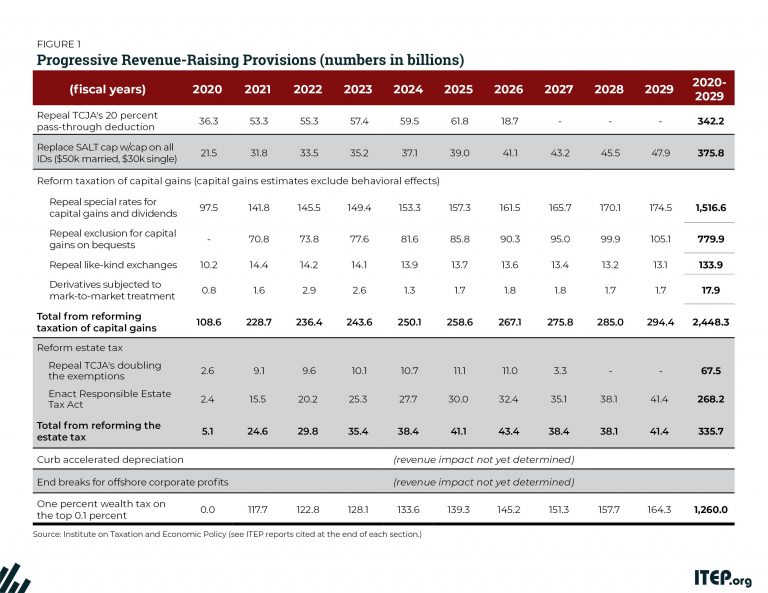
Progressive Revenue-Raising Options
• By Matthew Gardner, Steve Wamhoff
America has long needed a more equitable tax code that raises enough revenue to invest in building shared prosperity. The Tax Cuts and Jobs Act (TCJA), enacted at the end of 2017, moved the federal tax code in the opposite direction, reducing revenue by $1.9 trillion over a decade, opening new loopholes, and providing its most significant benefits to the well-off. The law cut taxes on the wealthy directly by reducing their personal income taxes…
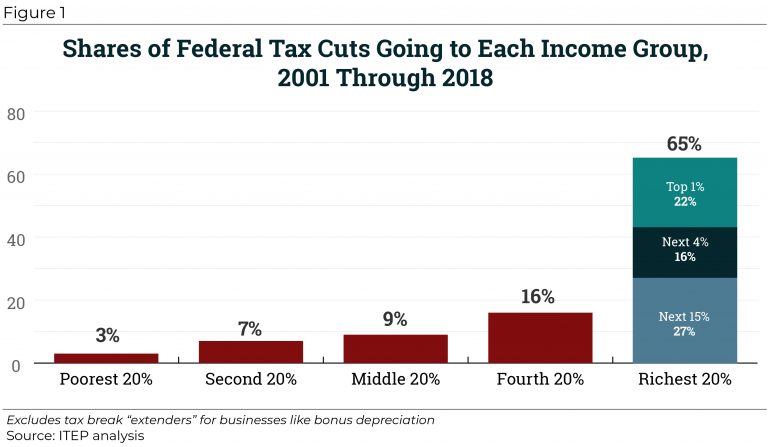
Federal Tax Cuts in the Bush, Obama, and Trump Years
• By Steve Wamhoff
Since 2000, tax cuts have reduced federal revenue by trillions of dollars and disproportionately benefited well-off households. From 2001 through 2018, significant federal tax changes have reduced revenue by $5.1 trillion, with nearly two-thirds of that flowing to the richest fifth of Americans.
The Federal Estate Tax: A Critical and Highly Progressive Revenue Source
• By Richard Phillips
For years, wealth and income inequality have been widening at a troubling pace. A recent study estimated that the wealthiest 1 percent of Americans held 42 percent of the nation's wealth in 2012, up from 28 percent in 1989. Public policies have exacerbated this trend by taxing income earned from investments at a lower rate than income from an ordinary job and by dramatically cutting taxes on inherited wealth. Further, lawmakers have done little to…

Fact Sheet: Preserving the Estate Tax
• By Richard Phillips
The federal estate tax is one of our most progressive sources of revenue and a critical tool in the fight against rising wealth inequality. Congressional legislation has significantly eroded the tax over the years, and now it is levied on only the wealthiest 0.2% of estates, meaning that 99.8% of estates will have no federal estate tax liability. The estate tax should be not only preserved but restored to a historical level to increase revenues…

Institute on Taxation
and Economic Policy
ITEP is a non-profit, non-partisan tax policy organization. We conduct rigorous analyses of tax and economic proposals and provide data-driven recommendations to shape equitable and sustainable tax systems.
Subscribe to ITEP Emails
Tax research and policy news in your inbox.
Promote Fair Tax Policy
Your gift to ITEP promotes tax justice. With your help, we do research that supports taxing millionaires and billionaires, taxing big corporations and raising revenue for the things our people, our communities and our planet need.
Together, we can create a country with more economic justice, more racial justice, more climate justice… and more tax justice.