
Georgia

Not-So-Free Kick: How the 2026 FIFA World Cup Will Cost Cities Millions
• By Page Gray
FIFA demanded sales tax breaks on World Cup Tickets. That means millions in lost revenue for host cities already shouldering the costs on providing infrastructure, security and logistics.

State Rundown 11/24: States Say ‘No Thank You’ to Federal Tax Cuts Reducing State Revenue
• By ITEP Staff
Lawmakers in two more states have wisely said “no thank you” to federal tax cuts that would have flowed through to their state tax codes and undermined funding for their priorities
Georgia Budget and Policy Institute: Breaking the Bank: Eliminating the State Income Tax Harms Most Georgians and Increases the Cost of Living
• By ITEP Staff
Eliminating Georgia’s income tax would represent the largest transfer of wealth from working and middle-class families to high income individuals and corporations in state history. Doing so would dramatically push Georgia’s budget out of balance, given that the income tax has been the state’s single largest source of revenue since 1982. Read more.

Local Vacancy Taxes: A Tool but Not a Panacea
• By Rita Jefferson
Vacancy taxes will not single-handedly solve problems in cities, but they are worth considering to address housing shortages, land use, and building thriving communities.

State Tax Dollars Shouldn’t Subsidize Federal Opportunity Zones
• By Eli Byerly-Duke
The Opportunity Zones program benefits wealthy investors more than it benefits disadvantaged communities.
The 5 Biggest State Tax Cuts for Millionaires this Year
• By Dylan Grundman O'Neill, Aidan Davis
Some states continue to hand out huge tax cuts to millionaires. The five largest tax cuts this year will cost states a total of $2.2 billion per year once fully implemented.

The Potential of Local Child Tax Credits to Reduce Child Poverty
• By Kamolika Das, Aidan Davis, Galen Hendricks, Rita Jefferson
Local governments have a critical role to play in reducing child poverty. Local Child Tax Credits could provide large tax cuts to families at the bottom of the income scale, lessening the overall regressivity of state and local tax systems.

Quite Some BS: Expanded ‘QSBS’ Giveaway in Trump Tax Law Threatens State Revenues and Enriches the Wealthy
• By Sarah Austin, Nick Johnson
States should decouple from the federal Qualified Small Business Stock (QSBS) exemption.

State Child Tax Credits Boosted Financial Security for Families and Children in 2025
• By Neva Butkus
Child Tax Credits (CTCs) are effective tools to bolster the economic security of low- and middle-income families and position the next generation for success.
State Rundown 9/4: Colorado Tackles Offshore Corporate Tax Avoidance, Paves Way for State Conformity Best Practices
• By ITEP Staff
Despite an increasingly bleak state revenue outlook, state lawmakers across the country continue to prioritize regressive tax cuts.
AP News: Georgia Republicans, Against Backdrop of 2026 Election, Push to Eliminate State Income Tax
August 20, 2025
As the 2026 election looms, Georgia Republicans seeking higher office met Tuesday to begin exploring plans to eliminate the state’s personal income tax.
State Rundown 8/6: Tax Policy is Hot in the Middle of Summer
• By ITEP Staff
As states prepare for the revenue loss and disruption resulting from the federal tax bill, tax policy is being considered in legislatures across the country.
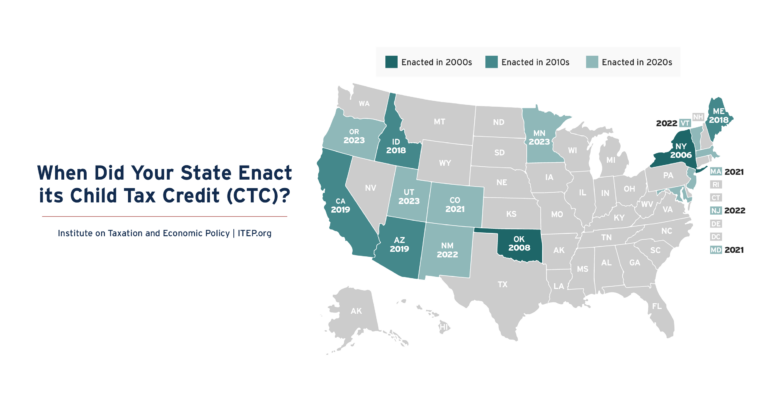
When Did Your State Enact a Child Tax Credit?
• By Neva Butkus
The Child Tax Credit (CTC) is an important tool to fight child poverty and help families make ends meet. When designed well, it can also make tax systems less regressive. As of 2020, only six states had CTCs. Today, 15 states have CTCs, with many credits exceeding $1,000 per qualifying child.

State Tax Action in 2025: Amid Uncertainty, Tax Cuts and New Revenue
• By Aidan Davis, Neva Butkus, Marco Guzman
Federal policy choices on tariffs, taxes, and spending cuts will be deeply felt by all states, which will have less money available to fund key priorities. This year some states raised revenue to ensure that their coffers were well-funded, some proceeded with warranted caution, and many others passed large regressive tax cuts that pile on to the massive tax cuts the wealthiest just received under the federal megabill.

Which States Expanded Refundable Credits in 2025?
• By Neva Butkus
Refundable tax credits were a big part of state tax policy conversations this year. In 2025, nine states improved or created Child Tax Credits or Earned Income Tax Credits.
State Rundown 7/24: States Begin Preparing for Federal Megabill Fallout
• By ITEP Staff
All eyes in statehouses in recent weeks have been on federal budget negotiations, and now that the “megabill” has passed, they are focused in on their own budgets in search of ways to cope with the enormous consequences coming their way. All states will see fewer federal dollars flowing through their coffers, higher needs due […]
Georgia Budget & Policy Institute: Historic Federal Tax Shift Benefits Wealthiest, Grows Deficit and Exacerbates Georgia’s Rural Challenges
• By ITEP Staff
In H.R. 1, the federal reconciliation bill, the federal government shirks its responsibility to Georgians, leaving the state to continue to support Georgians with fewer resources.

Sales Tax Holidays Miss the Mark When it Comes to Effective Sales Tax Reform
• By Miles Trinidad
Sales tax holidays are often marketed as relief for everyday families, but they do little to address the deeper inequities of regressive sales taxes. In 2025, 18 states offer these holidays at a collective cost of $1.3 billion.

States Should Move Quickly to Chart Their Own Course on SALT Deductions
• By Dylan Grundman O'Neill, Nick Johnson
While a federal SALT cap is hotly debated, capping deductibility at $10,000 was an unambiguously good idea at the state level. States would be smart to stick with the current cap or, better yet, go even farther and repeal SALT deductions outright. Going along with a higher federal SALT cap would double down on a regressive tax cut that will mostly benefit a small number of relatively wealthy state residents and cost states significant revenue.

Two in Three Americans Live in States with Variable-Rate Gas Taxes
• By Carl Davis
As inflation and fuel efficiency undercut traditional gas tax revenue, many states are rethinking how they fund transportation. Lawmakers across the country are beginning to modernize outdated gas tax systems to keep pace with rising infrastructure costs and changing driving habits.
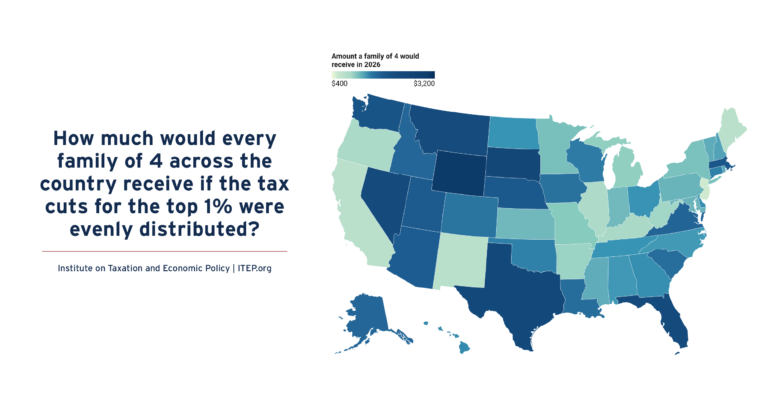
How Much Would Every Family in Every State Get if the Megabill’s Tax Cuts Given to the Rich Had Instead Been Evenly Divided?
• By Michael Ettlinger
If instead of giving $117 billion to the richest 1 percent, that money had been evenly divided among all Americans, we'd each get $343 - or nearly $1,400 for a family of four.

Analysis of Tax Provisions in the Trump Megabill as Signed into Law: National and State Level Estimates
• By Steve Wamhoff, Carl Davis, Joe Hughes, Jessica Vela
President Trump has signed into law the tax and spending “megabill” that largely favors the richest taxpayers and provides working-class Americans with relatively small tax cuts that will in many cases be more than offset by Trump's tariffs.

Trump Megabill Will Give $117 Billion in Tax Cuts to the Top 1% in 2026. How Much In Your State?
• By Michael Ettlinger
The predominant feature of the tax and spending bill working its way through Congress is a massive tax cut for the richest 1 percent — a $114 billion benefit to the wealthiest people in the country in 2026 alone.

How Much Do the Top 1% in Each State Get from the Trump Megabill?
• By Carl Davis
The Senate tax bill under debate right now would bring very large tax cuts to very high-income people. In total, the richest 1 percent would receive $114 billion in tax cuts next year alone. That would amount to nearly $61,000 for each of these affluent households.
Georgia Budget and Policy Institute: The House-Passed Reconciliation Bill Would Significantly Increase National Debt, Primarily Benefitting Top Earners, While Cutting Health Care and Food Assistance
• By ITEP Staff
Overall, the budget reconciliation legislation would reduce federal taxes for Georgians by $16.6 billion annually. However, 69% of these savings ($11.5 billion) are directed to the highest-earning 20% of Georgia households, or those making over $153,100 per year.
