
Louisiana

State Earned Income Tax Credits Will Support Families and Workers in 2027
• By Neva Butkus
Nearly two-thirds of states (plus the District of Columbia and Puerto Rico) have an Earned Income Tax Credit. These credits boost low-paid workers’ incomes and offset some of the taxes they pay, helping working class families achieve greater economic security.

State Rundown 9/10: States Brace for (and in Some Cases Embrace) Ballots and Budgets
• By ITEP Staff
States across the country will consider a host of ballot measures that could reshape the fairness and adequacy of their states’ tax systems, while other states are receiving budget forecasts that could further shape upcoming policy debates.
State-by-State Tax Expenditure Reports
• By ITEP Staff
Below is a list of tax expenditure reports published in the states.
State Rundown 5/14: Fund Priorities or Increase Shortfalls?
• By ITEP Staff
As many legislative sessions end, lawmakers are revealing their priorities.
State Tax Watch 2026
• By ITEP Staff
ITEP tracks tax discussions in legislatures across the country and uses our unique data capacity to analyze the revenue, distributional, and racial and ethnic impacts of many of these proposals. State Tax Watch offers the latest news and movement from each state.
State Rundown 4/1: No Fooling Around Anymore in Washington, But Cruel Pranks in South Carolina
• By ITEP Staff
In Washington, Gov. Bob Ferguson and lawmakers decided to stop fooling around with one of the nation’s most upside-down tax codes and finally brought to life a new millionaires’ tax, the first new income tax created in a state since 1991.
State Rundown 3/18: New Mexico Enacts Most Significant Corporate Tax Reform of the Year
• By ITEP Staff
As states lawmakers continue to weigh their linkages to the federal tax code in light of the recent federal tax law, New Mexico provides a blueprint for limiting multinational corporate tax avoidance.
State Rundown 3/12: Washington Lawmakers Pass Millionaires’ Tax, Expand Working Families Tax Credit
• By ITEP Staff
Washington is on its way to making history after the legislature approved the “millionaires’ tax,” a 9.9 percent tax on income over $1 million. The bill, which is expected to raise more than $3 billion a year, making significant investments in public education and childcare, will also expand the Working Families Tax Credit – the […]

Local Governments Are Increasingly Strapped: 2026 Will Bring New Challenges and New Opportunities
• By Kamolika Das
2025 saw an intensification of state and local tax fights across the country, as well as growing experimentation with local-option taxes, levies, fees, and tourism taxes aimed at keeping budgets afloat while also navigating political constraints imposed by state legislatures.
State Rundown 1/14: New Year Brings New Resolutions for Funding Key Priorities
• By ITEP Staff
State governors are beginning to lay out their top priorities as legislatures reconvene in statehouses around the country.

States Are Opening a Pandora’s Box of Data Centers
• By Page Gray
State governments are rushing to offer billions of dollars in subsidies to data center construction, apparently without understanding their full costs.
State Rundown 10/1: State and Local Governments Doing the Opposite of Shutting Down
• By ITEP Staff
State and local officials are staying very busy by considering a dizzying amount of reversals.
State Rundown 9/18: Lawmakers Confront Revenue Loss from Federal Policy Changes
• By ITEP Staff
Some states are trying to avoid revenue loss while others are welcoming it and doubling down.

State Earned Income Tax Credits Support Families and Workers in 2025
• By Neva Butkus
Nearly two-thirds of states now have an Earned Income Tax Credit (EITC). Momentum continues to build on these credits that boost low-paid workers’ incomes and offset some of the taxes they pay, helping lower-income families achieve greater economic security.

Trump’s Tax Law Clobbers State Budgets. Now’s the Time to Prepare.
• By ITEP Staff
The Trump megabill hands the richest 1% a trillion-dollar windfall while gutting funding for health care, education, and disaster relief — leaving communities to pick up the pieces. State and local leaders must step up, tax the wealthiest fairly, and safeguard the essentials that keep America healthy, educated, and safe.
State Rundown 7/24: States Begin Preparing for Federal Megabill Fallout
• By ITEP Staff
All eyes in statehouses in recent weeks have been on federal budget negotiations, and now that the “megabill” has passed, they are focused in on their own budgets in search of ways to cope with the enormous consequences coming their way. All states will see fewer federal dollars flowing through their coffers, higher needs due […]
New from ITEP: Gimmicky Sales Tax Holidays to Cost States & Localities $1.3 Billion This Year
• By ITEP Staff
Over the next month, 15 states will temporarily exempt a range of products from sales tax, joining one that held its sales tax holiday earlier this summer and two that do so a little later in the year. While these temporary suspensions may have some surface appeal, they have many significant downsides, as we explain in […]

Sales Tax Holidays Miss the Mark When it Comes to Effective Sales Tax Reform
• By Miles Trinidad
Sales tax holidays are often marketed as relief for everyday families, but they do little to address the deeper inequities of regressive sales taxes. In 2025, 18 states offer these holidays at a collective cost of $1.3 billion.
How Much Would Every Family in Every State Get if the Megabill’s Tax Cuts Given to the Rich Had Instead Been Evenly Divided?
• By Michael Ettlinger
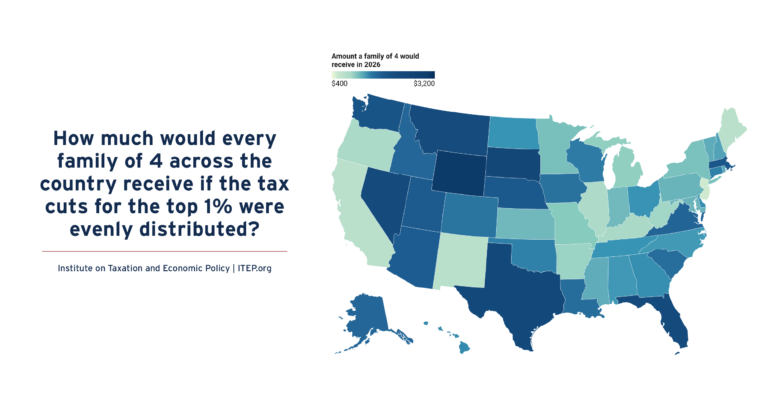
If instead of giving $117 billion to the richest 1 percent, that money had been evenly divided among all Americans, we'd each get $343 - or nearly $1,400 for a family of four.
State Rundown 7/8: State Tax Cuts Continue Despite Federal Megabill Passing
• By ITEP Staff
The last states are wrapping up legislative sessions, and some are crossing the finish line with major income tax cuts.

Analysis of Tax Provisions in the Trump Megabill as Signed into Law: National and State Level Estimates
• By Steve Wamhoff, Carl Davis, Joe Hughes, Jessica Vela
President Trump has signed into law the tax and spending “megabill” that largely favors the richest taxpayers and provides working-class Americans with relatively small tax cuts that will in many cases be more than offset by Trump's tariffs.

Trump Megabill Will Give $117 Billion in Tax Cuts to the Top 1% in 2026. How Much In Your State?
• By Michael Ettlinger
The predominant feature of the tax and spending bill working its way through Congress is a massive tax cut for the richest 1 percent — a $114 billion benefit to the wealthiest people in the country in 2026 alone.

How Much Do the Top 1% in Each State Get from the Trump Megabill?
• By Carl Davis
The Senate tax bill under debate right now would bring very large tax cuts to very high-income people. In total, the richest 1 percent would receive $114 billion in tax cuts next year alone. That would amount to nearly $61,000 for each of these affluent households.

With Fiscal Uncertainty Looming, Louisiana Senate Did the Right Thing on Tax Bills
• By Neva Butkus
If you find yourself in a hole, stop digging. This is exactly what Louisiana Senators did when they rejected two tax-cut bills that would have created a billion-dollar shortfall in the coming fiscal years.
State Rundown 6/11: States in The Eye of a Fiscal Hurricane?
• By ITEP Staff
State legislatures are enjoying a relatively quiet period right now, though it is merely a temporary calm before the storm of the federal tax and budget debate begins raging again.
