
New York
State Rundown 4/14: More Progressive Wins in the Headlines this Week, but Mind the Fine Print
April 14, 2021 • By ITEP Staff
Two significant victories headlined state tax debates in the past week, as New Mexico leaders improved existing targeted tax credits to give bigger boosts and reach more families in need, and West Virginia lawmakers unanimously shut down a destructive effort to eliminate the state’s progressive income tax. These developments follow last week’s major wins for progressive taxation and targeted assistance in New York, and more good news is likely soon as Washington legislators continue to advance their own targeted credit for working families. Not all the news is positive though, as costly and/or regressive tax cuts remain on the table…
National and State-by-State Estimates of President Biden’s Campaign Proposals for Revenue
April 8, 2021 • By ITEP Staff, Matthew Gardner, Steve Wamhoff
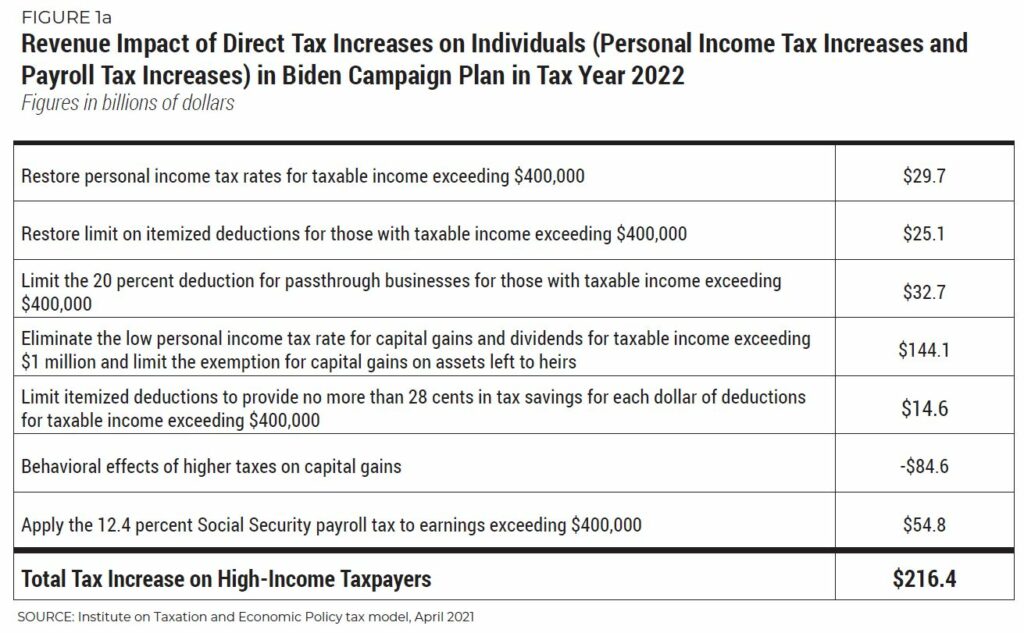
During his presidential campaign, Joe Biden proposed to change the tax code to raise revenue directly from households with income exceeding $400,000. More precisely, Biden proposed to raise personal income taxes on unmarried individuals and married couples with taxable income exceeding $400,000, and he also proposed to raise payroll taxes on individual workers with earnings exceeding $400,000. Just 2 percent of taxpayers would see a direct tax hike (an increase in either personal income taxes, payroll taxes, or both) if Biden’s campaign proposals were in effect in 2022. The share of taxpayers affected in each state would vary from a…
New York Times: Corporate Taxes Are Wealth Taxes
April 8, 2021
Since the mid-20th century, however, politicians of both political parties have supported cuts in the corporate-tax rate, often under intense lobbying from corporate America. The cuts have been so large — including in President Donald Trump’s 2017 tax overhaul — that at least 55 big companies paid zero federal income taxes last year, according to […]
State Rundown 4/7: Tax Justice Advocates Applaud New York Budget Deal
April 7, 2021 • By ITEP Staff
New York lawmakers stole the spotlight this week as they were able to agree on—and convince reluctant Gov. Andrew Cuomo to support—strong progressive tax increases on the highest-income households and corporations in the state to fund shared priorities like K-12 education and pandemic recovery efforts. Minnesota leaders are attempting a similar performance off Broadway with progressive reforms of their own, while Kansas legislators are getting poor reviews for cutting a number of taxes and worsening their budget situation. Thankfully major tax changes stayed backstage as sessions concluded in Georgia and Mississippi.
New York Times: Jeff Bezos says Amazon, a Notable Tax Avoider, Supports Raising Corporate Taxes.
April 7, 2021
For years, Amazon has been a model for corporate tax avoidance, fielding criticism of its tax strategies from Democrats and former President Donald J. Trump. In 2019, Amazon had an effective tax rate of 1.2 percent, which was offset by tax rebates in 2017 and 2018, according to the Institute on Taxation and Economic Policy, […]
Shelton Herald: Houston-based Kinder Morgan among Large Corporations that Didn’t Pay Federal Taxes in 2020
April 2, 2021
Houston-based Kinder Morgan is one of the largest infrastructure companies in North America — and they’re among the at least 55 American corporations that paid absolutely nothing in federal taxes on billions of dollars in profits in 2020. Citing a report from the Institute on Taxation and Economic Policy, Patricia Cohen reported for the New […]
Complex: Nike Hasn’t Paid Any Federal Income Tax for the Last Three Years
April 2, 2021
Nike has made $4.1 billion in profits over the last three years but didn’t pay a dime in federal income tax for its earnings, according to new reports by the New York Times. The publication’s latest findings revealed that the sportswear giant was among the companies that were able to evade federal income tax payments […]
New York Times: No Federal Taxes for Dozens of Big, Profitable Companies
April 2, 2021
Just as the Biden administration is pushing to raise taxes on corporations, a new study finds that at least 55 of America’s largest paid no taxes last year on billions of dollars in profits. The sweeping tax bill passed in 2017 by a Republican Congress and signed into law by President Donald J. Trump reduced […]
State Rundown 4/1: Most States Resisting Foolish Tax Cut Games That Tear Revenues Apart
April 1, 2021 • By ITEP Staff
Supporters of tax fairness and adequate funding for public needs are hoping West Virginia’s income tax elimination effort turns out to be a prank, but most states are not fooling around with such harmful policies this year. For example...
The New York Times: Biden Tax Plan Challenges G.O.P. Formula for Economic Growth
March 31, 2021
The Institute on Taxation and Economic Policy, which has long criticized American businesses for managing to avoid paying what they owe, conducted a study of Fortune 500 companies that were profitable and that provided enough information to calculate effective tax rates. The institute found that those companies on average paid 11.3 percent on their 2018 […]
Taxes and Racial Equity: An Overview of State and Local Policy Impacts
March 31, 2021 • By ITEP Staff
Historic and current injustices, both in public policy and in broader society, have resulted in vast disparities in income and wealth across race and ethnicity. Employment discrimination has denied good job opportunities to people of color. An uneven system of public education funding advantages wealthier white people and produces unequal educational outcomes. Racist policies such as redlining and discrimination in lending practices have denied countless Black families the opportunity to become homeowners or business owners, creating extraordinary differences in intergenerational wealth. These inequities have long-lasting effects that compound over time.
The Street: Cannabis Stocks Rise as New York Moves Closer to Legalization
March 30, 2021
New York would be the 16th state, plus the District of Columbia, to fully legalize marijuana after decades of imprisoning people who participated in the cannabis black market. About one in three Americans live in a state with legal sales of recreational cannabis, according to the Institute on Taxation and Economic Policy. Read more

The Biden administration has made clear that its top priorities include a major recovery package with critical investments to boost the nation’s economy and tax increases for corporations and the wealthy. Adequately funding the IRS must be part of that agenda. It seems every week, a new study, data set or research-driven commentary reveals how […]
The Street: New York Inches Closer to Legalizing Recreational Cannabis
March 24, 2021
Last November, voters in New Jersey and Arizona voted to legalize marijuana. And in December, New Jersey placed a social equity excise tax on cannabis sales in order to address the disparate effect of anti-marijuana laws on communities of color. About one in three Americans live in a state with legal sales of recreational cannabis, […]
It was a relatively quiet week in state fiscal policy, likely partly due to states waiting for federal guidance on some of the details in the American Rescue Plan. As they await those details, lawmakers in Mississippi and West Virginia continue to wrangle over whether to recklessly eliminate their income taxes, while leaders in states including Connecticut and New York considered more productive and progressive reforms. And in the meantime, groundbreaking work on the intersection of race and tax policy is now available.
New York Post: Zoom Paid No Federal Income Tax Last Year amid Pandemic Profit Surge
March 23, 2021
The Silicon Valley firm appears to have achieved that feat largely thanks to its use of stock-based compensation for employees, which helped reduce its worldwide tax bill by more than $302 million for the year ending Jan. 31. Corporations that pay their executives in stock often benefit from a provision in the federal tax code […]
State Rundown 3/17: Momentum for Sound Progressive Tax Reforms Continues to Build
March 17, 2021 • By ITEP Staff
We wrote last week that the inclusion of fiscal relief for states and localities in Congress’s American Rescue Plan should free up state lawmakers’ time and attention to focus on the comprehensive reforms needed to address upside-down and inadequate tax codes, and some states are already doing just that.
New York Times: Democrats Narrow Stimulus Payments as Biden Works to Keep Aid Plan on Track
March 4, 2021
If adopted, the change in income limits would mean that about 12 million adults and five million children who received stimulus payments under the last round of aid signed in December by President Donald J. Trump would not receive them under Mr. Biden’s bill, according to an analysis by the liberal Institute on Taxation and […]
New York Post: Nearly 12 million Americans could lose COVID stimulus checks under Biden’s new cap
March 4, 2021
About 200 million adults would receive stimulus checks under the new Senate plan, roughly 11.8 million fewer than under the $1.9 trillion COVID-19 relief bill the House of Representatives passed last week, which had a $100,000 income cap, according to estimates from the Institute on Taxation and Economic Policy. The changes would also result in […]
Although lawmakers in some states continue to push for expensive and regressive tax cuts that would primarily benefit wealthy households, worsen economic and racial injustices, and undermine funding for key public services, this week’s state fiscal news is dominated by efforts to do the opposite. Leaders in the District of Columbia, Maine, Nebraska, New York, Washington, and Wyoming made recent headlines by advocating for policies that improve on upside-down tax codes and generate needed funding for shared priorities like schools and health care.
State Rundown 2/24: State Tax Debates Quickly Thaw Out with Warmer Weather
February 24, 2021 • By ITEP Staff
Warming temperatures in many parts of the country this week seem to be thawing out state fiscal debates as well. Multiple states including California, Colorado, Maryland, and New Jersey saw movement on efforts to improve tax credits for low- and middle-income families. Mississippi House lawmakers suddenly rushed through a dangerous bill to eliminate the state’s income tax and shift those taxes onto lower-income households. Montana senators also approved regressive income tax cuts and South Dakota legislators advanced an anti-tax constitutional amendment, while lawmakers in Hawaii, Rhode Island, and Washington made progress on improving the progressivity of their tax codes. Gas…
The New York Times: California: Liberal Model or Cautionary Tale?
February 16, 2021
Below is an excerpt of an LTE by ITEP Research Director Carl Davis: Of course, the very richest people in California pay more tax than they would if they lived in Texas or Washington. But these top earners can afford to live wherever they want. The best available research concludes that top earners rarely […]
New York Amsterdam News: To dismantle white supremacy we must tax the rich
February 11, 2021
To further compound racial inequality, other parts of our tax code essentially function as giveaways to the wealthiest white households. Take the tax deduction for income earned from pass-through businesses. Over half of the savings from this deduction alone accrues exclusively to the top 1% of households, who are mostly white. Similarly, the Institute on […]
Law360: NY Gov.’s Pot Tax Proposal Unique, Tax Group Says
February 9, 2021
A potency-based cannabis tax proposal by New York’s governor would bring in more sustainable revenue to the state if passed, Institute on Taxation and Economic Policy said on Tuesday. Read more
Does New York’s Cannabis Tax Idea Offer a Glimpse of the Future?
February 9, 2021 • By Carl Davis

Taxing cannabis won’t end New York’s budget difficulties, but a potency tax could bring New York a more sustainable stream of cannabis tax revenue than we see in most states. It could also have significant benefits for cannabis consumers.
