
New York
New York Observer: Amazon Paid $0 in Federal Taxes Despite Making $11 Billion in 2018—And No One Knows Why
February 20, 2019
You may feel like a champion financial planner after filing last year’s income taxes, even though you did pay a hefty fee to an accountant or some tax software. But don’t even think about beating Amazon, which paid a whopping $0 in federal taxes last year—despite earning $11.2 billion in U.S. profits—according to a report from the […]
Axios: 1 Big Thing: Filthy Rich, Owing No Tax
February 19, 2019
Amazon is not a passive player in tax law, says ITEP's Matthew Gardner, who researched and wrote the Amazon report. "Amazon in particular has shaped tax law in its own image. They made the laws by lobbying so persistently and effectively," Gardner tells Axios.
The Hill: Tech Looks for Lessons From Amazon HQ2 Fight
February 17, 2019
Amazon's decision to scrap its plans for a second headquarters in New York City, dubbed HQ2, stunned both the tech world and its critics this week, raising new questions about the industry's ambitious expansion plans and their dealings with state and local governments.
Inequality.org: Organizers Oust Amazon HQ2 from New York
February 16, 2019
As details of the incentives agreement came out, New Yorkers heard from Seattleites about the mass gentrification spurred by Amazon. Seattle and King County declared a state of emergency over the city’s homelessness crisis. Meanwhile, Amazon lobbied hard to repeal a head tax on the city’s richest businesses to deal with that very crisis just […]
Salon.com: Activist Defeat of Amazon is a Win for Democracy Over Technology
February 15, 2019
However, Matthew Gardner, a senior fellow at the Institute on Taxation and Economic Policy, told Salon it is impossible to know truly if New York missed out on an economic loss or not, and to think of it as a “good” or “bad” deal is a “one-dimensional” way to look at it. “From an opportunity-cost […]
The American Prospect: Amazon Is Giving Up on New York, and Activists in Nashville and Northern Virginia Are Energized
February 15, 2019
Amazon’s announcement to abandon their New York plans comes on the heels of a report from the Institute on Taxation and Economic Policy showing that Amazon made a profit of $11.2 billion in 2018, and, through its navigation of tax loopholes, did not pay any federal income taxes, instead gaining a tax rebate of $129 […]
The New Yorker: New York City Activists Drive Out Amazon
February 14, 2019
Two rhyming bits of Amazon news. The first is that Amazon, according to a report from the Institute on Taxation and Economic Policy, was taxed at an effective rate of negative-one percent in 2018, having paid a federal income tax of zero dollars and having received a rebate from the federal government of a hundred and twenty-nine million dollars. During that year, the company nearly doubled its profits, from $5.6 billion to $11.2 billion.
The Hill: Hillicon Valley: New York says goodbye to Amazon’s HQ2 …
February 14, 2019
Amazon will not pay any federal income taxes for the second year in a row, according to a report released Wednesday. The Institute on Taxation and Economic Policy found that the online retailer, which reported $11.2 billion in profits in 2018, did not pay income tax because of unnamed “tax credits” in their disclosure.
Governing: With Amazon Out of New York, Some Lawmakers Seek Multistate Ban on Corporate Tax Breaks
February 14, 2019
Opponents of such deals cite data that suggest that tax incentives often aren’t worth what they cost governments. An Institute on Taxation and Economic Policy study noted that most giveaways simply move pieces on a chessboard, rather than create actual growth.
Happy Valentine’s Day to all lovers of quality research, sound fiscal policy, and progressive tax reforms! This week, some leaders in ARKANSAS displayed their infatuation with the rich by advancing regressive tax cuts, but others in the state are trying to show some love to low- and middle-income families instead. WISCONSIN lawmakers are devoted to tax reductions for the middle class but have not yet decided how to express those feelings. NEBRASKA legislators are playing the field, flirting with several very different property tax and school funding proposals. And VIRGINIA’s legislators and governor just decided to settle for a flawed…
New York Post: Amazon Paid No Federal Taxes Again
February 14, 2019
Instead, as first reported by the Institute on Taxation and Economic Policy, Amazon received a federal income tax rebate of $129 million, essentially amounting to a tax rate of negative 1 percent.
The Illusion of Race-Neutral Tax Policy
February 14, 2019 • By Alan Essig, Carl Davis, Jenice Robinson, Meg Wiehe, Misha Hill, Steve Wamhoff

It is well known that the bulk of the federal tax cuts flowed to the highest-earning households, who received the largest tax cut both in terms of real dollars and also as a share of income. But as our analysis with Prosperity Now reveals, solely examining the tax law in the context of class misses a bigger-picture story about how the nation’s public policies not only perpetuate widening income and wealth inequality, they also preserve historic and current injustices that continue to allow white communities to build wealth while denying the same level of opportunity (and often suppressing it) to…

On Monday a group of Senators and Representatives from the Northeast announced their latest proposal to repeal the cap on deductions for state and local taxes (SALT), this time offsetting the costs by restoring the top personal income tax rate to 39.6 percent. This is an improvement over previous proposals to repeal the cap on SALT deductions without offsetting the costs at all. But the new approach does not improve our tax system overall. Instead, it trades one tax cut for the rich (a lower top income tax rate) for another (repeal of the cap on SALT deductions).
Amazon in Its Prime: Doubles Profits, Pays $0 in Federal Income Taxes
February 13, 2019 • By Matthew Gardner
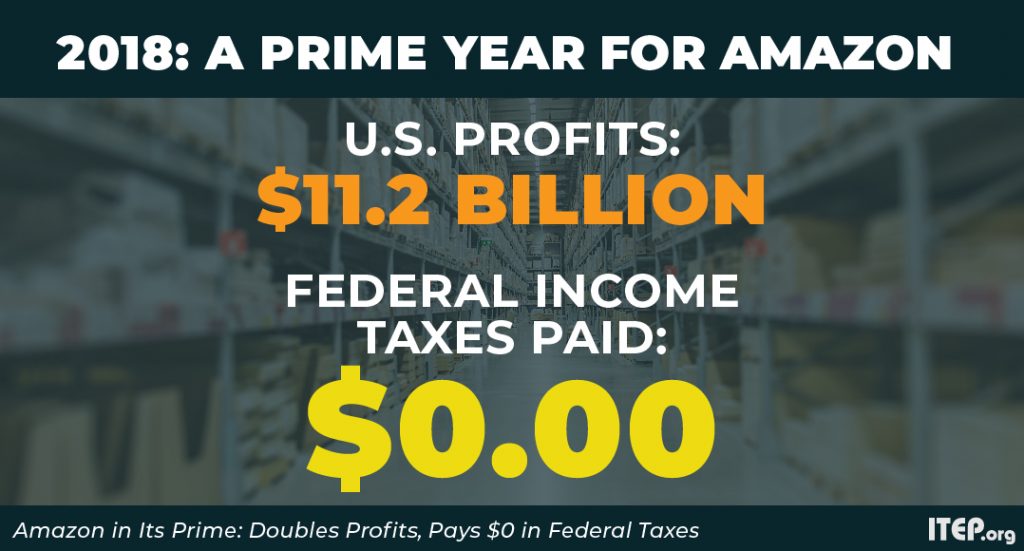
Amazon, the ubiquitous purveyor of two-day delivery of just about everything, nearly doubled its profits to $11.2 billion in 2018 from $5.6 billion the previous year and, once again, didn’t pay a single cent of federal income taxes.
Trends We’re Watching in 2019: Cannabis Tax Implementation and Reform
February 7, 2019 • By Carl Davis
Few areas of state tax policy have evolved as rapidly as cannabis taxation over the last few years. The first legal, taxable sale of recreational cannabis in modern U.S. history did not occur until 2014. Now, just five years later, a new ITEP report estimates that recreational cannabis is generating more than $1 billion annually in excise tax revenues and $300 million more in general sales tax dollars.
Trends We’re Watching in 2019: Raising Revenue and Spending Surpluses to Prioritize Critical Public Investments
February 7, 2019 • By Lisa Christensen Gee
A second notable trend in 2019 is states raising revenue to address longstanding needs and states allocating their surpluses to invest in critical public priorities such as early childhood programs, education and other human services.
Trends We’re Watching in 2019: The Use of Targeted Tax Breaks to Help Address Poverty and Inequality
February 7, 2019 • By Aidan Davis
Continuing to build upon the momentum of previous years, states are taking steps to create and improve targeted tax breaks meant to lift their most in-need state residents up and out of poverty. Most notably, a range of states are exploring ways to restore, enhance or create state Earned Income Tax Credits (EITC). EITCs are an effective tool to help struggling families with low wages make ends meet and provide necessities for their children. The policy, designed to bolster the earnings of low-wage workers and offset some of the taxes they pay, allows struggling families to move toward meaningful economic…
Congress Should Reduce, Not Expand, Tax Breaks for Capital Gains
February 1, 2019 • By Steve Wamhoff
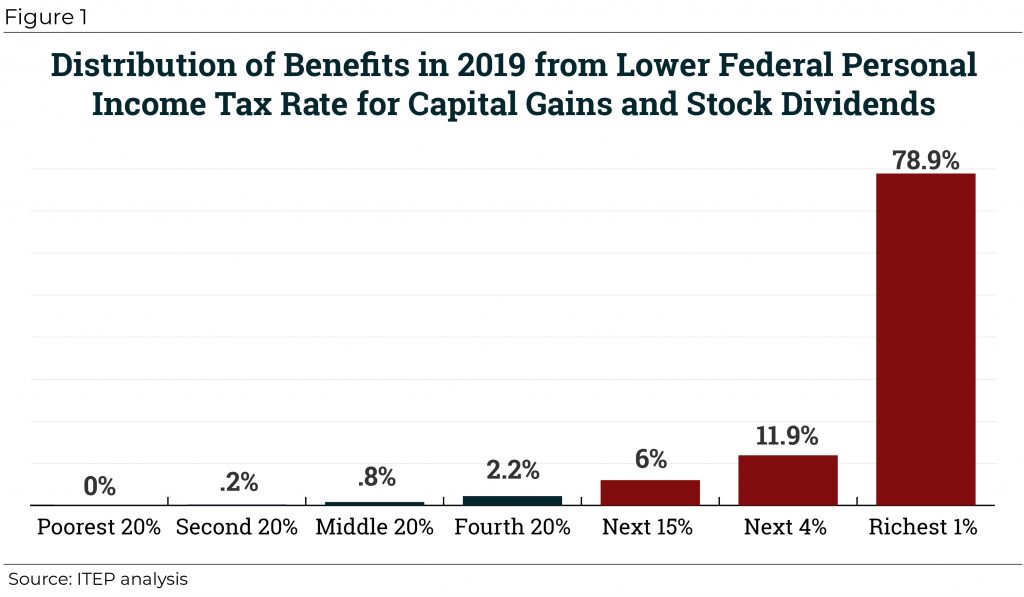
Even though income derived from capital gains receives a special lower tax rate and is therefore undertaxed, some proponents of lower taxes on the wealthy claim that capital gains are overtaxed due to the effects of inflation. But existing tax breaks for capital gains more than compensate for any problem related to inflation. Congress should repeal or restrict special tax provisions for capital gains rather than creating even more breaks.
Bloomberg: Warren’s Tax Proposal Aims at Assets of Wealthiest Americans
January 25, 2019
Her plan would do more to relieve inequality than New York Democratic Representative Alexandria Ocasio-Cortez’s idea to raise the top income tax rate to 70 percent, according to Steve Wamhoff, the director of federal tax policy at the left-leaning Institute on Taxation and Economic Policy. New research indicates that raising marginal income rates wouldn’t do […]
State Rundown 1/24: States Reflect on MLK’s Dream and Teacher Uprisings
January 24, 2019 • By ITEP Staff
This week, as Americans in every state celebrated Martin Luther King Jr. Day and reflected on his dream of peaceful protest and racial and economic justice, many eyes were on the teachers’ strike pressing for parts of this dream amid the “curvaceous slopes of California.” Governors and lawmakers in many states—including Arizona, Georgia, Indiana, Louisiana, Nevada, New Mexico, South Carolina, and Wisconsin—discussed ways to raise pay for teachers and/or enhance education investments generally.
New York Times: Warren’s Plan Is Latest Push by Democrats to Raise Taxes on the Rich
January 24, 2019
Ms. Warren appears to be the first declared Democratic candidate to release a plan for a wealth tax, but the idea is quickly gaining steam among liberal activists and policy experts. Two think tanks, the Institute on Taxation and Economic Policy and the Washington Center for Equitable Growth, released wealth-tax-themed policy briefs this week in […]

State policy toward cannabis is evolving rapidly. While much of the debate around legalization has rightly focused on potential health and criminal justice impacts, legalization also has revenue implications for state and local governments that choose to regulate and tax cannabis sales. This report describes the various options for structuring state and local taxes on cannabis and identifies approaches currently in use. It also undertakes an in-depth exploration of state cannabis tax revenue performance and offers a glimpse into what may lie ahead for these taxes.
Cannabis Tax Debates are Ramping Up; Here’s What We’ve Learned from Five Years of Cannabis Taxation Thus Far
January 23, 2019 • By Carl Davis
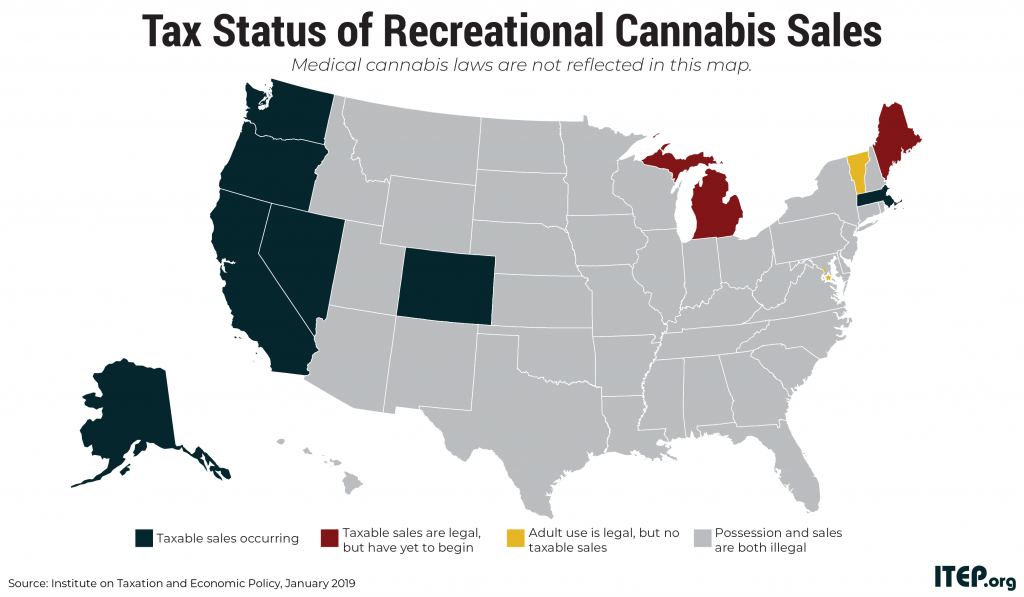
This year lawmakers in Connecticut, Delaware, Hawaii, Illinois, New Jersey, New York, Rhode Island, and Vermont will all be debating the taxation of recreational cannabis. A new ITEP report reviews the track record of recreational cannabis taxes thus far and offers recommendations for structuring cannabis taxes to achieve stable revenue growth over the long haul.
State Rundown 1/18: Governors’ Speeches Kick Off State Fiscal Debates
January 18, 2019 • By ITEP Staff
Gubernatorial speeches and budget proposals dominated state fiscal news this week, as governors proposed a wide array of policies including positive reforms such as Earned Income Tax Credit (EITC) enhancements in CALIFORNIA, a capital gains tax on wealthy households in WASHINGTON, and investments in education in several states. Proposals to exempt more retirement income from tax, particularly for veterans, are a common theme so far this year, having been raised in multiple states including MARYLAND, MICHIGAN, and SOUTH CAROLINA. And NEW JERSEY became the fourth state with a $15 minimum hourly wage. Those wishing to better understand and influence important debates about equitable tax policy should mark their…
A Simple Fix for a $17 Billion Loophole: How States Can Reclaim Revenue Lost to Tax Havens
January 17, 2019 • By Richard Phillips
Enacting Worldwide Combined Reporting or Complete Reporting in all states, this report calculates, would increase state tax revenue by $17.04 billion dollars. Of that total, $2.85 billion would be raised through domestic Combined Reporting improvements, and $14.19 billion would be raised by addressing offshore tax dodging (see Table 1). Enacting Combined Reporting and including known tax havens would result in $7.75 billion in annual tax revenue, $4.9 billion from income booked offshore.
