
North Carolina
State Rundown 4/16: No Vacation from Spring Tax Breaks as Bills Advance
April 16, 2025 • By ITEP Staff
While students and families are enjoying spring break vacations, legislative sessions are still in full swing. And some are poised for a spring tax break season as proposals advance with major implications for the sustainability of state budgets.
IRS Cooperation with ICE Will Damage Public Trust, Putting Tax Revenues in Jeopardy
April 10, 2025 • By Marco Guzman

Attempts by the Department of Homeland Security to secure private information from the IRS on people who file taxes with an Individual Taxpayer Identification Number is a violation of federal privacy laws that protect taxpayers. It is also a change that could seriously damage public trust in the IRS, which could jeopardize billions of dollars in tax payments by hardworking immigrant families.

This week, we celebrate 50 years of the federal Earned Income Tax Credit (EITC) and the impact it's had on millions of workers and families. In 2023 alone, the latest year of available data, the federal EITC alongside the refundable portion of the Child Tax Credit lifted 6.4 million people and 3.4 million children out of poverty.
March Madness kicks off today and the pressure is on as many states’ legislative sessions are nearing the final buzzer. Some state lawmakers are seemingly competing for the title of most regressive state tax policies while others are looking to lift up best practices for more equitable outcomes. The Mississippi legislature landed on a […]
Below is a list of tax expenditure reports published in the states.
State Rundown 2/20: Tools to Address Corporate Tax Avoidance and Property Tax Affordability
February 20, 2025 • By ITEP Staff
A new ITEP report finds that states could raise $19 billion a year with one policy change targeting corporate tax avoidance. That policy, worldwide combined reporting, strengthens state corporate taxation by giving states a full view of multinational corporate profits, essentially eliminating the tax savings that companies currently see by pretending their profits were earned in Switzerland, the Cayman Islands, and other international tax havens.
Turning IRS Agents to Deportation Will Reduce Public Revenues
February 11, 2025 • By Carl Davis, Jon Whiten
The Trump Administration’s plan to turn IRS agents into deportation agents will result in lower tax collections in addition to the harm done to the families and communities directly affected by deportations.
Tax changes have been proposed or are nearing the finish line in many states. Kentucky is poised to enact an income tax cut as a bill heads to the governor’s desk. In Pennsylvania, Gov. Josh Shapiro’s budget proposal called to accelerate existing corporate tax cuts while closing corporate tax loopholes by enacting combined reporting. Ohio Gov. Mike DeWine proposed a new credit for children of working parents. And Virginia Democrats countered Gov. Glenn Youngkin’s proposed tax cuts with a plan of their own that includes an increase to the state’s Earned Income Tax Credit (EITC) and a one-time, nonrefundable tax…

Local income taxes can be an important progressive revenue raiser, as they ask more of higher-income households and are connected to ability to pay. They can raise substantial revenue to fund key public services to make cities and regions better off.
Trump’s Plan to Extend His 2017 Tax Provisions: Updated National and State-by-State Estimates
January 8, 2025 • By Steve Wamhoff
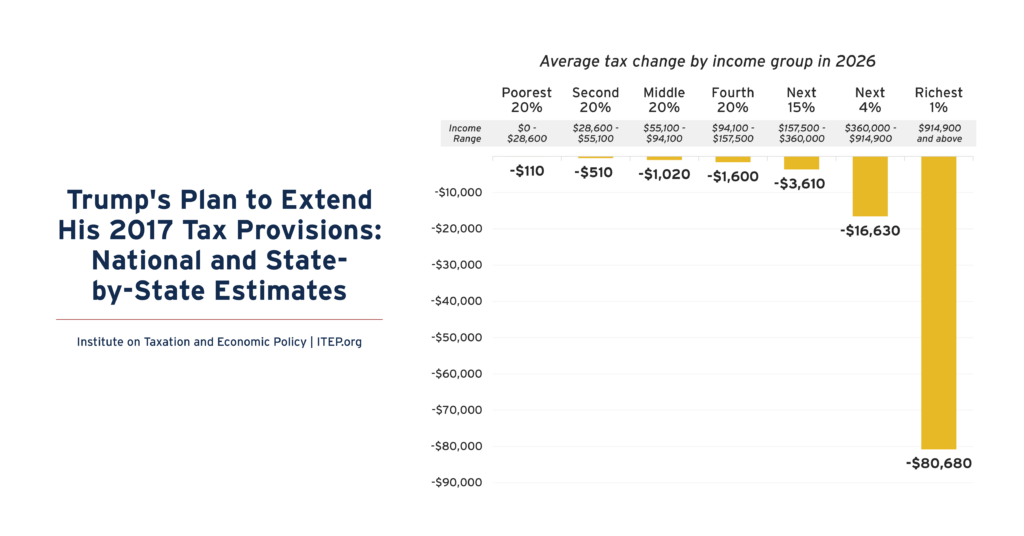
Trump’s plan to make most of the temporary provisions of his 2017 tax law permanent would disproportionately benefit the richest Americans. This includes all major provisions except the $10,000 cap on deductions for state and local taxes (SALT) paid.
State Rundown 12/3: Some States Cast Away Fiscal Responsibility as They Plan for 2025
December 3, 2024 • By ITEP Staff
The 2025 legislative season will be here before we know it, and state lawmakers have begun unveiling their priorities and proposals. Unfortunately, despite stagnating revenue growth, many lawmakers continue to push for deep, regressive tax cuts - often before the full impact of previous tax cuts is felt.
Average Louisianans Will Pay for Gov. Landry’s Tax Break for the Rich
November 26, 2024 • By Neva Butkus

Tax cuts for the wealthy and corporations will not make Louisiana more competitive. Rather, they will blow a hole in the state budget while asking low- and middle-income working families to make up the difference. Gov. Landry and the Louisiana legislature would make much better use of their time looking for ways to make Louisiana’s tax structure fairer and more capable of adequately funding important priorities.
On Election Day, Voters Across the Country Chose to Invest in Their States & Communities
November 19, 2024 • By Kamolika Das
On election day, voters across the country — in states red and blue and communities rural and urban — approved a wide range of state and local ballot measures on taxation and public investment. The success of these measures clearly shows that voters are willing to invest in public priorities that feel tangible and close to home.
2024 Local Tax Ballot Measures: Voters in Dozens of Communities Will Shape Local Policy
October 17, 2024 • By Rita Jefferson
Next month, voters across the country will weigh in on many local ballot measures that will have a profound effect on the adequacy of our local tax systems and whether cities and communities can fund public needs. These are in addition to statewide ballot questions, many of which have local implications this year.
North Carolina Budget & Tax Center: North Carolinians Deserve the Credit
October 11, 2024
Despite strong state performance in job growth and employment, too many households in North Carolina are struggling to make ends meet and cope with the rising cost of living — especially those with young children. Widespread low incomes and elevated poverty rates are preventing families from meeting their needs, reaching their potential, and contributing their full talents to our communities. The prevalence of this financial hardship has direct consequences for the long-term well-being of children and our state’s economy.
Extending Temporary Provisions of the 2017 Trump Tax Law: Updated National and State-by-State Estimates
September 13, 2024 • By Steve Wamhoff

The TCJA Permanency Act would make permanent the provisions of the Tax Cuts and Jobs Act of 2017 that are set to expire at the end of 2025. The legislation would disproportionately benefit the richest Americans. Below are graphics for each state that show the effects of making TCJA permanent across income groups. See ITEP’s […]

Many cities, counties, and townships across the country are in a difficult, or at least unstable, budgetary position. Localities are responding to these financial pressures in a variety of ways with some charging ahead with enacting innovative reforms like short-term rental and vacancy taxes, and others setting up local tax commissions to study the problem.
Sales Tax Holidays Miss the Mark When it Comes to Effective Sales Tax Reform
August 6, 2024 • By Marco Guzman

Nineteen states have sales tax holidays on the books in 2024. These suspensions combined will cost states and localities over $1.3 billion in lost revenue this year. Sales tax holidays are poorly targeted and too temporary to meaningfully change the regressive nature of a state’s tax system.

Undocumented immigrants paid $96.7 billion in federal, state, and local taxes in 2022. Providing access to work authorization for undocumented immigrants would increase their tax contributions both because their wages would rise and because their rates of tax compliance would increase.
Improving Refundable Tax Credits by Making Them Immigrant-Inclusive
July 17, 2024 • By Emma Sifre, Marco Guzman
Undocumented immigrants who work and pay taxes but don't have a valid Social Security number for either themselves or their children are excluded from federal EITC and CTC benefits. Fortunately, several states have stepped in to ensure undocumented immigrants are not left behind by the gaps in the federal EITC and CTC. State lawmakers should continue to ensure that immigrants who are otherwise eligible for these tax credits receive them.
While Massachusetts legislators recently dropped a real estate transfer tax from their major housing bill, the District of Columbia council sent a budget to the mayor that includes a mansion tax that would increase the tax rate on properties valued over $2.5 million. Meanwhile, lawmakers in New Jersey and South Carolina continue to, respectively, raise and reduce needed revenues.
State Rundown 6/26: Summer Special Sessions Are In, Anti-tax Ballot Initiatives Out
June 26, 2024 • By ITEP Staff
Many families are heading out on summer vacations, but legislators across the country are heading back to statehouses for special sessions...
States Should Enact, Expand Mansion Taxes to Advance Fairness and Shared Prosperity
June 26, 2024 • By Carl Davis, Erika Frankel

The report was produced in partnership with the Center on Budget and Policy Priorities and co-authored by CBPP’s Deputy Director of State Policy Research Samantha Waxman.[1] Click here to use our State Mansion Tax Estimator A historically large share of the nation’s wealth is concentrated in the hands of a few, a reality glaring in […]
Legislative sessions across the country are still very much in for summer, which means more pencils, more budgets, and more tax plans...
States Should Opt Into IRS Direct File as the Program is Made Permanent
May 30, 2024 • By Jon Whiten
While there is plenty of room to expand Direct File at the federal level, states can take matters into their own hands and bring this benefit to their residents by opting into the program.
