
North Carolina
State Rundown 5/9: Illinois Moves Closer to a Progressive Income Tax
May 9, 2019 • By ITEP Staff
Lawmakers in Illinois and Ohio have advanced major tax proposals but cannot rest just yet, as they must still get past the other legislative chamber. Their counterparts in Michigan, Minnesota, Nebraska, and Oregon, meanwhile, are all at impasses over education funding, as those in Texas left their school funding disagreement unresolved at least until they reconvene...in 2021. And in an era of many states pre-empting smaller jurisdictions by revoking local decision-making powers, leaders in Colorado and Delaware made moves in the opposite direction, entrusting cities and school districts with more local control.
Teachers in North Carolina and South Carolina are walking out and rallying this week for increased education funding, teacher and staff pay, and other improvements to benefit students—if you’re unsure why be sure to check out research on the teacher shortage and pay gap under “What We’re Reading” below. Meanwhile, budget debates have recently wrapped up in Indiana, Iowa, Massachusetts, New Hampshire, and Washington. And major tax debates are kicking into high gear in both Louisiana and Nebraska.
State Rundown 4/26: Capital Gains Taxes Make Gains and Regressive Proposals Regress
April 26, 2019 • By ITEP Staff
Progressive capital gains tax proposals made news this week in Connecticut and Massachusetts, while Nebraskans came out in force to oppose a regressive tax shift, and North Carolina teachers prepare to rally over their legislature’s proclivity to cut taxes on wealthy households while underfunding schools.
The Case for Extending State-Level Child Tax Credits to Those Left Out: A 50-State Analysis
April 17, 2019 • By Aidan Davis, Meg Wiehe
As of 2017, 11.5 million children in the United States were living in poverty. A national, fully-refundable Child Tax Credit (CTC) would effectively address persistently high child poverty rates at the national and state levels. The federal CTC in its current form falls short of achieving this goal due to its earnings requirement and lack of full refundability. Fortunately, states have options to make state-level improvements in the absence of federal policy change. A state-level CTC is a tool that states can employ to remedy inequalities created by the current structure of the federal CTC. State-level CTCs would significantly reduce…
State Rundown 4/11: An Estate Tax Win, Opioid Progress, and Teacher Uprising Updates
April 11, 2019 • By ITEP Staff
Hawaii made progress in pushing back against the increasing concentration of wealth and power by beefing up its estate tax. Delaware, New Jersey, and Rhode Island all took steps toward taxing opioid producers to raise funds to address the ongoing opioid crisis. Oregon lawmakers continue to try to address their chronic school underfunding with a $2 billion annual investment, in contrast to some of their counterparts in North Carolina who are responding to similar issues with the opposite approach, proposing to slash taxes in the face of their school funding issues – just as research highlighted in our What We’re…
State Rundown 3/27: Spring Bringing Smart State Tax Policy So Far
March 27, 2019 • By ITEP Staff
Though a long winter and a rough start to spring weather have wreaked havoc in much of the country, lawmakers are off to a good start in the world of state fiscal policy so far. In the last week, a progressive revenue package was passed in the nick of time in NEW MEXICO, a service-sapping tax cut was vetoed in KANSAS, and a regressive and unsustainable tax shift was soundly defeated in NORTH DAKOTA. Meanwhile, gas tax updates are on the table in MAINE, MINNESOTA, and OHIO. And exemptions for feminine hygiene products and diapers were enacted in VIRGINIA and introduced in MISSOURI.
North Carolina Justice Center: Higher Rates on Higher Income: Why a Graduated Income Tax is Good Policy for North Carolina
March 20, 2019 • By ITEP Staff
At the same time, a graduated rate structure — in contrast with the state’s current flat tax rate on income — can make more revenue available for key public investments, generating broad-based benefits to many people and communities. It is also better able to keep up with the needs of a growing state. That is […]
More than three billion dollars could be raised under a major progressive tax plan proposed by Illinois Gov. J.B. Pritzker this week, the point being to simultaneously improve the state’s upside-down tax code and address its notorious budget gap issues. One state, Utah, may already be looking at a special session to revisit the sales tax reform debate that ended this week without resolution, in contrast to Alabama and Arkansas, where leaders finally resolved years-long debates over gas taxes and infrastructure funding. And lawmakers in four states – California, Florida, Minnesota, and North Carolina – introduced legislation to expand or…
Fairness Matters: A Chart Book on Who Pays State and Local Taxes
March 6, 2019 • By ITEP Staff

There is significant room for improvement in state and local tax codes. State tax codes are filled with top-heavy exemptions and deductions and often fail to tax higher incomes at higher rates. States and localities have come to rely too heavily on regressive sales taxes that fail to reflect the modern economy. And overall tax collections are often inadequate in the short-run and unsustainable in the long-run. These types of shortcomings provide compelling reason to pursue state and local tax reforms to make these systems more equitable, adequate, and sustainable.
State Rundown 2/27: Temperatures and Tax Fights Continue to Polarize
February 27, 2019 • By ITEP Staff
As another polar vortex heads for large swaths of the country, state tax debates this week were highly polarized in another way. Lawmakers and advocates in MICHIGAN, OHIO, OREGON, UTAH, and elsewhere fought to enact or improve state Earned Income Tax Credits to give a boost to low- and middle-income working families. But the opposite extreme was heavily represented as well, as others pushed for regressive tax cuts for wealthy individuals and corporations, including in KANSAS, NEBRASKA, NORTH DAKOTA, OHIO, UTAH, and WEST VIRGINIA. Even our “What We’re Reading” section has informative reading on how education funding policy continues to…
NC Policy Watch: Report: Corporations Are Stiffing North Carolina on $373 Million in State Taxes
January 23, 2019 • By ITEP Staff
It turns out that state leaders can ensure that companies pay the proper amount of taxes on income generated from business conducted in their jurisdictions, but existing tax codes at the state level often allow loopholes for smart corporate tax lawyers to exploit. Corporations often use accounting sleights of hand to move income around within […]
A Simple Fix for a $17 Billion Loophole: How States Can Reclaim Revenue Lost to Tax Havens
January 17, 2019 • By Richard Phillips
Enacting Worldwide Combined Reporting or Complete Reporting in all states, this report calculates, would increase state tax revenue by $17.04 billion dollars. Of that total, $2.85 billion would be raised through domestic Combined Reporting improvements, and $14.19 billion would be raised by addressing offshore tax dodging (see Table 1). Enacting Combined Reporting and including known tax havens would result in $7.75 billion in annual tax revenue, $4.9 billion from income booked offshore.
Who Pays and Why It Matters | MECEP Policy Insights Conference Keynote Address
January 16, 2019 • By Aidan Davis

States have broad discretion in how they secure the resources to fund education, health care, infrastructure, and other priorities important to communities and families. Aidan Davis with the Institute on Taxation and Economic Policy will offer a national perspective on state-level approaches to funding public investments and the implications of those approaches on tax fairness and revenue adequacy, and their economic outcomes. She’ll also provide insight on what’s in store for 2019 among the states.
State Rundown 1/10: States Should Resolve to Pursue Equitable Tax Options
January 10, 2019 • By ITEP Staff
This week we released a handy guide of policy options for Moving Toward More Equitable State Tax Systems, and are pleased to report that many state lawmakers are promoting policies that are in line with our recommendations. For example, Puerto Rico lawmakers recently enacted a targeted EITC-like credit for working families, and leaders in Virginia and elsewhere are working toward similar improvements. Arkansas residents also saw their tax code improve as laws reducing regressive consumption taxes and enhancing income tax progressivity just went into effect. And there is still time for governors and legislators pushing for regressive income tax cuts…
Tuesday’s elections shook up statehouses, governors’ offices, and tax laws in many states, and in this week’s Rundown we bring you the top 3 election state tax policy stories to emerge. First, voters in Kansas and other states sent a message that regressive tax cuts and supply-side economics have not succeeded and are not welcome among their state fiscal policies. Meanwhile, residents of many other states, including most notably Illinois, voted for representatives who reflect their preference for equitable, sustainable policies to improve their state economies through smart public investments and improve the lives of all residents through progressive tax structures. Lastly, while some states missed…
Washington Post: In blow to liberal efforts, voters across the country reject tax increases. (California is the exception.)
November 7, 2018
North Carolina voters, for instance, approved a change to their state constitution bringing down the maximum allowable tax rate from 10 percent to 7 percent. That will effectively only spare the rich from higher taxes, because no tax increases in that neighborhood are on the table for the middle class, but the average voter may […]
Governing: Voters Lower Cap on Income Tax in North Carolina
November 6, 2018
Still, many worry that locking down North Carolina’s income tax rates will hamstring future policymakers’ ability to raise revenue. North Carolina is one of a handful of states that has prioritized tax cuts over restoring education funding since the recession ended in 2009. It also is among states that saw teacher protests this spring over […]
In this special edition of the Rundown we bring you a voters’ guide to help make sense of tax-related ballot questions that will go before voters in many states in November. Interests in Arizona, Florida, North Carolina, Oregon, and Washington state have placed process-related questions on those states’ ballots in attempts to make it even harder to raise revenue or improve progressivity of their state and/or local tax codes. In response to underfunded schools and teacher strikes around the nation, Colorado voters will have a chance to raise revenue for their schools and improve their upside-down tax system at the…
NC Policy Watch: North Carolina’s Tax Code Isn’t Helping the State’s Growing Inequality
October 22, 2018 • By ITEP Staff
Despite claims by the architects of North Carolina’s failed tax-cut experiment, policy choices since 2013 have not ensured that middle and low-income taxpayers are paying lower shares of their income in state and local taxes. Instead the richest taxpayers—whose average income is more than $1 million—continue to pay 33 percent less in state and local taxes as a share of their income than taxpayers who have averages incomes annually of $11,000, a threshold that aligns with deep poverty.
Christian Science Monitor: A New Candidate Class: Schoolteachers Running For Office
October 22, 2018
North Carolina, one of six states where teachers held strikes before school let out last spring, “is an example of how lawmakers have prioritized tax cuts for corporations and the wealthy over public services,” says Meg Wiehe, deputy director of the Washington, DC-based Institute on Taxation and Economic Policy, and a North Carolina resident. “The big tax-cutting spree started here in 2013, and they’ve continued cutting.”
NC Policy Watch: Low-income Tax Payers in NC Pay More of Their Income in State and Local Taxes Each Year Than the Richest Taxpayers
October 17, 2018 • By ITEP Staff
Sales taxes play a critical role in the regressive and consequently inequitable nature of the North Carolina tax system. Like most other states, North Carolina relies on sales and excise taxes (30.7% of the 2018-2019 approved budget) as a primary mechanism to raise revenue. However, in North Carolina, sales and excise taxes are the most regressive taxes when compared to income and property taxes. The lowest 20% of North Carolina workers pay 6.1 percent in sales taxes as a percentage of their income while the top 1 percent pays less than 1 percent in sales taxes as a percentage of…
North Carolina: Who Pays? 6th Edition
October 17, 2018 • By ITEP Staff
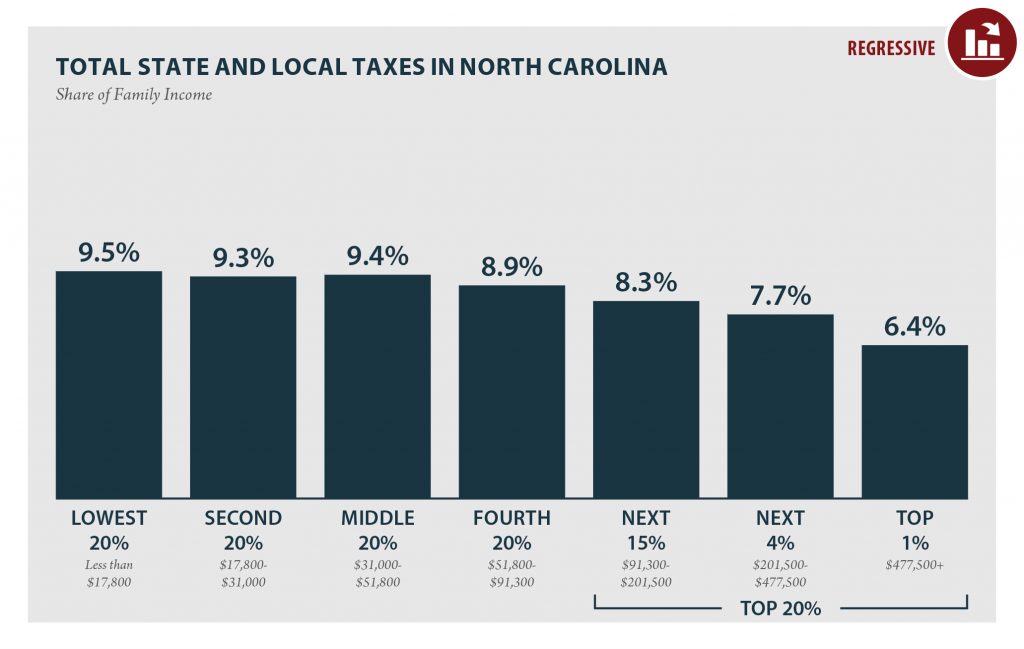
NORTH CAROLINA Read as PDF NORTH CAROLINA STATE AND LOCAL TAXES Taxes as Share of Family Income Top 20% Income Group Lowest 20% Second 20% Middle 20% Fourth 20% Next 15% Next 4% Top 1% Income Range Less than $17,800 $17,800 to $31,000 $31,000 to $51,800 $51,800 to $91,300 $91,300 to $201,500 $201,500 to $477,500 […]
Truthout: North Carolina Ballot Initiative Would Enshrine Tax Cuts for the Rich
October 16, 2018
“Since 2012, when Republicans took full control of the legislature and governorship for the first time in modern history, they’ve been on a tax cutting rampage,” said Meg Wiehe, a North Carolina native and deputy director of the Institute on Taxation and Economic Policy. “The state will be about $3.6 billion shorter in revenue than it would have been otherwise, which is a pretty significant difference in a state with a general fund of just around $21 billion.”
TalkPoverty: North Carolina Legislators Want to Add Tax Breaks for the Rich to the State Constitution
October 11, 2018
“Since 2012, when Republicans took full control of the legislature and governorship for the first time in modern history, they’ve been on a tax cutting rampage,” said Meg Wiehe, a North Carolina native and deputy director of the Institute on Taxation and Economic Policy. “The state will be about $3.6 billion shorter in revenue than it would have been otherwise, which is a pretty significant difference in a state with a general fund of just around $21 billion.”
BTC Report: Income tax rate cap amendment is costly for taxpayers, communities
September 28, 2018 • By ITEP Staff
Imposing an arbitrary income tax cap in the North Carolina Constitution could fundamentally compromise our state’s ability to fund our schools, roads, and public health, as well as raise the cost of borrowing. This could all happen even as the tax load shifts even further onto middle- and low-income taxpayers and the state’s highest income taxpayers — the top 1 percent — continue to benefit from recent tax changes since 2013.
