
Policy Briefs
196 posts

New Estimates of the Total Number of People and Children in Immigrant Families who Could Lose Eligibility for the Refundable Portions of the Earned Income Tax Credit and Child Tax Credit
• By Emma Sifre
Treasury and the IRS proposed a new rule that would further restrict eligibility for the refundable portions of four tax credits. The rule would affect primarily lawfully present immigrants authorized to work in the U.S. and their family members, including their children, the vast majority of whom are citizens.

State Earned Income Tax Credits Will Support Families and Workers in 2027
• By Neva Butkus
Nearly two-thirds of states (plus the District of Columbia and Puerto Rico) have an Earned Income Tax Credit. These credits boost low-paid workers’ incomes and offset some of the taxes they pay, helping working class families achieve greater economic security.

State Child Tax Credits Will Boost Financial Security for Families and Children in 2027
• By Neva Butkus
Sixteen states provide Child Tax Credits to reduce poverty, boost economic security, and invest in children. State lawmakers have several options to maximize the impact of Child Tax Credits.

The Impact of Proposed New Tax Credit Restrictions for Immigrant Filers: An Updated Analysis of the DACA Recipient Population
• By Carl Davis, Erika Frankel, Emma Sifre
New Treasury Department public regulations would drastically reduce tax credit claims by DACA recipients and their families, among others. We find that 158,000 people in households with at least one DACA recipient will suffer financial harm, and that more than half of the impacted individuals are U.S. citizens.

How Federal Tax Policy Can Address AI
• By Steve Wamhoff, Joe Hughes, Erika Frankel
Congress could use its taxing power to ensure a fairer distribution of the fruits of labor, innovation and investment, address the specific harms (the negative externalities) of AI specifically, and acquire a public stake in the companies that are driving the AI revolution.

The Changing Landscape of State Tax Rates
• By Sarah Austin
Many states have repeatedly cut top personal and corporate income tax rates in recent years, sometimes while approving increased sales tax rates to push tax systems in a more regressive direction. Other states, however, have charted a very different course and have moved to increase taxes on higher income households to fund public services.
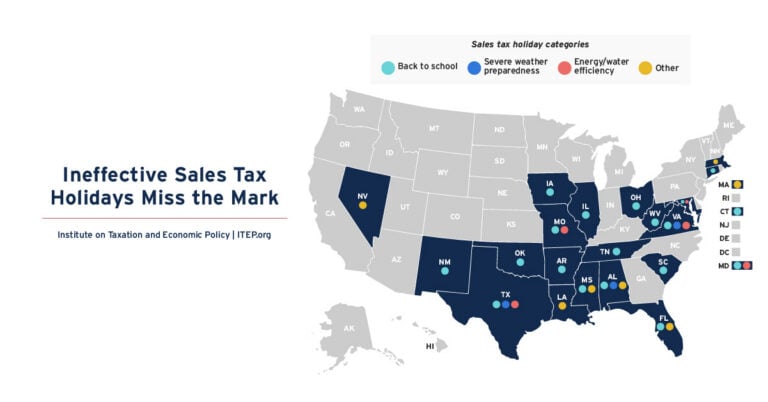
Ineffective Sales Tax Holidays Miss the Mark
• By Miles Trinidad
Twenty states have sales tax holidays in 2026. These sales tax holidays will cost states and localities nearly $600 million in lost revenue this year, and they're poorly targeted and too temporary to meaningfully change the regressive nature of a state’s tax system.

Missouri’s Amendment 5 Would Cut Taxes for the Rich and Raise Taxes on Seniors and the Middle Class
• By Eli Byerly-Duke
On August 4, Missouri voters will vote on whether to increase taxes on the middle class and seniors to fund tax cuts for the richest households in the state.
The Impact of Proposed New Tax Credit Restrictions for Immigrant Filers: An Analysis of the DACA Recipient Population
• By Carl Davis, Erika Frankel, Emma Sifre
We find that 337,000 people in households with at least one DACA recipient will suffer financial harm, and that nearly two-thirds (66 percent) of the impacted individuals are U.S. citizens.

The Impact of Proposed New Tax Credit Restrictions for Immigrant Filers: An Analysis of State EITCs
• By Neva Butkus
Immigrants and their families in as many as 30 states are at risk of seeing their state tax credits such as the Earned Income Tax Credit (EITC) and Child Tax Credit (CTC) reduced unless state lawmakers act.

The ‘Black Women Best’ Framework: An Innovative Method for Showing How Inheritance Taxes Affect the Racial Wealth Gap
• By Brakeyshia Samms, Francine Lipman
The approach posits that if policies improve the economic wellbeing of Black women, they will benefit the broader economic health of the rest of the population.

The Next Illegal, Costly Tax Cut for the Rich: Indexing Capital Gains
• By Steve Wamhoff
Proposals to index taxes on capital gains for inflation would overwhelmingly benefit the richest 1 percent and increase the deficit by nearly $1 trillion over a decade.

While States Debate New Trump Tax Changes, Equity Must Be at the Core
• By Brakeyshia Samms
States continue to debate whether and how to link their state tax codes to the 2025 federal tax law. This is not just a technical debate.

South Carolina’s Expensive, Regressive Tax Law Will Eliminate State’s Income Tax
• By Neva Butkus, Dylan Grundman O'Neill
South Carolina signed into law a regressive tax cut that will disproportionately benefit the state’s highest-income residents while simultaneously jeopardizing the state’s ability to pay for basic public services in the years to come.

Travelers’ Checks: How to Tax Tourists in States and Localities
• By Rita Jefferson
Taxing tourists is a relatively efficient way to ensure that visitors are paying a share of essential government services. Places with a modest number of tourists should limit general sales tax rates to minimize the effect on the full-time population. Places with higher proportions of tourists may have higher sales tax rates to better capture the economic behavior of tourists.

These States Are Most Impacted by the Spike in Gas Prices
• By Carl Davis
The recent spike in gasoline prices is on pace to cost American drivers an extra $9.4 billion per month. Gas prices are up dramatically across the country, but the South has been hit hardest and is on pace to pay $4.2 billion more per month.

How Four Big Pro-Trump Tech Companies Avoided Taxes
• By Steve Wamhoff, Matthew Gardner
The leaders of Alphabet, Amazon, Meta, and Tesla publicly supported Trump to ensure the most favorable corporate tax policies possible. And Trump delivered for them, both in his 2017 tax bill and again in 2025 with the so-called One Big Beautiful Bill Act.

Analysis of Sen. Chris Van Hollen’s Approach to Tax Policy
• By Steve Wamhoff
Sen. Chris Van Hollen has recently introduced the Working Americans’ Tax Cut Act, which offers a generous middle-class tax cut paid for with a new tax on millionaires.

State-by-State Estimates of the First Year of Trump’s Tax Policies: All But the Richest Americans Face Higher Taxes
• By Steve Wamhoff, Michael Ettlinger
As a result of the tax policies approved by President Trump and the Republican majority in Congress, all but the richest Americans are paying higher taxes on average in 2026 than they did last year.
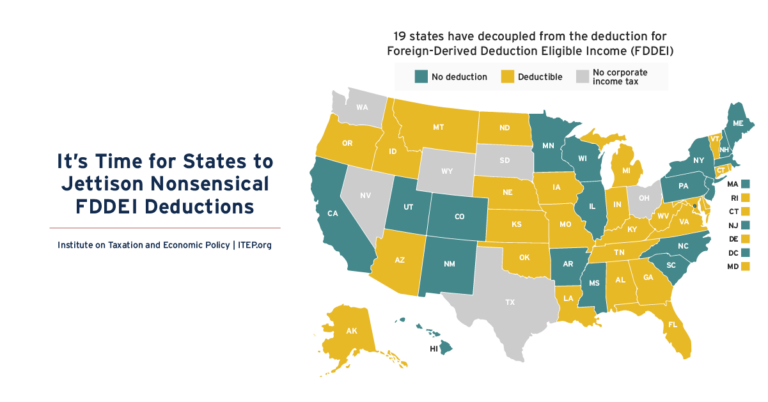
It’s Time for States to Jettison Nonsensical FDDEI Deductions
• By Carl Davis
FDDEI deductions should be repealed for policy reasons alone as they do not serve a legitimate purpose at the state level.

Michigan Ballot Proposal Would Boost Public Education While Creating a Fairer Tax System
• By Miles Trinidad, Matthew Gardner
A new proposal in Michigan would create a 5-percentage point surcharge on top earners with taxable incomes over $1 million for joint filers and $500,000 for single filers. This would raise about $1.7 billion a year, which would be used for public education priorities.

An Analysis of a Potential Reduction in Massachusetts’ Long-Term Capital Gains Tax Rate
• By Eli Byerly-Duke, Matthew Gardner
A ballot initiative in Massachusetts has proposed cutting the base rate for nearly all income sources from 5 to 4 percent. In 2026, this would cost the state about $5 billion per year of which $347 million would come from the reduced rate on long-term capital gains.

10 Reasons Why the U.S. Should Reform Its Corporate Income Tax
• By Steve Wamhoff
The U.S. needs a tax code that is more progressive and that raises more revenue than the one we have now. An important way to achieve this is to reform the taxation of business profits.

Tax Haven Data Demonstrate Need for Global Minimum Tax Despite Opposition from Trump Administration
• By Steve Wamhoff
American corporations use accounting gimmicks to make profits appear to be earned in tax havens. This widespread problem could be fixed by Congress enacting legislation to implement a minimum tax on corporations that meets the standards of the global minimum tax that other countries have begun to implement.

Linking to Tipped and Overtime Income Deductions Would Worsen State Shortfalls, Do Little to Help Workers
• By Neva Butkus, Galen Hendricks
State deductions for tips and overtime are not only ineffective at supporting working-class people, it will come at a substantial cost to state budgets.

Institute on Taxation
and Economic Policy
ITEP is a non-profit, non-partisan tax policy organization. We conduct rigorous analyses of tax and economic proposals and provide data-driven recommendations to shape equitable and sustainable tax systems.
Subscribe to ITEP Emails
Tax research and policy news in your inbox.
Promote Fair Tax Policy
Your gift to ITEP promotes tax justice. With your help, we do research that supports taxing millionaires and billionaires, taxing big corporations and raising revenue for the things our people, our communities and our planet need.
Together, we can create a country with more economic justice, more racial justice, more climate justice… and more tax justice.