
Louisiana

Invest in Louisiana: A Flat Tax Is Not the Answer
• By ITEP Staff
Louisiana’s economy works best when all of us have access to high-quality education and training, affordable health care and a strong public safety net that offers support during hard times.

State Rundown 9/18: Special Tax Session Results? “Reply Hazy, Try Again”
• By ITEP Staff
As the dust settles...

Extending Temporary Provisions of the 2017 Trump Tax Law: Updated National and State-by-State Estimates
• By Steve Wamhoff
The TCJA Permanency Act would make permanent the provisions of the Tax Cuts and Jobs Act of 2017 that are set to expire at the end of 2025. The legislation would disproportionately benefit the richest Americans. Below are graphics for each state that show the effects of making TCJA permanent across income groups. See ITEP’s […]
State Earned Income Tax Credits Support Families and Workers in 2024
• By Neva Butkus
Nearly two-thirds of states (31 plus the District of Columbia and Puerto Rico) have an Earned Income Tax Credit. These credits boost low-paid workers’ incomes and offset some of the taxes they pay, helping lower-income families achieve greater economic security.
State Rundown 9/5: Property Tax Policy Continues to Make Headlines
• By ITEP Staff
Property tax bills are undeniably a concern for many low- and moderate-income households across the nation...

Sales Tax Holidays Miss the Mark When it Comes to Effective Sales Tax Reform
• By Marco Guzman
Nineteen states have sales tax holidays on the books in 2024. These suspensions combined will cost states and localities over $1.3 billion in lost revenue this year. Sales tax holidays are poorly targeted and too temporary to meaningfully change the regressive nature of a state’s tax system.

Tax Payments by Undocumented Immigrants
• By ITEP Staff
Undocumented immigrants paid $96.7 billion in federal, state, and local taxes in 2022. Providing access to work authorization for undocumented immigrants would increase their tax contributions both because their wages would rise and because their rates of tax compliance would increase.
State Rundown 7/25: Summertime Hits Different in Different States
• By ITEP Staff
State lawmakers will have a lot to discuss when they compare notes on how they spent their summer vacations this year...
Improving Refundable Tax Credits by Making Them Immigrant-Inclusive
• By Emma Sifre, Marco Guzman
Undocumented immigrants who work and pay taxes but don't have a valid Social Security number for either themselves or their children are excluded from federal EITC and CTC benefits. Fortunately, several states have stepped in to ensure undocumented immigrants are not left behind by the gaps in the federal EITC and CTC. State lawmakers should continue to ensure that immigrants who are otherwise eligible for these tax credits receive them.
State Rundown 6/26: Summer Special Sessions Are In, Anti-tax Ballot Initiatives Out
• By ITEP Staff
Many families are heading out on summer vacations, but legislators across the country are heading back to statehouses for special sessions...

Tax Policy is a Part of the Black American Story
• By Brakeyshia Samms
Juneteenth is a reminder of the hard-fought victories that helped Black Americans secure their delayed freedom, justice, and suffrage. And in the chapters about tax policy, the tales are no less fraught. From America’s prologue to the last paragraph of the Civil War, governments raised more tax revenue from the taxation of Black bodies than […]
States Should Opt Into IRS Direct File as the Program is Made Permanent
• By Jon Whiten
While there is plenty of room to expand Direct File at the federal level, states can take matters into their own hands and bring this benefit to their residents by opting into the program.
State Rundown 5/22: When One Legislative Session Closes, Another Opens
• By ITEP Staff
State legislatures are wrapping up, but don’t stray too far from your state capital or you’ll miss out on the action...

Better Tax Codes Help Boost Teacher Pay
• By Alex Welch
There are a variety of factors that affect teacher pay. But one often overlooked factor is progressive tax policies that allow states to raise and provide the funding educators and their students deserve.
State Rundown 5/2: Vetoes and New Major Tax Proposals
• By ITEP Staff
This week, many states took steps toward enacting tax cuts...
State Rundown 3/28: Tax Cut Madness, But Our Brackets Bet on Tax Fairness
• By ITEP Staff
While madness is typically reserved for basketball in March, several high-profile, regressive tax cuts are making their way through state legislatures this week...
Eliminating Income Taxes Would Be an Expensive Giveaway
• By Aidan Davis
Governors and legislative leaders in a dozen states have made calls to fully eliminate their taxes on personal or corporate income, after many states already deeply slashed them over the past few years. The public deserves to know the true impact of these plans, which would inevitably result in an outsized windfall to states’ richest taxpayers, more power in the hands of wealthy households and corporations, extreme cuts to basic public services, and more deeply inequitable state…
State Rundown 2/22: Some Top-Heavy Tax Cut Proposals are Getting the Chop
• By ITEP Staff
With many state legislatures now in full swing with activity heating up, some tax cut proposals have lost steam...
State Rundown 2/1: Black History Month Begins as Tax Debates Heat Up Nationwide
• By ITEP Staff
This week the showdown between the Kansas legislature and governor continued as Gov. Kelly vetoed the legislature’s latest attempt to pass a flat personal income tax. Elsewhere, the focus is on doing more for working families through proposals to expand refundable credits in Maryland and adding a millionaire tax bracket in Rhode Island. Meanwhile, there’s […]
State Rundown 1/26: Wealth Taxes Drawing Interest Early in Legislative Sessions
• By ITEP Staff
Bills are moving and state legislative sessions are picking up across the country, giving elected officials the opportunity to consider two distinct paths when it comes to tax policy...
State Tax Watch 2024
• By ITEP Staff
Updated July 15, 2024 In 2024, state lawmakers have a choice: advance tax policy that improves equity and helps communities thrive, or push tax policies that disproportionately benefit the wealthy, drain funding for critical public services, and make it harder for low-income and working families to get ahead. Despite worsening state fiscal conditions, we expect […]

How the Fairness of State Tax Codes Affects Public Education
• By Carl Davis
The findings of Who Pays? go a long way toward explaining why so many states are failing to raise the amount of revenue needed to provide full and robust support for our public schools.
State Rundown 1/18: State Tax Priorities Taking Shape in 2024
• By ITEP Staff
Tax policy themes have begun to crop up in states as governors give their yearly addresses and legislators lay out their plans for the 2024 legislative season...
In Most States, the Tax Code Makes Inequality Worse
• By Carl Davis
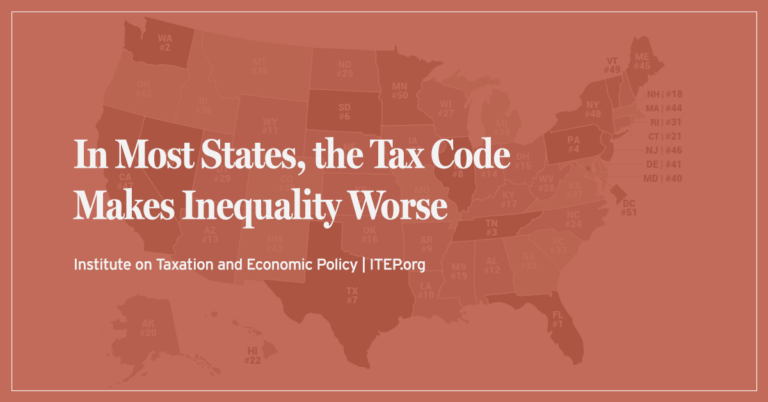
The vast majority of state and local tax systems are upside-down, with the wealthy paying a far lesser share of their income in taxes than low- and middle-income families. Yet a few states have made strides to buck that trend and have tax codes that are somewhat progressive and therefore do not worsen inequality.
Tax Systems in 44 States Exacerbate Inequality, In-Depth ‘Who Pays?’ Study Finds
• By ITEP Staff
The vast majority of state and local tax systems are upside-down, with the wealthy paying a far lesser share of their income in taxes than low- and middle-income families. That’s according to the latest edition of the Institute on Taxation and Economic Policy’s Who Pays?, the only distributional analysis of tax systems in all 50 states and the District of Columbia.

Institute on Taxation
and Economic Policy
ITEP is a non-profit, non-partisan tax policy organization. We conduct rigorous analyses of tax and economic proposals and provide data-driven recommendations to shape equitable and sustainable tax systems.
Subscribe to ITEP Emails
Tax research and policy news in your inbox.
Promote Fair Tax Policy
Your gift to ITEP promotes tax justice. With your help, we do research that supports taxing millionaires and billionaires, taxing big corporations and raising revenue for the things our people, our communities and our planet need.
Together, we can create a country with more economic justice, more racial justice, more climate justice… and more tax justice.