
New Hampshire
Below is a list of tax expenditure reports published in the states.
A veritable superbloom of tax and budget policies occurred over these last few weeks, including both flowers worth admiring and weeds worth fighting back.
State Rundown 4/30: Aloha to Tax Cuts, Hawaiʻi Lawmakers Address Revenue Gap with High-End Tax Changes
April 30, 2026 • By ITEP Staff
This week Hawaiʻi lawmakers reached a compromise to balance the state budget and maintain tax cuts for most residents by, in part, raising rates on the richest Hawaiians. Other states are working to generate revenue from their wealthiest residents, too.
State Tax Watch 2026
April 8, 2026 • By ITEP Staff
ITEP tracks tax discussions in legislatures across the country and uses our unique data capacity to analyze the revenue, distributional, and racial and ethnic impacts of many of these proposals. State Tax Watch offers the latest news and movement from each state.
State Rundown 3/26: Sobering Revenue Projections Keep States on Their Toes
March 26, 2026 • By ITEP Staff
This week, troubling revenue projections are making headlines, with many lawmakers scrambling to determine how the tax changes at the federal level, plus price hikes driven by national policy decisions, will impact their states.
State Rundown 3/12: Washington Lawmakers Pass Millionaires’ Tax, Expand Working Families Tax Credit
March 12, 2026 • By ITEP Staff
Washington is on its way to making history after the legislature approved the “millionaires’ tax,” a 9.9 percent tax on income over $1 million. The bill, which is expected to raise more than $3 billion a year, making significant investments in public education and childcare, will also expand the Working Families Tax Credit – the […]
Education Week: How Do Schools Solve a Problem Like Property Taxes?
February 19, 2026
As tax season dawns, backlash to a nationwide surge in property-tax bills is spurring states to double down on proposals to diminish one of the main revenue sources for school districts. At least 10 states are pitching the end of one of schools’ chief revenue sources. Read more.
NCTI is an Important Part of the Federal Corporate Tax. States Should Adopt It Too.
February 12, 2026 • By Carl Davis

Including NCTI in state corporate tax law is an effective way to neutralize much of the tax avoidance that occurs when multinational companies artificially shift their profits into overseas tax havens.
State Rundown 2/11: This Valentine’s Day, Conscious Decoupling Is Our Love Language
February 11, 2026 • By ITEP Staff
While some may be excited for a romantic Valentine’s Day this weekend, many state lawmakers are breaking up and decoupling from recent federal tax changes that are poised to leave states with revenue shortfalls – much like a bad date who forgets their wallet and asks you to pick up the tab.
State Rundown 1/22: Cautious Tone Noticeable in Most Statehouses
January 22, 2026 • By ITEP Staff
Most states are adopting a very cautious approach so far this year as legislators begin their sessions and governors make their annual addresses, thanks to ongoing economic uncertainty and federal retrenchment.
State Rundown 1/14: New Year Brings New Resolutions for Funding Key Priorities
January 14, 2026 • By ITEP Staff
State governors are beginning to lay out their top priorities as legislatures reconvene in statehouses around the country.
Texas Property Tax Plan Mimics California’s Damaging Prop 13
December 19, 2025 • By Neva Butkus, Rita Jefferson

This proposal would disrupt the state’s housing market and jeopardize local revenues while doing very little to help workers and families struggling to pay their property tax bills – just as Prop 13 did in California.
New Hampshire Fiscal Policy Institute: New Federal Reconciliation Law Reduces Taxes, Health Access, and Food Assistance Supports for Granite Staters
August 6, 2025 • By ITEP Staff
The new federal reconciliation law, signed on July 4, 2025, makes significant changes to programs that will impact Granite Staters. These changes include direct interactions with individuals and families, including reducing taxes for most residents, particularly those with higher incomes, and limiting access to both health services and food assistance. The new law also impacts the financial outlooks for both the State and federal governments, which may affect subsequent policy choices and services.
How Much Would Every Family in Every State Get if the Megabill’s Tax Cuts Given to the Rich Had Instead Been Evenly Divided?
July 14, 2025 • By Michael Ettlinger
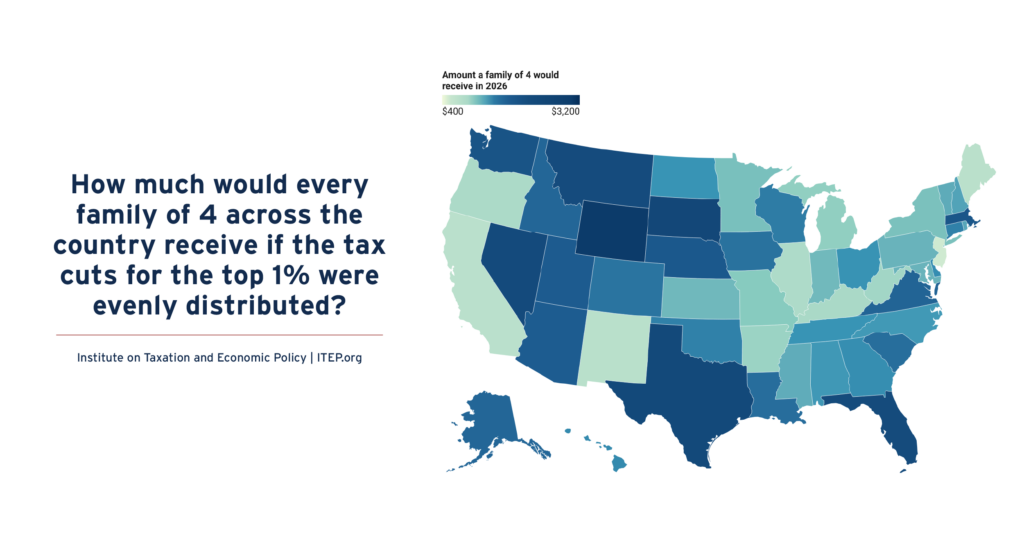
If instead of giving $117 billion to the richest 1 percent, that money had been evenly divided among all Americans, we'd each get $343 - or nearly $1,400 for a family of four.
Analysis of Tax Provisions in the Trump Megabill as Signed into Law: National and State Level Estimates
July 7, 2025 • By Steve Wamhoff, Carl Davis, Joe Hughes, Jessica Vela

President Trump has signed into law the tax and spending “megabill” that largely favors the richest taxpayers and provides working-class Americans with relatively small tax cuts that will in many cases be more than offset by Trump's tariffs.
Trump Megabill Will Give $117 Billion in Tax Cuts to the Top 1% in 2026. How Much In Your State?
June 30, 2025 • By Michael Ettlinger

The predominant feature of the tax and spending bill working its way through Congress is a massive tax cut for the richest 1 percent — a $114 billion benefit to the wealthiest people in the country in 2026 alone.
How Much Do the Top 1% in Each State Get from the Trump Megabill?
June 30, 2025 • By Carl Davis

The Senate tax bill under debate right now would bring very large tax cuts to very high-income people. In total, the richest 1 percent would receive $114 billion in tax cuts next year alone. That would amount to nearly $61,000 for each of these affluent households.
State legislatures are enjoying a relatively quiet period right now, though it is merely a temporary calm before the storm of the federal tax and budget debate begins raging again.

As the Washington, D.C. region heads toward a likely recession, local policymakers will need to look to new revenue sources to help lessen the pain. In D.C., lawmakers ought to adopt a simple reform that would raise substantial revenue and make the District’s business tax system fairer.
State Rundown 6/5: States Wrap Sessions, Some Prepare for Fiscal Uncertainty
June 5, 2025 • By ITEP Staff
States use the final hours of their legislative sessions to address deficits and preserve revenue in preparation for the times ahead.
Analysis of Tax Provisions in the House Reconciliation Bill: National and State Level Estimates
May 22, 2025 • By Carl Davis, Jessica Vela, Joe Hughes, Steve Wamhoff
The poorest fifth of Americans would receive 1 percent of the House reconciliation bill's net tax cuts in 2026 while the richest fifth of Americans would receive two-thirds of the tax cuts. The richest 5 percent alone would receive a little less than half of the net tax cuts that year.
America Has Left the Building: U.S. Loses from Our Global Tax Policy Choices, Others Could Gain
May 5, 2025 • By Amy Hanauer

Countries that once looked to the U.S. for direction on tax policy have concluded they need to form alliances without us. If so, it will often be to the benefit of other people around the globe and to the deficit of U.S. communities.
Want to know more about the tax and spending megabill that President Trump recently signed into law? We've got you covered.
Trump Administration’s Decision to End Direct File is Another Gift to Big Corporations
April 16, 2025 • By ITEP Staff
Contact: Jon Whiten ([email protected]) According to multiple reports, the Trump administration plans to eliminate the IRS Direct File program, a free electronic system for filing tax returns directly to the agency. Statement from ITEP Executive Director Amy Hanauer “The tax preparation industry has for years lobbied to prevent the IRS from providing a tool to […]
IRS Cooperation with ICE Will Damage Public Trust, Putting Tax Revenues in Jeopardy
April 10, 2025 • By Marco Guzman

Attempts by the Department of Homeland Security to secure private information from the IRS on people who file taxes with an Individual Taxpayer Identification Number is a violation of federal privacy laws that protect taxpayers. It is also a change that could seriously damage public trust in the IRS, which could jeopardize billions of dollars in tax payments by hardworking immigrant families.

Institute on Taxation
and Economic Policy
ITEP is a non-profit, non-partisan tax policy organization. We conduct rigorous analyses of tax and economic proposals and provide data-driven recommendations to shape equitable and sustainable tax systems.
Subscribe to ITEP Emails
Tax research and policy news in your inbox.
Promote Fair Tax Policy
Your gift to ITEP promotes tax justice. With your help, we do research that supports taxing millionaires and billionaires, taxing big corporations and raising revenue for the things our people, our communities and our planet need.
Together, we can create a country with more economic justice, more racial justice, more climate justice… and more tax justice.