
New Jersey
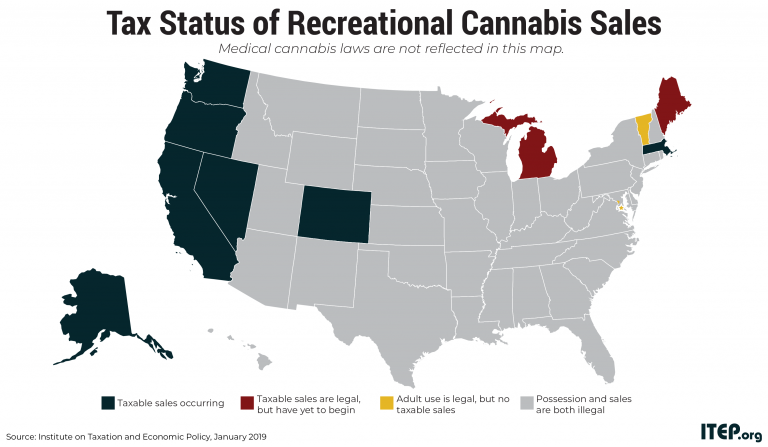
Cannabis Tax Debates are Ramping Up; Here’s What We’ve Learned from Five Years of Cannabis Taxation Thus Far
• By Carl Davis
This year lawmakers in Connecticut, Delaware, Hawaii, Illinois, New Jersey, New York, Rhode Island, and Vermont will all be debating the taxation of recreational cannabis. A new ITEP report reviews the track record of recreational cannabis taxes thus far and offers recommendations for structuring cannabis taxes to achieve stable revenue growth over the long haul.

State Rundown 1/18: Governors’ Speeches Kick Off State Fiscal Debates
• By ITEP Staff
Gubernatorial speeches and budget proposals dominated state fiscal news this week, as governors proposed a wide array of policies including positive reforms such as Earned Income Tax Credit (EITC) enhancements in CALIFORNIA, a capital gains tax on wealthy households in WASHINGTON, and investments in education in several states. Proposals to exempt more retirement income from tax, particularly for veterans, are a common theme so far this year, having been raised in multiple states including MARYLAND, MICHIGAN, and SOUTH CAROLINA. And NEW JERSEY became…
A Simple Fix for a $17 Billion Loophole: How States Can Reclaim Revenue Lost to Tax Havens
• By Richard Phillips
Enacting Worldwide Combined Reporting or Complete Reporting in all states, this report calculates, would increase state tax revenue by $17.04 billion dollars. Of that total, $2.85 billion would be raised through domestic Combined Reporting improvements, and $14.19 billion would be raised by addressing offshore tax dodging (see Table 1). Enacting Combined Reporting and including known tax havens would result in $7.75 billion in annual tax revenue, $4.9 billion from income booked offshore.

Who Pays and Why It Matters | MECEP Policy Insights Conference Keynote Address
• By Aidan Davis
States have broad discretion in how they secure the resources to fund education, health care, infrastructure, and other priorities important to communities and families. Aidan Davis with the Institute on Taxation and Economic Policy will offer a national perspective on state-level approaches to funding public investments and the implications of those approaches on tax fairness and revenue adequacy, and their economic outcomes. She’ll also provide insight on what’s in store for 2019 among the states.

Gov. Cuomo Has the Right Idea on How to Tax Recreational Cannabis
• By ITEP Staff
Following is a statement by Carl Davis, research director at the Institute on Taxation and Economic Policy, regarding the cannabis tax structure unveiled by New York Gov. Andrew Cuomo.
State Rundown 1/10: States Should Resolve to Pursue Equitable Tax Options
• By ITEP Staff
This week we released a handy guide of policy options for Moving Toward More Equitable State Tax Systems, and are pleased to report that many state lawmakers are promoting policies that are in line with our recommendations. For example, Puerto Rico lawmakers recently enacted a targeted EITC-like credit for working families, and leaders in Virginia and elsewhere are working toward similar improvements. Arkansas residents also saw their tax code improve as laws reducing regressive consumption…
State Rundown 12/19: Time to Rest and Recharge for Big Year Ahead
• By ITEP Staff
With many people enjoying time off over the next couple weeks, and the longest nights of the year coming over the weekend, now is a good time to get plenty of rest and relaxation in advance of what is likely to be a very busy 2019 for state fiscal policy and other debates. Among those debates, Kentucky lawmakers will be returning to topics they could not resolve in a brief special session held this week,…
NorthJersey.com: Democrats Taking Another Run at SALT Restoration
November 24, 2018
While it remains to be seen whether bipartisan support for a full or partial SALT restoration is feasible or even affordable in the new Congress, the fight – or at least the conversation – is one well worth having. Indeed, homeowners, particularly in the northern part of New Jersey, are going to be hit hard […]
State Rundown 11/16: Election Results Clarify Agendas as Real Work Begins
• By ITEP Staff
State policymakers, voters, and observers have been reflecting on this year’s campaigns and looking ahead to how the policy opportunities in their states have shifted as a result. For example, Arkansas’s governor sees a fresh chance to slash income taxes on the state’s wealthiest residents, while the governor-elect of Illinois will be doing just the opposite, launching into a promised effort to shore up the state’s budget by asking the wealthy to pay more. New…
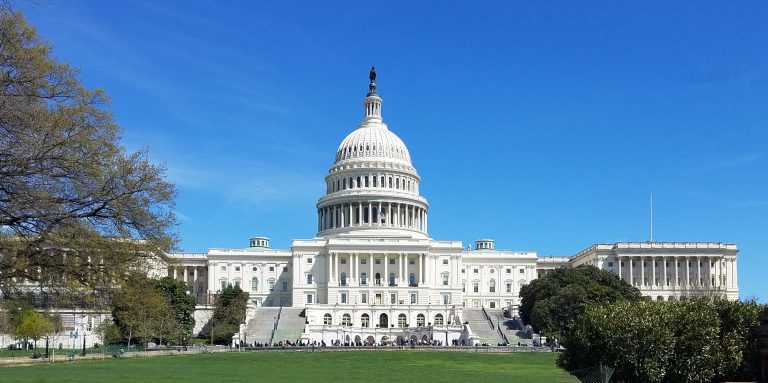
A Fair Way to Limit Tax Deductions
• By Carl Davis, Steve Wamhoff
The cap on federal tax deductions for state and local taxes (SALT) that is in effect now under the Tax Cuts and Jobs Act (TCJA) is a flawed provision but repealing it outright would be costly and provide a windfall to the rich. Congress should consider replacing the SALT cap with a different type of limit on deductions that would avoid both of these outcomes. Using the ITEP microsimulation tax model, this report provides revenue…

Three Tax Takeaways on Amazon’s Expansion Announcement
• By Carl Davis
Today Amazon announced major expansions in New York and Virginia, where it intends to hire up to 50,000 full-time employees. The announcement marks the culmination of a highly publicized search that lasted more than a year and involved aggressive courting of the company by cities across the nation. The following are three tax-related observations on the announcement.
NJ Spotlight: GOP Leaders Call on NJ Democrats to Reconsider Middle-class Tax Cuts
October 29, 2018
The related tax-cut bills — and another that would shield most retirement-savings contributions from state income taxes — were introduced at the start of the year but have not been posted for votes by the Democratic leaders who control the Assembly’s agenda. Bucco suggested a report released earlier this month by the left-leaning Institute on Taxation and Economic Policy that found middle-income taxpayers in New Jersey pay a higher effective tax rate than any other group —…
NorthJersey.com: 2018 Elections: Candidates Taking Wait-and-See Approach to SALT Deductions
• By ITEP Staff
A study by the Institute on Taxation and Economic Policy, a non-partisan think tank, found that a majority of New Jersey taxpayers in every income group will pay less taxes next year than they did in 2017 as a result of last year’s federal tax-code overhaul. The cap is expected to affect those in high-income brackets the most. Thousands of New Jersey homeowners rushed to prepay their 2018 taxes in December to take advantage of…
NJ Spotlight: New Jersey’s Tax System Ranked Among Fairest in the Country
• By ITEP Staff
A report on the fairness of state and local tax policy that was released yesterday by the Washington, D.C.-based Institute on Taxation and Economic Policy ranked New Jersey among the U.S. states with the most equitable tax systems. Read more
NJ BIZ: Report: NJ’s Top Earners Pay Lower Tax Share Than Middle-Income Families
October 17, 2018
New Jersey’s top earners enjoy vastly more wealth than the majority of New Jersey residents but pay a much lower percentage of taxes than middle-income families in the state. That’s according to a nationwide analysis released Wednesday by New Jersey Policy Perspective and the Institution of Taxation and Economic Policy.
Insider NJ: New Analysis: Middle Class Taxpayers in New Jersey Still Paying More Than Tax Rate Paid by Richest 1 Percent of New Jerseyans
• By ITEP Staff
A new study released today by the Institute on Taxation and Economic Policy (ITEP) and New Jersey Policy Perspective (NJPP) finds that New Jersey’s middle class families pay more in taxes as a percent of their income compared to the state’s wealthiest residents.
New Report Finds that Upside-down State and Local Tax Systems Persist, Contributing to Inequality in Most States
• By Aidan Davis
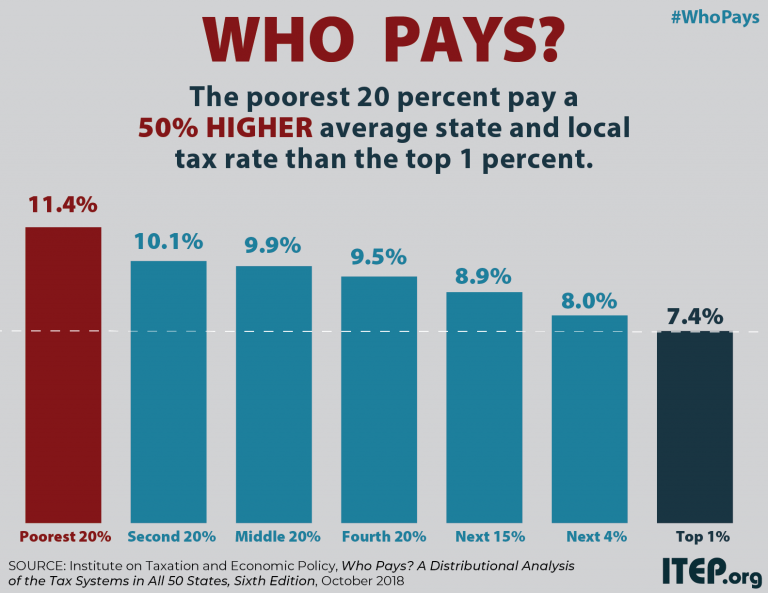
State and local tax systems in 45 states worsen income inequality by making incomes more unequal after taxes. The worst among these are identified in ITEP’s Terrible 10. Washington, Texas, Florida, South Dakota, Nevada, Tennessee, Pennsylvania, Illinois, Oklahoma, and Wyoming hold the dubious honor of having the most regressive state and local tax systems in the nation. These states ask far more of their lower- and middle-income residents than of their wealthiest taxpayers.
New Jersey: Who Pays? 6th Edition
• By ITEP Staff
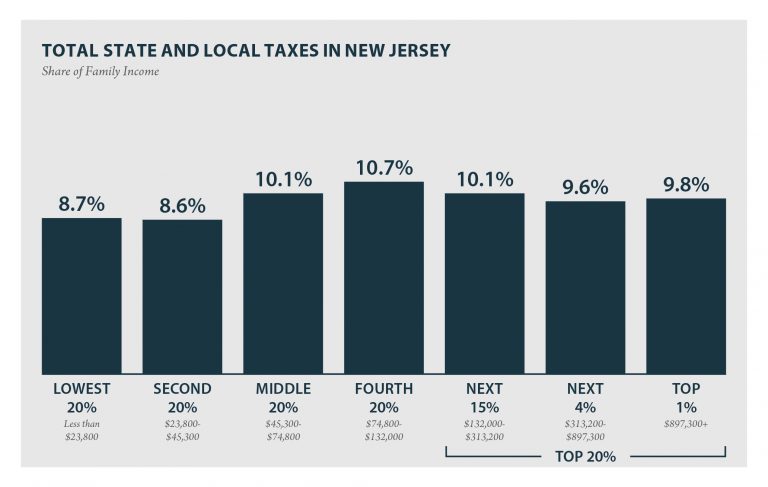
According to ITEP’s Tax Inequality Index, New Jersey’s state and local tax system does not worsen income inequality and ranks 46th on the index. The large income gap between lower- and middle-income taxpayers, as compared to the wealthy, is somewhat narrower after state and local taxes than before.
State Rundown 10/4: Ballot/Election Season in Full Swing
• By ITEP Staff
South Carolina lawmakers have finally passed a federal conformity bill in response to last year’s federal tax-cut legislation. Voters in many states are hearing a lot about tax-related questions they’ll see on the ballot in November, particularly residents of Florida, Montana, and Oregon, where corporate donors and other anti-tax interests are spending major sums to alter policy in their states. And states continue to work on ensuring they can collect online sales taxes and, in…
Tax Cuts 2.0 – New Jersey
• By ITEP Staff
The $2 trillion 2017 Tax Cuts and Jobs Act (TCJA) includes several provisions set to expire at the end of 2025. Now, GOP leaders have introduced a bill informally called “Tax Cuts 2.0” or “Tax Reform 2.0,” which would make the temporary provisions permanent. And they falsely claim that making these provisions permanent will benefit […]
State Rundown 9/26: States Cleaning Up from Florence, Gearing Up for November
• By ITEP Staff
Affordable housing efforts made news in Minnesota and Virginia this week, as tax breaks for homeowners and other victims of Hurricane Florence were made available in multiple states. Meanwhile, New Jersey is still looking into legalizing and taxing cannabis, and Wyoming continues to consider a corporate income tax. And gubernatorial candidates and ballot initiative efforts will give voters in many states much to consider in the November elections.

State Tax Codes Can Help Mitigate Poverty and Impact of Federal Tax Cuts on Low- and Middle-Income Families
• By Misha Hill
The national poverty rate declined by 0.4 percentage points to 12.3 percent in 2017. According to the U.S. Census, this was not a statistically significant change from the previous year. 39.7 million Americans, including 12.8 million children, lived in poverty in 2017. Median household income also increased for the third consecutive year, but this was […]
State Rundown 9/19: Don’t Call it a Comeback
• By ITEP Staff
The Rundown is back after a few-week hiatus, with lots of state fiscal news and quality research to share! Maine lawmakers found agreement on a response to the federal tax-cut bill, states continue to sort out how they’ll collect online sales taxes in the wake of the Wayfair decision, and policymakers in several states have been working on summer tax studies and other preparations for 2019 legislative sessions. Meanwhile, work on ballot measures and candidate tax plans to go before…
State Tax Codes as Poverty Fighting Tools: 2018 Update on Four Key Policies in All 50 States
• By Aidan Davis, Misha Hill
This report presents a comprehensive overview of anti-poverty tax policies, surveys tax policy decisions made in the states in 2018, and offers recommendations that every state should consider to help families rise out of poverty. States can jumpstart their anti-poverty efforts by enacting one or more of four proven and effective tax strategies to reduce the share of taxes paid by low- and moderate-income families: state Earned Income Tax Credits, property tax circuit breakers, targeted…

Rewarding Work Through State Earned Income Tax Credits in 2018
• By ITEP Staff
The Earned Income Tax Credit (EITC) is a policy designed to bolster the earnings of low-wage workers and offset some of the taxes they pay, providing the opportunity for struggling families to step up and out of poverty toward meaningful economic security. The federal EITC has kept millions of Americans out of poverty since its enactment in the mid-1970s. Over the past several decades, the effectiveness of the EITC has been magnified as many states…

Institute on Taxation
and Economic Policy
ITEP is a non-profit, non-partisan tax policy organization. We conduct rigorous analyses of tax and economic proposals and provide data-driven recommendations to shape equitable and sustainable tax systems.
Subscribe to ITEP Emails
Tax research and policy news in your inbox.
Promote Fair Tax Policy
Your gift to ITEP promotes tax justice. With your help, we do research that supports taxing millionaires and billionaires, taxing big corporations and raising revenue for the things our people, our communities and our planet need.
Together, we can create a country with more economic justice, more racial justice, more climate justice… and more tax justice.