
New Mexico
State Rundown 11/16: Election Results Clarify Agendas as Real Work Begins
November 16, 2018 • By ITEP Staff
State policymakers, voters, and observers have been reflecting on this year’s campaigns and looking ahead to how the policy opportunities in their states have shifted as a result. For example, Arkansas’s governor sees a fresh chance to slash income taxes on the state’s wealthiest residents, while the governor-elect of Illinois will be doing just the opposite, launching into a promised effort to shore up the state’s budget by asking the wealthy to pay more. New York and Virginia residents may end up with buyers’ remorse after Amazon accepted their combined $2 billion tax subsidy offers for its HQ2 project. And…
Tuesday’s elections shook up statehouses, governors’ offices, and tax laws in many states, and in this week’s Rundown we bring you the top 3 election state tax policy stories to emerge. First, voters in Kansas and other states sent a message that regressive tax cuts and supply-side economics have not succeeded and are not welcome among their state fiscal policies. Meanwhile, residents of many other states, including most notably Illinois, voted for representatives who reflect their preference for equitable, sustainable policies to improve their state economies through smart public investments and improve the lives of all residents through progressive tax structures. Lastly, while some states missed…
New Mexico Voices for Children: The Next Governor Should Improve Our Tax System and Increase Wages
November 2, 2018
When it comes to fairness, New Mexico’s tax system is backwards. Those who earn the smallest incomes pay the highest rates in state and local taxes, according to a new report from the Institute on Taxation and Economic Policy. The responsibility for taxes should not fall hardest on those with the least ability to pay, but it does. There are several ways we can make our tax system fairer.
KRWG: Lowest-Income Taxpayers in NM Pay 1.8 Times the Tax Rate Paid by the Richest New Mexicans
October 18, 2018
Commentary: A new study released by the Institute on Taxation and Economic Policy (ITEP) finds that the lowest-income New Mexicans pay a state and local tax rate that is almost double what the state’s wealthiest residents pay as a share of their income.
New Mexico Voices for Children: New Analysis: Lowest-Income Taxpayers in NM Pay 1.8 Times the Tax Rate Paid by the Richest New Mexicans
October 17, 2018
“Taxes are the way we accomplish great things for our state – build our schools and infrastructure, provide health care and public safety, and more,” said James Jimenez, executive director of New Mexico Voices for Children, which partnered with ITEP on the report release. “These systems and services underpin our economy and improve our quality of life. We all need to do our part to support them, but our current state tax system ensures that those who can afford to pay the most actually pay the least.”
Public News Service: Report: NM Tax Overhaul Would Benefit Kids, Families
October 17, 2018
Regressive tax systems hurt children and families, according to a new report from the Institute on Taxation and Economic Policy - and by that standard, it says New Mexico has the 19th-worst tax system in the United States. The study showed that as a share of their income, the lowest-income New Mexicans are paying state and local tax rates almost double those of the state's wealthiest residents.
New Mexico: Who Pays? 6th Edition
October 17, 2018 • By ITEP Staff
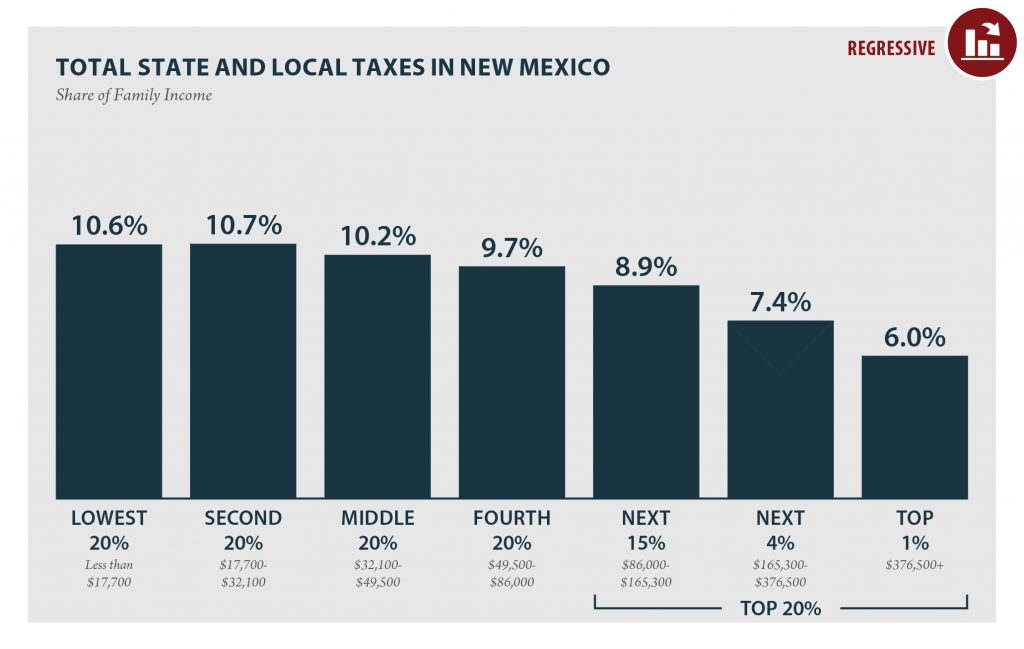
NEW MEXICO Read as PDF NEW MEXICO STATE AND LOCAL TAXES Taxes as Share of Family Income Top 20% Income Group Lowest 20% Second 20% Middle 20% Fourth 20% Next 15% Next 4% Top 1% Income Range Less than $17,700 $17,700 to $32,100 $32,100 to $49,500 $49,500 to $86,000 $86,000 to $165,300 $165,300 to $376,500 […]
Tax Cuts 2.0 – New Mexico
September 26, 2018 • By ITEP Staff
The $2 trillion 2017 Tax Cuts and Jobs Act (TCJA) includes several provisions set to expire at the end of 2025. Now, GOP leaders have introduced a bill informally called “Tax Cuts 2.0” or “Tax Reform 2.0,” which would make the temporary provisions permanent. And they falsely claim that making these provisions permanent will benefit […]
Reducing the Cost of Child Care Through State Tax Codes in 2018
September 17, 2018 • By Aidan Davis
Families in poverty contribute over 30 percent of their income to child care compared to about 6 percent for families at or above 200 percent of poverty. Most families with children need one or more incomes to make ends meet which means child care expenses are an increasingly unavoidable and unaffordable expense. This policy brief examines state tax policy tools that can be used to make child care more affordable: a dependent care tax credit modeled after the federal program and a deduction for child care expenses.
Consumers’ growing interest in online shopping and “gig economy” services like Uber and Airbnb has forced states and localities to revisit their sales taxes, for instance. Meanwhile new evidence on the dangers and causes of obesity has led to rising interest in soda taxes, but the soda industry is fighting back. Carbon taxes are being discussed as a tool for combatting climate change. And changing attitudes toward cannabis use have spurred some states to move away from outright prohibition in favor of legalization, regulation and taxation.
Although most state legislatures are out of session during the summer, the pursuit of better fiscal policy has no "off-season." Here at ITEP, we've been revamping the State Rundown to bring you your favorite summary of state budget and tax news in the new-and-improved format you see here. Meanwhile, leaders in Massachusetts and New Jersey have been hard at work in recent weeks and are already looking ahead their next round of budget and tax debates. Lawmakers in many states are using their summer break to prepare for next year's discussions over how to implement online sales tax legislation. And…
Sales Tax Holidays: An Ineffective Alternative to Real Sales Tax Reform
July 12, 2018 • By Dylan Grundman O'Neill
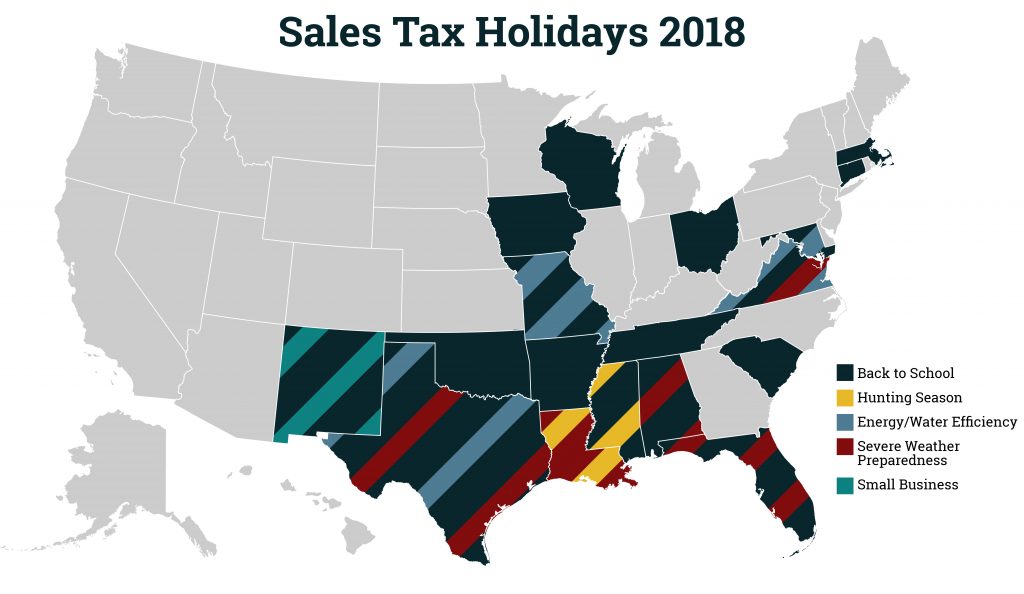
An updated version of this brief for 2019 is available here. Read this report in PDF. Overview Sales taxes are an important revenue source, composing close to half of all state tax revenues.[1] But sales taxes are also inherently regressive because the lower a family’s income, the more the family must spend on goods and […]
With many state fiscal years beginning July 1, most states that will make decisions this year about federal tax conformity have now done so, so it is now time for an update on how well state policymakers have kept to, or veered from, the path we charted out earlier this year. Most states that have enacted laws in response to the federal changes have adhered to some but not all of the principles we laid out, with a few responding rather prudently and a handful charting a much more treacherous course of unfair, unsustainable policy based on unfounded promises of…
This week, lawmakers in Louisiana, Pennsylvania, Rhode Island, Vermont, and the District of Columbia wrapped up their budgets in time for the new fiscal year that starts July first in most states, with some of these resolutions coming after contentious debates and repeated special sessions. New Jersey's debate is not yet finished as leaders clash over spending priorities and the taxes on millionaires and corporations needed to fund them. Meanwhile, signature drives to put tax-related questions on fall ballots are heating up in several other states. And our "What We're Reading" section includes helpful resources on implications of the Supreme…
New Tax Subsidy for Private K-12 Tuition in Massachusetts Creates a Host of Problems
May 9, 2018 • By Carl Davis

Last year’s federal tax cut bill changed 529 college savings accounts in a major way, expanding them so that they can be used as tax shelters by higher-income families who choose to send their children to private K-12 schools. This controversial change was added in the Senate by the slimmest of margins—requiring a tie-breaking vote […]
Trends We’re Watching in 2018, Part 5: 21st Century Consumption Taxes
April 20, 2018 • By Misha Hill
We're highlighting the progress of a few newer trends in consumption taxation. This includes using the tax code to discourage consumption of everything from plastic bags to carbon and collecting revenue from emerging industries like ride sharing services and legalized cannabis sales.
New Mexico Voices for Children: Celebrate Democracy- It’s Tax Day!
April 17, 2018
While it’s easy to tick off a list of the things we enjoy that are paid for out of our taxes, paying taxes is really a moral duty that we all participate in. It is a contract that we honor collectively because it’s the way we invest in our communities. In fact, some research shows that Americans […]
State Rundown 4/13: Teacher Strikes, Special Sessions, Federal Cuts Haunting States
April 13, 2018 • By ITEP Staff
This Friday the 13th is a spooky one for many state lawmakers, as past bad fiscal decisions have been coming back to haunt them in the form of teacher strikes and walk-outs in Arizona, Kentucky, and Oklahoma. Meanwhile, policymakers in Maryland, Nebraska, New Jersey, Oregon, and Utah all attempted to exorcise negative consequences of the federal tax-cut bill from their tax codes. And our What We're Reading section includes yet another stake to the heart of the millionaire tax-flight myth and other good reads.
The U.S. Supreme Court is scheduled to consider a case next week (South Dakota v. Wayfair, Inc.) that has the potential to significantly improve states and localities’ ability to enforce their sales tax laws on Internet purchases.
What to Expect if the Supreme Court Allows for Online Sales Tax Collection
April 11, 2018 • By Carl Davis

Online shopping is hardly a new phenomenon. And yet states and localities still lack the authority to require many Internet retailers to collect the sales taxes that their locally based, brick and mortar competitors have been collecting for decades.
Politifact: The Facts Behind Trump’s Jabs at Amazon on Taxes, USPS and Lost Retail Jobs
March 30, 2018
Amazon paid $957 million in income tax in 2017, according to regulatory filings. Amazon paid nothing in federal taxes this year thanks to tax credits and, in large part, Trump’s new tax law. But the Institute on Taxation and Economic Policy found that Amazon is either not collecting local taxes or is charging a lower […]
Fortune: President Trump Claims Amazon Pays “Little or No Taxes.” Here’s Where He’s Wrong
March 30, 2018
Where Trump is correct: Amazon doesn’t collect taxes on behalf of third-party vendors, and it still may not collect some local taxes, giving it an advantage over some traditional retailers, according to the Institute on Taxation and Economic Policy, a think tank. According to an analysis from the ITEP, the gap between the tax rate […]
Bloomberg Law: Trump’s Amazon Tweet Comes at Eventful Time for State-Local Taxes
March 30, 2018
Meanwhile, Amazon may not be paying its share of local sales taxes. A report released March 26 by the left-leaning Institute on Taxation and Economic Policy said Amazon either doesn’t collect and remit local sales tax or is charging a lower sales tax rate than traditional retailers in seven states: Alabama, Alaska, Idaho, Iowa, Mississippi, […]
Dallas Morning News: Texas Was Tougher Than Other States in Dealing with Amazon on Sales Taxes
March 30, 2018
When a Dallas resident or shopper in College Station or Lubbock makes a purchase from Amazon or any other online retailer with a physical presence in Texas such as Wayfair and RH.com, the state gets its 6.25 percent. The cities get their local sales taxes too. In Dallas, that’s an additional 2 percent for a […]
New York Times: As Amazon Steps Up Tax Collections, Some Cities Are Left Out
March 27, 2018
When Amazon agreed last year to begin collecting sales tax in New Mexico, state officials celebrated what they said could be tens of millions of dollars in annual tax revenue. But they aren’t cheering in Albuquerque City Hall. A year after that announcement, New Mexico’s largest city hasn’t seen a dime from Amazon. That’s because […]

Institute on Taxation
and Economic Policy
ITEP is a non-profit, non-partisan tax policy organization. We conduct rigorous analyses of tax and economic proposals and provide data-driven recommendations to shape equitable and sustainable tax systems.
Subscribe to ITEP Emails
Tax research and policy news in your inbox.
Promote Fair Tax Policy
Your gift to ITEP promotes tax justice. With your help, we do research that supports taxing millionaires and billionaires, taxing big corporations and raising revenue for the things our people, our communities and our planet need.
Together, we can create a country with more economic justice, more racial justice, more climate justice… and more tax justice.