
Texas
As states prepare for the revenue loss and disruption resulting from the federal tax bill, tax policy is being considered in legislatures across the country.
State Rundown 7/24: States Begin Preparing for Federal Megabill Fallout
July 24, 2025 • By ITEP Staff
All eyes in statehouses in recent weeks have been on federal budget negotiations, and now that the “megabill” has passed, they are focused in on their own budgets in search of ways to cope with the enormous consequences coming their way. All states will see fewer federal dollars flowing through their coffers, higher needs due […]
Sales Tax Holidays Miss the Mark When it Comes to Effective Sales Tax Reform
July 17, 2025 • By Miles Trinidad

Sales tax holidays are often marketed as relief for everyday families, but they do little to address the deeper inequities of regressive sales taxes. In 2025, 18 states offer these holidays at a collective cost of $1.3 billion.
Anti-Tax Revolts Backfire: What We’ve Learned from 50 Years of Property Tax Limits
July 15, 2025 • By Rita Jefferson

Across-the-board property tax cuts create less fair local tax systems in the long run. State legislators and local governments should prioritize the residents who can least afford their property taxes, not the residents and businesses who can.
How Much Would Every Family in Every State Get if the Megabill’s Tax Cuts Given to the Rich Had Instead Been Evenly Divided?
July 14, 2025 • By Michael Ettlinger
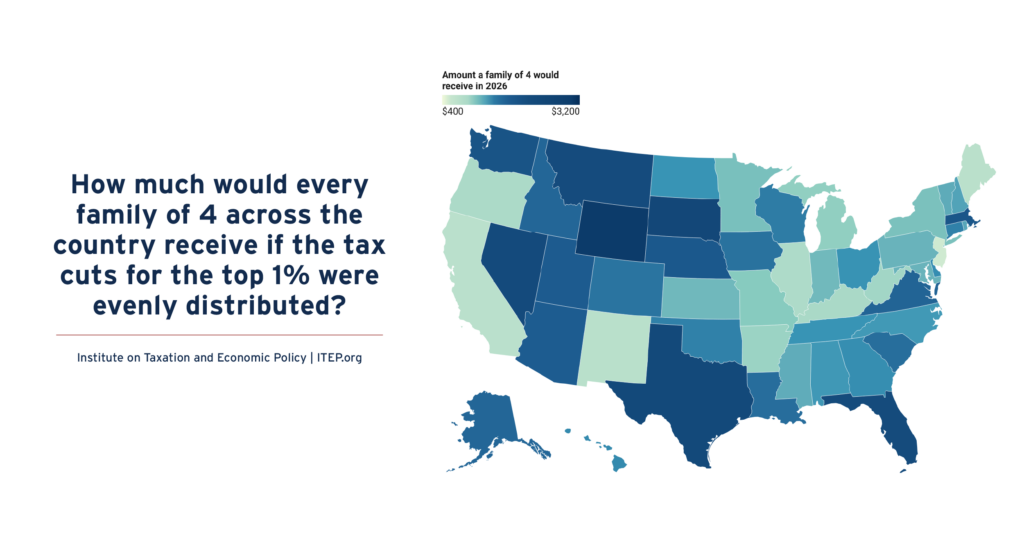
If instead of giving $117 billion to the richest 1 percent, that money had been evenly divided among all Americans, we'd each get $343 - or nearly $1,400 for a family of four.
10 Crazy Comparisons Showing How Much Trump and Congress Just Cut Taxes for the Rich
July 10, 2025 • By ITEP Staff

$117 billion is a big number, so we thought it could use a little context.
State Rundown 7/8: State Tax Cuts Continue Despite Federal Megabill Passing
July 8, 2025 • By ITEP Staff
The last states are wrapping up legislative sessions, and some are crossing the finish line with major income tax cuts.
Analysis of Tax Provisions in the Trump Megabill as Signed into Law: National and State Level Estimates
July 7, 2025 • By Steve Wamhoff, Carl Davis, Joe Hughes, Jessica Vela

President Trump has signed into law the tax and spending “megabill” that largely favors the richest taxpayers and provides working-class Americans with relatively small tax cuts that will in many cases be more than offset by Trump's tariffs.
Houston Chronicle: The Biggest Winners in Texas from Trump’s ‘Big, Beautiful Bill’
July 1, 2025
Most every Texan stands to see at least some benefit from the tax cuts at the heart of President Donald Trump’s “big, beautiful bill.” But the biggest benefits are geared toward the wealthiest people, who will not only continue to enjoy hefty tax cuts but also gain access to a host of new tax breaks of […]

As federal aid ends and economic uncertainty grows, local governments face tough budget choices. Now is the time for localities to protect vulnerable residents and build stronger, more equitable fiscal foundations.
Trump Megabill Will Give $117 Billion in Tax Cuts to the Top 1% in 2026. How Much In Your State?
June 30, 2025 • By Michael Ettlinger

The predominant feature of the tax and spending bill working its way through Congress is a massive tax cut for the richest 1 percent — a $114 billion benefit to the wealthiest people in the country in 2026 alone.
How Much Do the Top 1% in Each State Get from the Trump Megabill?
June 30, 2025 • By Carl Davis

The Senate tax bill under debate right now would bring very large tax cuts to very high-income people. In total, the richest 1 percent would receive $114 billion in tax cuts next year alone. That would amount to nearly $61,000 for each of these affluent households.
State Rundown 6/20: Federal tax policy heats up, states wrap sessions and weigh impacts
June 18, 2025 • By ITEP Staff
As state legislative sessions come to a close, decisions on tax policy are being made. Several southern states have cut taxes, while the northeast is making some more measured reforms.
State Rundown 6/5: States Wrap Sessions, Some Prepare for Fiscal Uncertainty
June 5, 2025 • By ITEP Staff
States use the final hours of their legislative sessions to address deficits and preserve revenue in preparation for the times ahead.
House Bill’s $164 Billion Giveaway to Multinational Corporations Puts America Last
May 27, 2025 • By Sarah Austin

The House of Representatives’ recently passed tax bill changes course on taxing multinational corporations engaged in shifting U.S. profits overseas, offering massive tax giveaways that weaken American revenues and risk sending more American corporate investment offshore.
Analysis of Tax Provisions in the House Reconciliation Bill: National and State Level Estimates
May 22, 2025 • By Carl Davis, Jessica Vela, Joe Hughes, Steve Wamhoff
The poorest fifth of Americans would receive 1 percent of the House reconciliation bill's net tax cuts in 2026 while the richest fifth of Americans would receive two-thirds of the tax cuts. The richest 5 percent alone would receive a little less than half of the net tax cuts that year.
State Rundown 5/7: As Budget Season Heats Up, Tax Proposals Are Getting Serious
May 7, 2025 • By ITEP Staff
With spring in full bloom ,many state lawmakers are reaching tax policy agreements. Out west, lawmakers in North Dakota and Texas have moved major property tax cuts. Meanwhile, in the east and south, Vermont appears likely to pass an expansion to its Child Tax Credit and Earned Income Tax Credit, and South Carolina lawmakers are aiming to make deep, drastic cuts to the state’s income tax.

Want to know more about the tax and spending megabill that President Trump recently signed into law? We've got you covered.
State Rundown 4/24: States Push Tax Cuts Despite Fiscal Uncertainty
April 24, 2025 • By ITEP Staff
While some states are preparing for uncertainty – slowing revenue growth, chaos from unpredictable tariffs, cuts to federal programs, etc. – others continue to move forward with plans for deep tax cuts. For instance, Georgia Gov. Brian Kemp signed legislation accelerating the cut to the personal income tax rate, which is currently phasing down. […]
Millions of Citizen Children Would be Harmed by Proposal Billed as Targeting Immigrant Tax Filers
April 24, 2025 • By Emma Sifre, Joe Hughes

Congressional Republicans have floated a proposal to strip the Child Tax Credit from millions of children who are U.S. citizens and legal residents in situations where their parents do not have Social Security numbers. Approximately 4.5 million citizen children with Social Security numbers would lose access to the credit under this proposal.
Trump Administration’s Decision to End Direct File is Another Gift to Big Corporations
April 16, 2025 • By ITEP Staff
Contact: Jon Whiten ([email protected]) According to multiple reports, the Trump administration plans to eliminate the IRS Direct File program, a free electronic system for filing tax returns directly to the agency. Statement from ITEP Executive Director Amy Hanauer “The tax preparation industry has for years lobbied to prevent the IRS from providing a tool to […]
IRS Cooperation with ICE Will Damage Public Trust, Putting Tax Revenues in Jeopardy
April 10, 2025 • By Marco Guzman

Attempts by the Department of Homeland Security to secure private information from the IRS on people who file taxes with an Individual Taxpayer Identification Number is a violation of federal privacy laws that protect taxpayers. It is also a change that could seriously damage public trust in the IRS, which could jeopardize billions of dollars in tax payments by hardworking immigrant families.
Every Texan: Texas Taxes Are Upside-Down. Big Tax Cuts Don’t Help.
March 18, 2025 • By ITEP Staff
Texas’ tax system is upside-down. When it comes to funding our public services, schools, and state and local governments, Texans with lower incomes are expected to pay more than their fair share. Read more.
Learn from Prop 13 History to Avoid Repeating Past Mistakes
February 26, 2025 • By Rita Jefferson

Worries about housing costs and property tax bills are leading people to check the history books for solutions, but there’s a danger that they’ll repeat past mistakes. If anti-tax lawmakers carelessly weaken property taxes as they did in the 1970s, as they did with California’s Proposition 13, they will undercut public finances, making municipalities, school districts, and other special districts worse off.
State Rundown 2/20: Tools to Address Corporate Tax Avoidance and Property Tax Affordability
February 20, 2025 • By ITEP Staff
A new ITEP report finds that states could raise $19 billion a year with one policy change targeting corporate tax avoidance. That policy, worldwide combined reporting, strengthens state corporate taxation by giving states a full view of multinational corporate profits, essentially eliminating the tax savings that companies currently see by pretending their profits were earned in Switzerland, the Cayman Islands, and other international tax havens.

Institute on Taxation
and Economic Policy
ITEP is a non-profit, non-partisan tax policy organization. We conduct rigorous analyses of tax and economic proposals and provide data-driven recommendations to shape equitable and sustainable tax systems.
Subscribe to ITEP Emails
Tax research and policy news in your inbox.
Promote Fair Tax Policy
Your gift to ITEP promotes tax justice. With your help, we do research that supports taxing millionaires and billionaires, taxing big corporations and raising revenue for the things our people, our communities and our planet need.
Together, we can create a country with more economic justice, more racial justice, more climate justice… and more tax justice.