
Washington
KUOW: Why Washington Ranks as the Worst State for Poor Residents
March 12, 2019
Washington ranks as the worst state for low-income earners to live, and it’s notably worse than any other state. The Institute on Taxation and Economic Policy (ITEP) places Washington, Texas and Florida at the top of the “terrible 10” list in its annual report. The institute says these have the most regressive tax systems, in […]
Washington Post: State and Local Tax Laws Are Making the Rich Richer
March 6, 2019
State and local taxes effectively redistribute national income from the poor to the very rich, according to data released this week by the Institute on Taxation and Economic Policy, a progressive think tank. Many state and local governments are heavily reliant on sales taxes, rather than income taxes. Lower-income households tend to spend a greater […]
Bloomberg: Democrats In the Home of Hedge Funds Are Divided Over Tax Plans Sparing Rich
March 1, 2019
“Most public finance experts will tell you if you have sales tax it should be applied to a broad base,” said Carl Davis, the research director at the Institute on Taxation and Economic Policy in Washington. “If people are no longer going to Blockbuster and now they’re downloading movies, that’s created a gap in the […]
Bloomberg Tax: Tax Executives Fear Overhaul Impermanence as Dems Mull Tweaks
February 28, 2019
The GILTI income subject to the tax is the income earned through a controlled foreign corporation that exceeds 10 percent of the value of the CFC’s tangible, depreciable assets, such as machinery and other equipment. The Institute on Taxation and Economic Policy, a Washington think tank, said in a June 2018 post that this measurement […]
Washington Post: Amazon Paid No Federal Taxes on $11.2 Billion in Profits Last Year
February 16, 2019
Amazon, the e-commerce giant helmed by the world’s richest man, paid no federal taxes on profit of $11.2 billion last year, according to an analysis of the company’s corporate filings by the Institute for Taxation and Economic Policy (ITEP), a progressive think tank. Read more

The Tax Cuts and Jobs Act (TCJA), enacted by President Trump and Congressional Republicans at the end of 2017, has caused quite a bit of confusion, and a recent “Fact Checker” column by the Washington Post’s Glenn Kessler does not help. TCJA created real problems that can't be resolved without real tax reform. To begin that process fact checkers, lawmakers, and everyone else need to be clear about what TCJA did, and did not, do to our tax system.
Newsweek: We Shouldn’t Wait for Washington to Tax the Rich: We Can Begin at the State Level
February 11, 2019
Following is an excerpt from an op-ed by ITEP deputy director Meg Wiehe published in Newsweek Magazine: The historic role tax and other policies have played in exacerbating the wealth divide and discussions about how to remedy this injustice is a national conversation that is long overdue. Examining the federal policy landscape is a logical […]
Washington Post: Live Commentary on Trump’s SOTU
February 5, 2019
E.J. DIONNE JR., 9:27 p.m.: “A massive tax cut for working families.” Really? “If you look at the richest 1 percent, they’re getting more than the bottom 60 percent of Americans,” said Steve Wamhoff, director of federal tax policy at the Institute on Taxation and Economic Policy. Read more
Data for the Win: Advocating for Equitable State and Local Tax Policy (Webinar)
January 30, 2019 • By Aidan Davis, Dylan Grundman O'Neill, ITEP Staff, Meg Wiehe
Watch the video recording below for discussion on how ITEP’s distributional data can be part of an advocacy and communications strategy for securing state tax policies that raise enough revenue to fund various priorities. Outline includes a brief overview of findings from the sixth edition of Who Pays? A Distributional Analysis of the Tax Systems in All 50 States as well as insight from state advocates who use Who Pays? and other tax policy analyses research to pursue their legislative agendas.
Washington Post: Warren’s Push for a Wealth Tax Could Be a Game Changer
January 29, 2019
Many on the right are already lashing out at Warren’s proposal. (On Fox News, it was preposterously likened to Venezuelan socialism.) Others have argued that it would be unconstitutional, a dubious claim that relies on a controversial 1895 Supreme Court ruling that, as the Institute on Taxation and Economic Policy explains, “has been limited to […]
Washington Post: Elizabeth Warren to Propose Wealth Tax
January 25, 2019
Estimates of how much money can be raised by taxing the very rich vary dramatically. The Institute on Taxation and Economic Policy, a left-leaning think tank, published a report on Wednesday finding that a 1 percent wealth tax on the wealthiest 0.1 percent of Americans would raise $1.3 trillion over a decade. That would affect […]
Wall Street Journal: Democrat Elizabeth Warren Proposes Wealth Tax
January 24, 2019
That is roughly 10 times the revenue that the current estate and gift taxes are projected to raise, but Ms. Warren’s “ultramillionaire-tax” proposal on the top 0.1% isn’t just about generating money to pay for government programs. It marks Democrats’ intense emphasis on inequality as the party tries to reclaim the White House in 2020. […]
New York Times: Warren’s Plan Is Latest Push by Democrats to Raise Taxes on the Rich
January 24, 2019
Ms. Warren appears to be the first declared Democratic candidate to release a plan for a wealth tax, but the idea is quickly gaining steam among liberal activists and policy experts. Two think tanks, the Institute on Taxation and Economic Policy and the Washington Center for Equitable Growth, released wealth-tax-themed policy briefs this week in […]
Bloomberg: Cannabis Excise Tax Revenue Could Eclipse Alcohol Revenue in 2019
January 23, 2019
Excise tax revenue from marijuana sales is expected to surpass alcohol excise collections in 2019, according to the co-author of a new report. Carl Davis, a research director at the Institute on Taxation and Economic Policy, noted in his report that state and local retail marijuana excise tax collections already rivaled alcohol tax collections in […]
Five Years in, Cannabis Tax Haul Rivals or Exceeds Alcohol Taxes in Many States
January 23, 2019 • By ITEP Staff
A first-of-its-kind look at state excise taxes on legal cannabis sales finds that taxing the substance can be a meaningful source of state revenue but cautions that achieving sustainable revenues over time will be difficult under the price-based tax structures adopted in most states thus far.
Cannabis Tax Debates are Ramping Up; Here’s What We’ve Learned from Five Years of Cannabis Taxation Thus Far
January 23, 2019 • By Carl Davis
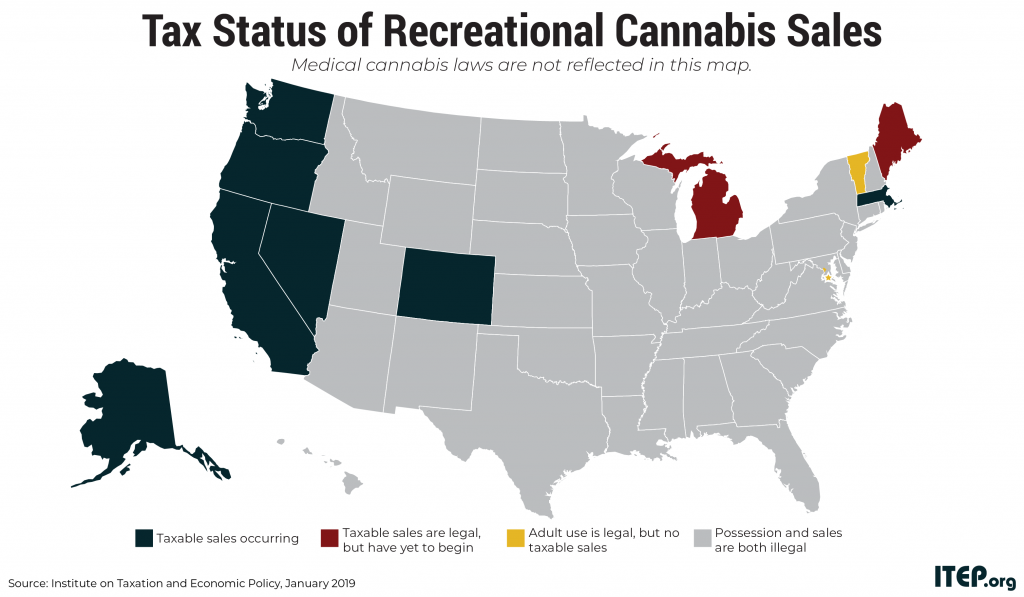
This year lawmakers in Connecticut, Delaware, Hawaii, Illinois, New Jersey, New York, Rhode Island, and Vermont will all be debating the taxation of recreational cannabis. A new ITEP report reviews the track record of recreational cannabis taxes thus far and offers recommendations for structuring cannabis taxes to achieve stable revenue growth over the long haul.
State Rundown 1/18: Governors’ Speeches Kick Off State Fiscal Debates
January 18, 2019 • By ITEP Staff
Gubernatorial speeches and budget proposals dominated state fiscal news this week, as governors proposed a wide array of policies including positive reforms such as Earned Income Tax Credit (EITC) enhancements in CALIFORNIA, a capital gains tax on wealthy households in WASHINGTON, and investments in education in several states. Proposals to exempt more retirement income from tax, particularly for veterans, are a common theme so far this year, having been raised in multiple states including MARYLAND, MICHIGAN, and SOUTH CAROLINA. And NEW JERSEY became the fourth state with a $15 minimum hourly wage. Those wishing to better understand and influence important debates about equitable tax policy should mark their…
The Daily Chronicle: Senate Hears Testimony on Governor’s Proposed Capital Gains Tax
January 18, 2019
Last fall, a report from the Institute on Taxation and Economic Policy showed that the lowest 20 percent of earners pay almost 18 percent of family income in taxes, while the top one percent pay just three percent in taxes. Multiple people testified that Washington’s “upside-down” tax system needs to be changed. Read more
Who Pays and Why It Matters | MECEP Policy Insights Conference Keynote Address
January 16, 2019 • By Aidan Davis
States have broad discretion in how they secure the resources to fund education, health care, infrastructure, and other priorities important to communities and families. Aidan Davis with the Institute on Taxation and Economic Policy will offer a national perspective on state-level approaches to funding public investments and the implications of those approaches on tax fairness and revenue adequacy, and their economic outcomes. She’ll also provide insight on what’s in store for 2019 among the states.
Washington Times: Trump Tax Cut Foiled by State’s Itemized Deduction Rule
December 31, 2018
Last year, many states opened their legislative sessions at the beginning of January, just after the federal tax law passed in December 2017, leaving them little time to figure out the new landscape. “I think they were very flat-footed,” said Meg Wiehe, deputy director of the Institute on Taxation and Economic Policy. “We were even […]
CNBC: Democrats Are Going to Attack the GOP Tax Law from Several Angles, Including SALT Caps and Breaks for Corporations
December 18, 2018
Many of the changes that Democrats are seeking have little chance of enactment amid divided government in Washington. But Alan Essig, executive director of the Institute on Taxation and Economic Policy, said Democrats are looking beyond the next two years. “While it may be difficult for the next Congress and President Trump to agree on […]
Washington Post: In Early Win for Party’s Left, House Democrats Back off Tax Rule
December 11, 2018
Henry Connelly, a spokesman for Pelosi, said the rule was unnecessary to prevent Democrats from hiking taxes on the middle class. He also noted that House Republicans waived their rule to pass their tax law in 2017, because the legislation did raise taxes on some families. “Unlike the House GOP, at the end of the […]
Washington Post: Does the Republican Tax Law Encourage Outsourcing?
December 6, 2018
“These multinational firms are going to want to stay below the 10 percent threshold, because that means the U.S. tax system won’t touch their foreign earnings,” said Matt Gardner, a tax expert at the Institute on Taxation and Economic Policy, a left-leaning think tank. “If you move a whole factory overseas, that sharply increases what […]
The Federal Estate Tax: An Important Progressive Revenue Source
December 6, 2018 • By ITEP Staff

For years, wealth and income inequality have been widening at a troubling pace. One study estimated that the wealthiest 1 percent of Americans held 42 percent of the nation’s wealth in 2012, up from 28 percent in 1989. Lawmakers have exacerbated this trend by dramatically cutting federal taxes on inherited wealth, most recently by doubling the estate tax exemption as part of the 2017 Tax Cuts and Jobs Act. Further, lawmakers have done little to stop aggressive accounting schemes designed to avoid the estate tax altogether. This report explains how the percentage of estates subject to the federal estate tax…
