With many Americans frustrated by the cost of living and struggling to afford the basics, President Trump is considering a familiar response: another tax cut that overwhelmingly benefits the wealthy.
Trump is once again weighing a proposal to index capital gains taxes to inflation as part of a set of policy promises ahead of the midterm elections, according to Bloomberg. The change would allow investors to adjust the original purchase price of an asset for inflation, reducing the profit they report to the IRS and therefore the tax they owe. Notably, this tax cut has also been suggested by the Republican Study Committee, which is a caucus of almost 190 House Republicans.
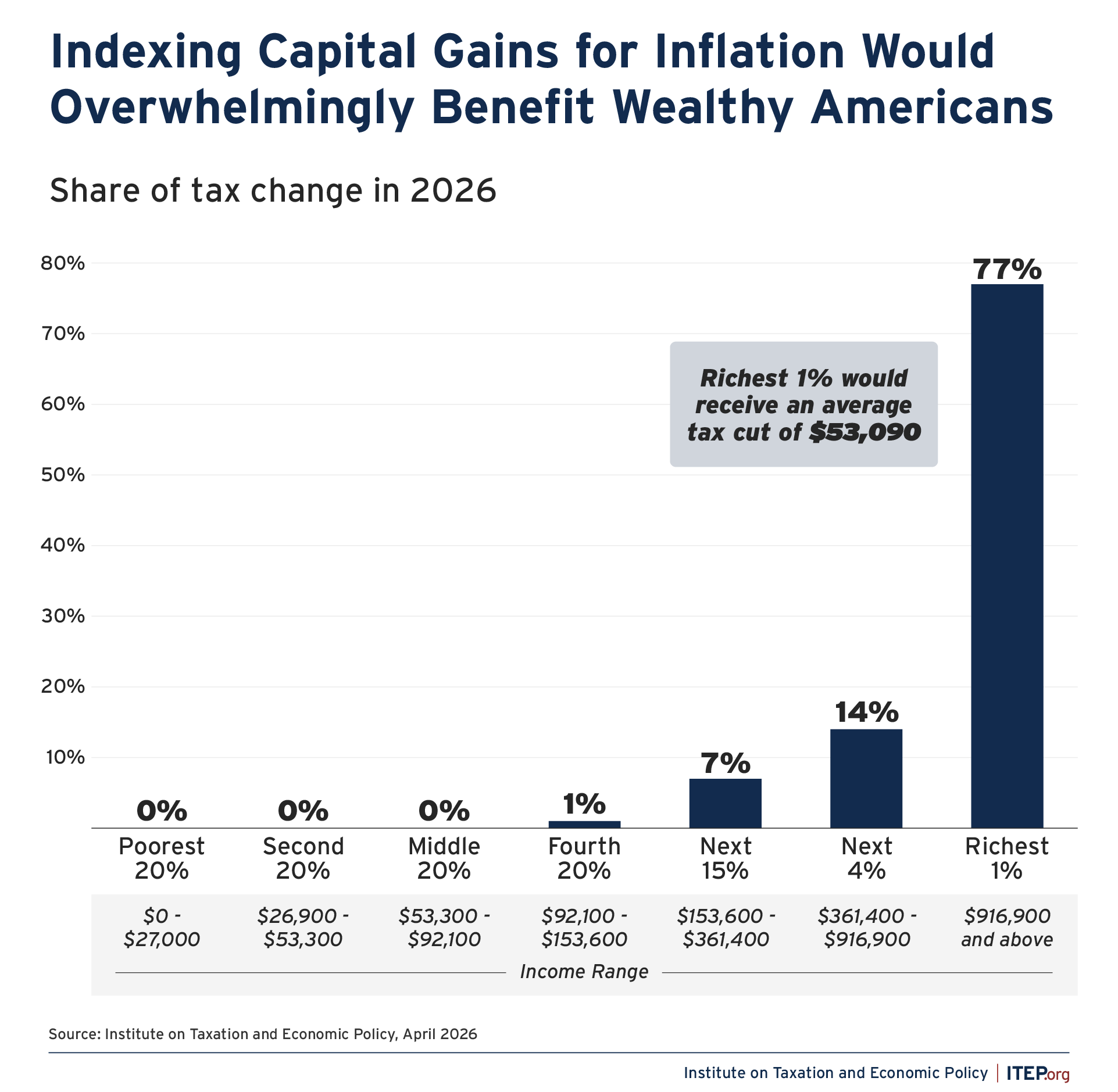
While “indexing capital gains” may sound like an arcane technical adjustment, it would amount to a massive new tax break for wealthy investors. ITEP’s analysis finds that most of its benefits would go to the richest 1 percent and nearly all would flow to the richest 20 percent. What’s more, one version of the proposal would add nearly $1 trillion to the federal deficit over a decade.
Figure 1
This would be a tax cut for income that already receives preferential treatment. Long-term capital gains face a top federal tax rate of 23.8 percent, compared with 40.8 percent for many other forms of income. Investors can also defer capital gains taxes until they sell an asset and often escape the tax entirely by holding the asset until they die. Inflation indexing would add yet another tax advantage.
This idea would also be utterly irrelevant for the vast majority of middle-income Americans. IRS data show that in 2022, 75 percent of Americans reported less than $100,000 in adjusted gross income, and 96 percent of those taxpayers didn’t report a dime of capital gains income.
The proposal is especially striking given the record of Trump’s tax policies during the first year of his second term, which are raising taxes for middle-income Americans by an average of $900 in 2026 at the same time as they are slashing taxes for the richest 1 percent. Over the next decade, the richest 1 percent are already slated to receive at least $1 trillion in tax cuts.
Meanwhile, the Trump tax law enacted last year will add $4.6 trillion to the debt over a decade, even as it cuts spending on healthcare and food assistance. Indexing capital gains could pile nearly another trillion dollars onto that tab.
Trump and his allies would have their work cut out for them in marketing capital gains tax cuts to voters. Gallup polling shows that just 12 percent of Americans think that upper-income people are paying too much in federal taxes. The constituency clamoring for new tax cuts for the rich, like capital gains indexing, is not a large one.
To get around this obvious problem, it’s likely that the administration would pitch this idea as relief from inflation. But the truth is that it would do astonishingly little for working families paying more for everyday necessities. Instead, it would use inflation as a pretext to further reduce taxes for wealthy investors.
With this proposal, the administration is doubling down on a tax agenda that asks ordinary Americans to pay more while delivering ever-larger tax breaks to those at the very top.