Key Findings
- Circuit breaker credits are states’ best tools to make property taxes more affordable. These policies prevent a property tax “overload” by crediting back property taxes that go beyond a certain share of income.
- Most states (29 and the District of Columbia) offer some kind of circuit breaker, though these policies vary widely in size and scope. The remaining 21 states also offer property tax breaks to some residents based at least partly on their incomes, but these states’ mechanisms are not circuit breakers because they do not factor in the amount of property taxes paid.
- Slightly more than half of states with circuit breakers (19 out of 29) target property tax cuts primarily to seniors, on the theory that older taxpayers may have more difficulty affording the property taxes on a home they bought during their prime earning years. The other 10 states and D.C. recognize that non-senior households are susceptible to property tax overload as well, if home values have grown sharply or income has declined.
- More than two-thirds of states with circuit breakers (20 out of 29) and D.C. extend their programs to at least some renters. It is widely understood that landlords pass through at least some of their property tax liability to renters through higher rents. Including renters is especially vital to ensuring that people of color can benefit, as centuries of racial exclusion and discrimination have meant people of color of all ages have lower average incomes and are much more likely to be renters.
- The most effective credits are those that do the most to reduce property taxes as a share of income, that benefit a range of low and middle-income households while targeting those most in need, and that residents know about and can easily access. Robust and well-publicized circuit breakers have immense potential to improve property tax affordability and reduce the overall regressive tilt of property tax systems.
Housing Affordability, Residential Property Taxes, and How Circuit Breakers Can Help
Housing has become a major cost burden for many American households. About one in three U.S. households pays more than 30 percent of their monthly income for housing. This includes a quarter of all homeowners and half of all renters. These housing costs include mortgage payments, insurance, rent, utilities, and — to a lesser degree — residential property taxes.
Concerns about rising housing costs and affordability more broadly have led state policymakers across the country to propose a wide array of property tax cuts, often in the form of very large homestead exemptions, tax rate caps, or limits on growth in assessed value.
These proposals typically have two major flaws.
The first flaw is that they fail to target the households who are most affected by unaffordable property taxes. A homestead exemption or a property tax cap, for example, benefits property owners independent of whether their property taxes are affordable in the context of the family budget. The best way to measure the impact of property taxes on individual families is to compare a family’s tax level to its income.
The second flaw is a consequence of the first. Partly because they are so poorly targeted, many property tax cut proposals are very costly to local governments, which rely on property taxes to fund public schools, local roads and parks, and public safety services like police and fire departments.
The obvious solution to both these problems is to choose property tax reductions that direct their benefits to taxpayers for whom property taxes represent an unaffordable share of income. Some of the people especially likely to be among this group include:
- Low-income households. Average property taxes are higher for the poorest 20 percent of taxpayers, who pay 4.4 percent of their income to these taxes, than for other income groups, according to ITEP’s most recent comprehensive study of state and local tax codes.1 These households also face, on average, the highest housing costs as a share of income. Making matters worse, low-value homes are often mismeasured by being over-assessed relative to high-value homes, for property tax purposes, in ways that exaggerate this fundamental fact.2
- Households of all types experiencing sudden financial shocks. A taxpayer who suddenly becomes unemployed, for example, will find that their property tax bill is unchanged even though their ability to pay those taxes is greatly reduced.
- Low-income senior citizens. Incomes during retirement tend to be lower than during a person’s working years, making it challenging for some seniors to afford a property tax bill that they previously could afford, particularly if their home’s assessed value has increased dramatically since they purchased it. This is especially true for today’s retirees of color, who often faced workplace discrimination and may have been relegated to lower-wage jobs with limited retirement benefits.
- Renters. Property tax affordability is a problem not just for homeowners but also for renters. Landlords pass at least some of their property tax expense along to their tenants. Because renters tend to have lower incomes and less wealth than homeowners, affordability concerns can be particularly acute for this group.
- Black and Latino households. Research suggests that Black and Latino households may be disproportionately affected by high property taxes relative to their incomes. Homes owned by lower-income people and people of color tend to be over-assessed relative to those owned by high-income people.3 People living in gentrifying areas — a disproportionate share of whom are Black or Latino — can also be harmed if their home value and property tax bill surges but their annual income does not keep pace.4
- Residents of low-income, low-wealth communities. In poorer communities, homeowners and renters often pay more in property taxes for a given level of public services than they would in wealthier jurisdictions, because there are often higher rates since there is a smaller collective tax base over which to spread the cost.
Property tax circuit breakers direct their benefits to these households by reducing property taxes based on the affordability of property taxes relative to families’ ability to pay.
Circuit breakers protect families from property tax overload much in the same way that traditional circuit breakers protect against electrical overload. Under most circuit breaker programs, when a property tax bill exceeds a certain percentage of a taxpayer’s income, the circuit breaker reduces property taxes in excess of this level.
This report introduces the key problem presented by property taxes, explains how circuit breakers function, summarizes major features of programs across the country, and outlines important considerations for policymakers interested in designing or reforming a credit.
Types of Circuit Breakers
The basic idea behind the circuit breaker approach to reducing property taxes is simple: taxpayers earning below a certain income level should be helped when their property taxes are high relative to their income.
A threshold-style circuit breaker is the most common type. Under this approach, households receive a credit, administered through the income or property tax system, for some or all property taxes that exceed a designated percentage of income.5 In West Virginia, for example, property taxes that exceed 4 percent of income can be credited back to eligible taxpayers (up to a maximum credit of $1,000) as long as income was below $45,180 for single individuals or $61,320 for married couples in 2024.6
Not all circuit breakers take this form, however. Researchers at the Lincoln Institute of Land Policy have identified a handful of other types of circuit breakers that achieve a broadly similar purpose with somewhat different mechanics. They define circuit breakers to include policies where “direct property tax relief to households … increases as household income declines.”7 Idaho’s program, for instance, provides a credit of $1,500 to households with income below $15,750 in 2026; the credit gradually declines as income rises to a minimum amount of $250 for households with income at $39,130.8 While the program does not specifically provide credit for taxes paid above a specific threshold level, the end result looks quite similar.
Many states, including all the states without circuit breakers, offer other forms of property tax breaks that are restricted to people with incomes below a certain amount. These include programs like homestead exemptions, deferral programs, and assessment limitations. While limiting eligibility based on income considers ability to pay, these provisions are not as carefully targeted as true circuit breakers. Rather than measuring property taxes against income directly, these tax breaks extend the same amount of relief to everyone below the income limit regardless of actual property tax amounts.
Circuit Breakers Are Common in the States
Figure 1
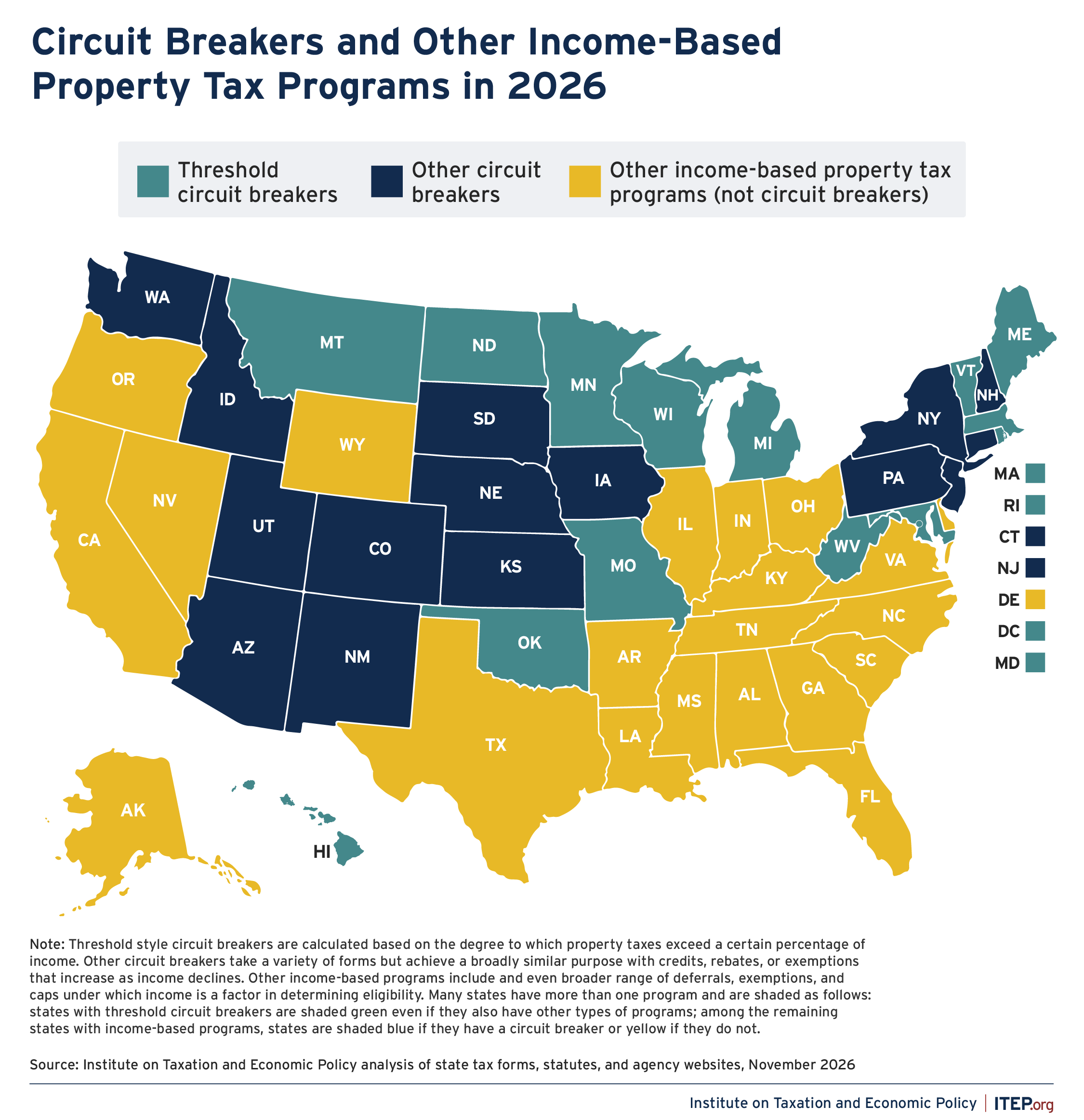
Most states offer a property tax circuit breaker, though they vary widely in size and scope. As of 2025, 29 states and the District of Columbia offer property tax circuit breaker programs.9 Among these states, 14 plus D.C. use the threshold approach discussed above while 15 offer other forms of circuit breakers. The remaining 21 states have at least one other type of income-limited property tax break but do not provide circuit breakers.
More detail on circuit breaker programs can be found in the appendices.
Circuit breaker programs’ costs tend to be modest relative to the property tax revenue states collect overall. Annual program costs range from roughly three one-hundredths of a percent of property tax collections under smaller, more narrowly targeted state programs like Washington’s to 9 percent in states with broader eligibility and more generous benefits like Vermont. The average benefit for recipients typically falls between $100 and $2,000 depending on the program’s income thresholds, benefit caps, and the share of property taxes offset.
Figure 2
State Spending on Circuit Breakers Relative to Property Tax Collections, FY 2022
Note: States shaded gray either have no data available or no circuit breaker program available.
Source: Institute on Taxation and Economic Policy analysis of U.S. Census Bureau 2022 Census of Governments, government financial reports, and state program websites, September 2026
By comparison, the average federal Earned Income Tax Credit benefit – for many families, the most important source of tax-based assistance — was $2,894 in 2025.10 In other words, for a relatively low cost, property tax circuit breakers can provide a level of assistance comparable to much better-known assistance programs. (For more information on program costs and average credit size see Appendix C.)
A Small but Growing Presence of Local Government Circuit Breakers
A few local governments also operate their own circuit breakers. Some are structured as a local supplement to the state’s credit. In Melrose, Massachusetts, for example, the Senior Circuit Breaker Property Tax Exemption matches 100 percent of the state’s credit, although its income thresholds are considerably lower, ranging from less than $25,000 to $37,000, depending on household size, roughly one-third the state’s thresholds.11
Other programs operate independently of any state credit. For example, Hawai’i lacks a state circuit breaker credit but its counties offer circuit breakers of their own. In Maui County, a credit is available to homeowners with incomes under $126,000 whose property taxes exceed 2 percent of their income, up to a maximum credit of $8,200. Similarly, Hialeah, Florida, recently created a more limited program where only homeowners over the age of 65 with incomes below $37,694 are eligible.12
Some localities are not authorized to offer circuit breaker programs, though some have developed alternative approaches. Durham, North Carolina’s Low Income Homeowner Relief program, for example, provides property tax assistance to homeowners who do not receive state assistance and have less than 80 percent of area median income.13 Programs of this kind address a recurring problem, as local governments face pressure to raise revenue for services as well as concerns that high property taxes will strain family budgets. A state circuit breaker remains the better approach, but where states have not acted and localities lack authority to establish one directly, targeted local programs can help offset the effect of property tax increases on households least able to afford them.
Such standalone structures illustrate how circuit breakers can be administered independently while still directing benefits toward households facing the greatest property tax bills relative to income. The downside of locally funded programs is that wealthy communities with large property tax bases have more resources to fund a circuit breaker, while less wealthy communities with often greater needs have fewer dollars and are less able to afford a program. Nonetheless, local policymakers are recognizing the value of these programs in addressing property tax affordability.
Circuit Breakers Improve Property Tax Fairness
Robust circuit breakers lessen the regressive tilt in state and local property tax systems. Figure 3 presents data from the Minnesota Department of Revenue revealing how Minnesota property taxes vary across the income scale.14 Absent the state’s circuit breaker program, the property tax would be regressive: affluent families as a group would pay the least, relative to income, while low-income families would pay the most, and middle-income families would fall somewhere in between.
But the offset provided through the state’s circuit breaker program, which is one of the largest in the country, significantly reduces this regressivity.
After the circuit breaker is included, very low-income families still pay the highest share of income in property taxes but otherwise the property tax is moderately progressive throughout most of the income scale.
Figure 3
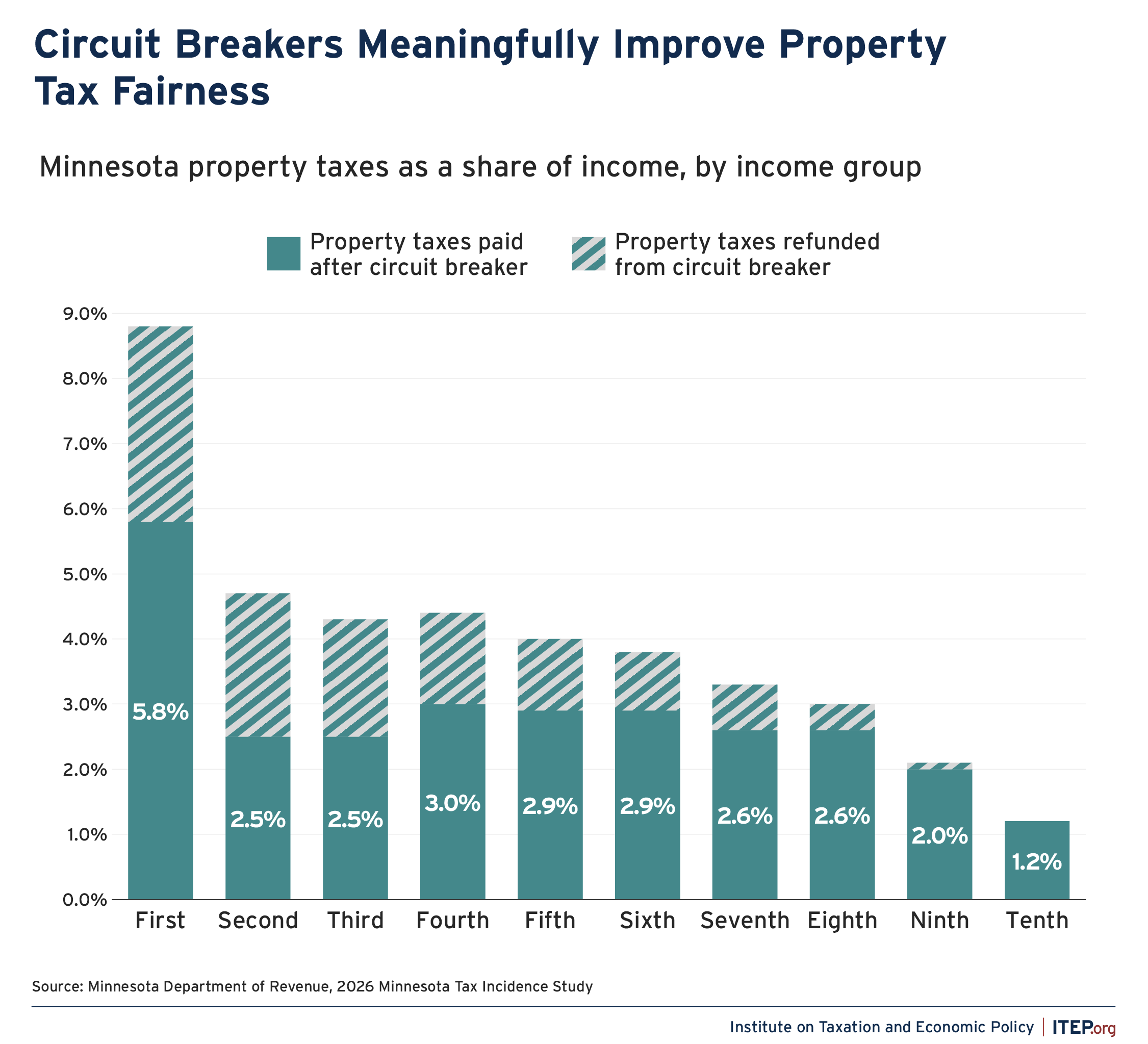
At the top of the income distribution, however, the Minnesota property tax remains somewhat regressive. This finding illustrates that while circuit breakers are well equipped to improve property tax fairness for low- and middle-income families, ending property tax regressivity at the top of the income scale would require adopting policies such as a progressive tax on high-value homes.15
Designing Effective Circuit Breakers
The circuit breakers that do the most to promote affordability are those that:
Extend the credit to taxpayers of all ages.
Slightly more than half the states with circuit breakers (19 of 30) target their programs exclusively to seniors. This is usually based on the perception that seniors have less ability to pay taxes due to having lower incomes than in their prime earning years when they likely purchased their homes.16 But other households can be susceptible to property tax overload including people who have recently lost their jobs or who live in gentrifying areas. Eleven states make their circuit breaker programs available to non-senior homeowners.
Offer the credit to renters.
Property tax affordability is also a problem for renters, as landlords pass some of their property tax expense along to their tenants. Because of this, more than two-thirds of states with circuit breakers (21 of 30) extend their programs to at least some renters by treating a share of rent as a proxy for the property taxes embedded within it. Including renters helps reach low-income households, which are more likely to rent because they have limited savings for a down payment and face barriers to accessing credit for homeownership. Discriminatory employment and housing practices mean that people of color earn less on average and are more likely to rent. This means for circuit breakers to reach all households that struggle with property taxes, including households of color, they should be extended to renters.
Set an income cap that makes the credit available to a substantial swath of families, not only families significantly below the poverty line.
Some states extend eligibility only to the poorest families because this group is most likely to struggle with high property tax bills or rent. That approach, however, fails to recognize that many non-poor families also grapple with property tax affordability. Extending relief to them can be beneficial, although it will increase the cost of the program. States with income eligibility ceilings above $50,000 include Connecticut, the District of Columbia, Hawai’i, Maine, Maryland, Massachusetts, Michigan, Minnesota, Montana, Nebraska, New Jersey, North Dakota, Vermont, and West Virginia. 17 (See Appendix B.) Some states further restrict eligibility based not just on income, but on families’ overall wealth holdings or the assessed value of the home.
Set the benefit ceiling at an amount that can reasonably cover property tax costs.
Circuit breakers typically limit the size of the tax break that any individual or family can receive.18 Most programs cap the annual tax cut at between $200 and $1,500 per family, though there are states with higher and lower caps. Minnesota, for example, caps its homeowner circuit breaker at $3,480 in 2025 and Vermont caps the combined benefit of two of its programs at $8,000.
Caps on the size of overall credits can ensure that families living in valuable homes do not receive exceptionally large credits. They can also limit the cost to state budgets.
Setting the cap very low, however, risks residents still paying an unaffordable share of their income in property taxes, undercutting the very affordability the program is meant to deliver. To avoid this, states should adjust the benefit against their own data. For example, they could target the amount such that a poverty-level household in a modestly priced home pays no higher a percentage of income in property taxes than the typical percentage paid by high-income households. Nebraska sits at the extreme end of this, where the program covers a recipient’s entire property tax bill.
Index the maximum income level and the maximum credit to inflation.
Indexing both income limits and the maximum credit amount to inflation helps ensure that circuit breakers continue to provide meaningful benefits in the long run. Failing to do so, on the other hand, will result in the program effectively shrinking, in real terms, with each passing year. Most states that index for inflation use the Consumer Price Index for All Urban Consumers (CPI-U), a good fit for circuit breakers because it tracks a broad measure of price changes facing Americans. Many states have unintentionally allowed the value of their circuit breakers to decline over time by ignoring the impact of inflation.19
Create threshold-style circuit breakers that are accurate and fair representations of households’ share of income paid in property taxes.
A threshold-style circuit breaker provides a credit based on the amount by which property tax payments exceed a specified percentage of income. The percentage can be a flat rate or it can vary by income, but typically it is in the single digits. In West Virginia, for example, taxpayers can claim the credit only once their property taxes exceed 4 percent of income, while in Massachusetts the threshold is 10 percent.
Lower thresholds benefit more households, while higher thresholds reserve the credit for those households whose budgets are most impacted by property tax. The optimal number will vary by state, so states should use a threshold percentage that is low enough to create meaningful equity between residents. For example, a state might choose to set the threshold at a level comparable to what higher-income households pay as a share of income. Since the average high-income household in most states pays no more than 2 to 3 percent of its income in property taxes, fairness suggests that a similar threshold may be appropriate for low- and middle-income households. (See Appendix D.)
Allow eligible immigrants to receive the credit.
States vary in the extent to which immigrants can access these programs. Many allow eligibility not just for American citizens but also for some or all categories of non-citizen immigrants. For example, Connecticut, Maryland, Minnesota, New Jersey, and D.C. explicitly allow circuit breakers to be claimed by people who file with an Individual Taxpayer Identification Number (ITIN), a common circumstance for many residents who are not citizens. Colorado goes further. For example, filers without a Social Security Number (SSN) or ITIN can still claim the credit by completing an application for an Alternate Identification Number.20
The stakes of this policy choice reach beyond the adults who file, because mixed-status families with citizen children and immigrant parents are common. When a program is structured so that an immigrant parent can’t claim it, the support is withdrawn from the entire household. Since housing stability in childhood is closely tied to economic wellbeing, excluding immigrant adults doesn’t just deny a benefit to non-citizens; it risks negatively affecting childhood outcomes for American citizens as well.
Link the administration of the program closely with the income or property tax system to raise awareness of the benefit.
States vary in their administration of circuit breaker programs, with approaches ranging from standalone rebates to administration through property tax or income tax systems. In states with income taxes, the option to claim these credits through the personal income tax likely increases their reach, as most families file income tax returns and tax preparers and software programs can do much of the work needed to verify eligibility.
However, people who don’t meet the requirements to file an income tax return—including senior citizens with nontaxable retirement income, for example—should be offered the chance to claim the credit as a standalone rebate instead as they still pay property taxes and other state and local levies.21 In states without income taxes, the program must be administered either as a standalone rebate or by allowing taxpayers to submit eligibility information to their local property tax office in advance of the mailing of property tax bills.22
Find ways to promote, simplify, and automate the circuit breaker program to reach eligible taxpayers.
The principal drawback of circuit breakers is that they generally reach only those taxpayers who actively apply for them annually, whereas broader homestead exemption programs are often granted after a single application and renewed until a property is sold. Eligible taxpayers will, of course, only apply for circuit breaker credits if they are aware of their existence. In some states it appears that many, or even most, eligible taxpayers are unaware of these programs. To increase awareness, states with income taxes should incorporate applications for these programs in their income tax filing process.
Public announcements and well-placed advertisements by government agencies and nonprofits can make a difference. Simplifying the claims process, such as by folding these credits into the income tax filing process that many families already engage in, and enacting robust credits that are worth the time and effort to claim can also increase uptake. To reach more eligible taxpayers, states may want to investigate ways to partially automate the circuit breaker claims process through innovative matching of income and property tax data.
A circuit breaker that meets these standards will cost the state more than one than one that doesn’t. As the next section explains, however, it will likely cost less than other, less well-designed changes to property taxes.
Circuit Breakers Stand Apart
Among state policies to reduce property taxes, only circuit breakers directly address the biggest shortcoming of the property tax: its disconnect from ability to pay and the resulting unaffordability of the tax for many households. By basing the relief of property taxes on income, policymakers can identify the taxpayers most heavily affected by the tax. No other instrument is as precisely matched to this objective.
Homestead exemptions, by contrast, exempt a certain portion of home value from tax and are less squarely focused on the issue of property tax affordability since they usually provide benefits to all homeowners regardless of need.23 When the exemption is provided as a flat dollar amount, for example, homes worth $200,000 receive the same tax benefit as homes worth $20 million. Percentage-based exemptions are even less equitable, as high-value homes receive the largest benefits. The result is a policy that does not reliably reach the households for whom property taxes are least affordable.
Capping growth in assessed value misses the mark by an even wider margin and these policies tend to favor wealthier people living in high-value homes that are appreciating quickly in value. 24 Young families seeking to buy their first home fare particularly poorly under assessment caps because artificially holding down the property tax bills of long-time homeowners pushes more of the responsibility for funding local services onto new buyers. Far from improving affordability for those who need it most, assessment caps can actively deepen the inequities they are often presumed to address.
Circuit breakers stand out among property tax policies because they are designed to accomplish a single objective: ensure that property taxes remain affordable.
Unlike assessment caps or homestead exemptions, which distribute benefits broadly and often at considerable cost, circuit breakers concentrate relief where the need is greatest, rendering them both more equitable and, in many cases, less expensive. This targeting allows states to improve the fairness of the property tax without incurring the substantial revenue losses that can jeopardize funding for education, healthcare, and other essential public services – the policies in which we all pay taxes to fund.
When paired with a robust outreach strategy to ensure that eligible residents claim the benefits available to them, a well-designed circuit breaker represents one of the most effective instruments available to policymakers seeking to shield their residents from unaffordable property tax bills.
Endnotes
- 1. Carl Davis, et al., “Who Pays? A Distributional Analysis of the Tax Systems in All 50 States,” Institute on Taxation and Economic Policy. January 2024.
- 2. Christopher Berry, “Reassessing the Property Tax” February 2021.
- 3. Ibid. Carlos Avenancio-León and Troup Howard, “The Assessment Gap: Racial Inequalities in Property Taxation,” The Quarterly Journal of Economics, Volume 137, Issue 3. August 2022.
- 4. David Crawford, “Gentrification and the Property Tax: How Circuit Breakers Can Help,” Institute on Taxation and Economic Policy, April 2021.
- 5. Credits are typically administered via the personal income tax for reasons of administrative simplicity despite the fact that they are intended as property tax cuts. Rebates, by contrast, are administered as standalone programs. A small number of circuit breaker programs are structured as exemptions rather than credits or rebates.
- 6. The income cutoff is based on the number of people in the household. These are the amounts for homes with one or two people. Larger households enjoy higher income cutoffs. More detail can be found at: West Virginia Tax Division, “Senior Citizens,” Accessed June 23, 2026.
- 7. A thorough discussion of this definition and description of various circuit breaker types can be found in: John H. Bowman, Daphne A. Kenyon, Adam Langley, and Bethany P. Paquin, “Property Tax Circuit Breakers: Fair and Cost-Effective Relief for Taxpayers,” Lincoln Institute of Land Policy. May 2009. For a more recent accounting of circuit breakers using the Lincoln Institute of Land Policy’s definition, see the following database: Lincoln Institute of Land Policy and George Washington Institute of Public Policy, “Significant Features of the Property Tax, Residential Property Tax Relief Programs,” Accessed May 1, 2026.
- 8. Idaho State Tax Commission, “2026 Property Tax Reduction Income Brackets,” Accessed June 23, 2026.
- 9. Some ITEP publications issued prior to 2023 included a lower count of states with circuit breakers because they focused only on the traditional “threshold” style programs. This report adopts a more expansive definition more closely in line with the one used by the Lincoln Institute of Land Policy.
- 10. Internal Revenue Service, “EITC reports and statistics,” Accessed August 4, 2026.
- 11. H. B. 3979, 194th Reg. Session, (Mass. 2025).
- 12. City of Hialeah, “Ordinance No. 2026-022,” Accessed July 16, 2026.
- 13. Durham County Tax Administration, “Low Income Homeowner Relief (LIHR) Program,” Accessed August 24, 2026.
- 14. Minnesota Department of Revenue Tax Research Division, “2026 Minnesota Tax Incidence Study: An Analysis of Minnesota’s Household and Business Taxes,” March 5, 2026.
- 15. Carl Davis and Erika Frankel. “States Should Enact, Expand Mansion Taxes to Advance Fairness and Shared Prosperity,” Institute on Taxation and Economic Policy. June 26, 2024.
- 16. Younger disabled people are also often eligible for circuit breaker programs.
- 17. ITEP analysis of the information found in the Lincoln Institute of Land Policy and George Washington Institute of Public Policy’s “Significant Features of the Property Tax” database, as well as information from state tax agencies. Note that Hawaiʻi’s circuit breakers are administered at the local level rather than the state level.
- 18. This is usually accomplished by directly capping each family’s maximum tax savings, though sometimes caps are structured such that only a portion of each home’s value qualifies for the program.
- 19. Dylan Grundman O’Neill, “Indexing Income Taxes for Inflation: Why It Matters,” Institute on Taxation and Economic Policy, August 2016.
- 20. Colorado Department of Revenue, “Instructions for the Colorado Alternate Identification Number for the Property Tax/ Rent/Heat Rebate (PTC rebate) program,” Accessed August 4, 2026.
- 21. ITEP’s comprehensive analysis of state and local taxes can be found at: Carl Davis, et al., “Who Pays? A Distributional Analysis of the Tax Systems in All 50 States,” Institute on Taxation and Economic Policy. January 2024.
- 22. A helpful discussion of administrative options is available in Chapter 6 of: John H. Bowman, Daphne A. Kenyon, Adam Langley, and Bethany P. Paquin, “Property Tax Circuit Breakers: Fair and Cost-Effective Relief for Taxpayers,” Lincoln Institute of Land Policy. May 2009.
- 23. Institute on Taxation and Economic Policy, “Property Tax Homestead Exemptions,” September 2011.
- 24. Institute on Taxation and Economic Policy, “Capping Property Taxes: A Primer,” September 2011.