
California
Texas Property Tax Plan Mimics California’s Damaging Prop 13
December 19, 2025 • By Neva Butkus, Rita Jefferson

This proposal would disrupt the state’s housing market and jeopardize local revenues while doing very little to help workers and families struggling to pay their property tax bills – just as Prop 13 did in California.
property tax debates are taking place throughout the nation.
Re-Examining 529 Plans: Stopping State Subsidies to Private Schools After New Trump Tax Law
November 20, 2025 • By Miles Trinidad, Nick Johnson

The 2025 federal tax law risks making 529 plans more costly for states by increasing tax avoidance and allowing wealthy families to use these funds for private and religious K-12 schools.

Vacancy taxes will not single-handedly solve problems in cities, but they are worth considering to address housing shortages, land use, and building thriving communities.
State Tax Dollars Shouldn’t Subsidize Federal Opportunity Zones
November 12, 2025 • By Eli Byerly-Duke

The Opportunity Zones program benefits wealthy investors more than it benefits disadvantaged communities.
State and Local Policymakers Can Resist Austerity Even Amid Historic Federal Retreat
November 6, 2025 • By Kamolika Das
The progressivity of the federal tax code has been waning. State and local policymakers should respond by protecting their revenue bases, promoting equity, and safeguarding vulnerable communities from harmful budget cuts.
In 2025, Voters Said Yes to Public Resources and Community Investments
November 6, 2025 • By Rita Jefferson

Important tax measures were on the ballot this week, and the outcomes are clear: many voters support new state and local spending to support critical services in their communities.
States Begin Decoupling from Flawed ‘QSBS’ Tax Break
November 6, 2025 • By Nick Johnson, Sarah Austin

A costly tax break for wealthy venture capitalists is drawing some critical attention from state policymakers.
Oil and Gas Companies Are Paying Less Tax to the U.S. than to Foreign Governments
October 30, 2025 • By Matthew Gardner

Since 2017, these companies paid $135 billion in income taxes to foreign governments, but just $29 billion to the U.S.
The Wealth Proceeds Tax: A Simple Way for States to Tax the Wealthy
October 30, 2025 • By Sarah Austin, Carl Davis

Taxing the proceeds generated by wealth through a new Wealth Proceeds Tax is a simple way for states to raise billions in new revenue and improve the fairness of their tax systems.
States across the nation are debating how best to respond to costly new federal tax cuts.
Many lawmakers who were vocal supporters of this bill will see direct personal benefits while most of their constituents benefit little or will be worse off.
The Potential of Local Child Tax Credits to Reduce Child Poverty
October 8, 2025 • By Kamolika Das, Aidan Davis, Galen Hendricks, Rita Jefferson

Local governments have a critical role to play in reducing child poverty. Local Child Tax Credits could provide large tax cuts to families at the bottom of the income scale, lessening the overall regressivity of state and local tax systems.
San Francisco Chronicle: New SALT cap means savings for California homeowners. Here’s how much
October 6, 2025
Steve Wamhoff, director of federal tax policy for the Institute on Taxation and Economic Policy, said his organization’s analysis found less SALT savings for Californians than Redfin reported. He ran the new SALT rules through ITEP’s tax microsimulation model, which uses a database of taxpayer and census records to create a computer model of state […]
Quite Some BS: Expanded ‘QSBS’ Giveaway in Trump Tax Law Threatens State Revenues and Enriches the Wealthy
October 2, 2025 • By Sarah Austin, Nick Johnson

States should decouple from the federal Qualified Small Business Stock (QSBS) exemption.
State Earned Income Tax Credits Support Families and Workers in 2025
September 11, 2025 • By Neva Butkus

Nearly two-thirds of states now have an Earned Income Tax Credit (EITC). Momentum continues to build on these credits that boost low-paid workers’ incomes and offset some of the taxes they pay, helping lower-income families achieve greater economic security.
State Child Tax Credits Boosted Financial Security for Families and Children in 2025
September 11, 2025 • By Neva Butkus

Child Tax Credits (CTCs) are effective tools to bolster the economic security of low- and middle-income families and position the next generation for success.
Colorado Lawmakers Help Fill Trump-Induced Shortfall by Tackling Offshore Corporate Tax Avoidance
August 26, 2025 • By ITEP Staff

As the Trump megabill blows holes in state budgets, Colorado is leading with reforms to curb offshore tax avoidance and roll back wasteful corporate subsidies.
SALT in the Wound: New Tax Law’s Limit on State Tax Deductions Exempts Some of the Very Wealthiest
August 21, 2025 • By ITEP Staff

The new tax law enacted last month found a temporary compromise on the level of the cap, boosting it to $40,000 through 2029, but failed to fix a loophole that allows some rich taxpayers with good accountants to completely avoid the cap
State Rundown 8/20: States to Face Serious Conformity, Revenue Issues as Summer Ends
August 20, 2025 • By ITEP Staff
While tax news has slowed as summer comes to an end, there are rumblings beneath the surface that could be an inauspicious sign of the times ahead for states and state budgets.
Trump’s Tax Law Clobbers State Budgets. Now’s the Time to Prepare.
August 13, 2025 • By ITEP Staff

The Trump megabill hands the richest 1% a trillion-dollar windfall while gutting funding for health care, education, and disaster relief — leaving communities to pick up the pieces. State and local leaders must step up, tax the wealthiest fairly, and safeguard the essentials that keep America healthy, educated, and safe.
The Sacramento Bee: Why California’s Wealthiest Tax Payers Could Get Less of a Trump Tax Break
August 12, 2025
The rich will get richer from President Donald Trump’s Big Beautiful Bill’s tax provisions – but California’s millionaires won’t get as much of a benefit as their counterparts in most other states.
United Ways of California: The Economic Impact of Immigrants in California
August 5, 2025 • By ITEP Staff
Communities across California are feeling the effects of immigration raids and mass deportation efforts, both in the fabric of their communities as well as their economies. Actions and threats against employees, jobs, and neighbors will have a profound impact on our state and nation in both the short and long term. Here, we delve deeper into one aspect of why by discussing the impact immigrants have on our economy.
Anti-Tax Revolts Backfire: What We’ve Learned from 50 Years of Property Tax Limits
July 15, 2025 • By Rita Jefferson

Across-the-board property tax cuts create less fair local tax systems in the long run. State legislators and local governments should prioritize the residents who can least afford their property taxes, not the residents and businesses who can.
How Much Would Every Family in Every State Get if the Megabill’s Tax Cuts Given to the Rich Had Instead Been Evenly Divided?
July 14, 2025 • By Michael Ettlinger
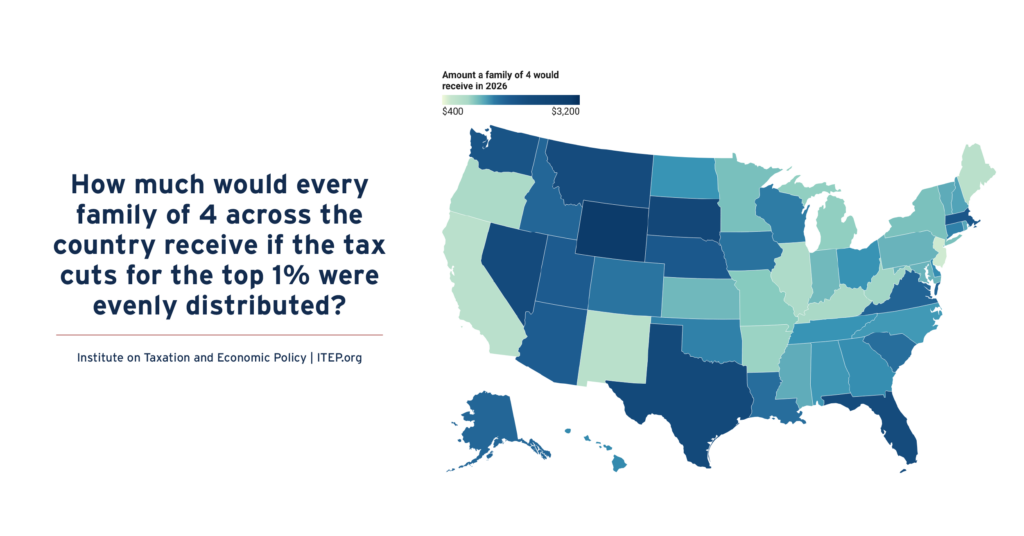
If instead of giving $117 billion to the richest 1 percent, that money had been evenly divided among all Americans, we'd each get $343 - or nearly $1,400 for a family of four.
