
Blog
State Rundown 10/22: Despite Obstacles, Progressive Taxes Define 2026
• By ITEP Staff
As more states move to raise revenue and tax the rich, anti-tax lobbyists and lawmakers are hard at work to undo that progress. Despite pushback, important conversations around needed revenue continue.
State Rundown 9/10: States Brace for (and in Some Cases Embrace) Ballots and Budgets
• By ITEP Staff
States across the country will consider a host of ballot measures that could reshape the fairness and adequacy of their states’ tax systems, while other states are receiving budget forecasts that could further shape upcoming policy debates.
State Rundown 7/29: The Misguided, Miserly Missouri Amendment to Eliminate the Income Tax
• By ITEP Staff
Missouri voters are facing a major decision at the ballot box next week on Amendment 5, which would amend the state constitution to allow lawmakers to eliminate the individual income tax and expand the state’s sales tax on any good or service to make up for lost revenue.
State Rundown 6/25: Trending This Summer? New Revenue!
• By ITEP Staff
It's the first official week of summer, and while many of us are planning vacations, state lawmakers remain busy finalizing and debating tax proposals.
State Rundown 6/11: Taxing the Rich Heats Up
• By ITEP Staff
As we head into summer, many state legislatures are in the final stretches of their sessions. Rhode Island moved another step closer to joining the ranks of Washington, Maine, and Hawai’i in enacting a new high-income surcharge this year.
State Rundown 6/4: Fiscal Flowers and Weeds Bloom in June
• By ITEP Staff
A veritable superbloom of tax and budget policies occurred over these last few weeks, including both flowers worth admiring and weeds worth fighting back.
State Rundown 5/7: Federal Showers Make States Dour
• By ITEP Staff
The effects of last year’s federal tax and spending cuts continue to ripple through the states. With gas prices soaring due to the Iran war, some states are attempting to provide a bit of relief in the form of gas tax reductions and suspensions.
State Rundown 4/8: Budget and Tax Packages Take Shape as Sine Die Approaches in Many States
• By ITEP Staff
State legislative sessions are wrapping up, and final tax and budget packages are making their way to governors’ desks.
State Rundown 3/18: New Mexico Enacts Most Significant Corporate Tax Reform of the Year
• By ITEP Staff
As states lawmakers continue to weigh their linkages to the federal tax code in light of the recent federal tax law, New Mexico provides a blueprint for limiting multinational corporate tax avoidance.
State Rundown 2/19: Necktie (NCTI) Offers a Way Out of a Knotty Situation
• By ITEP Staff
State lawmakers are grappling with a range of challenges as their fiscal outlooks deteriorate, federal tax enforcement wanes (after the Trump administration cut the IRS workforce by 25 percent), and a rewritten federal tax code sends states scrambling to decide what changes they might want to make in their own codes.
State Rundown 2/11: This Valentine’s Day, Conscious Decoupling Is Our Love Language
• By ITEP Staff
While some may be excited for a romantic Valentine’s Day this weekend, many state lawmakers are breaking up and decoupling from recent federal tax changes that are poised to leave states with revenue shortfalls – much like a bad date who forgets their wallet and asks you to pick up the tab.
State Rundown 1/22: Cautious Tone Noticeable in Most Statehouses
• By ITEP Staff
Most states are adopting a very cautious approach so far this year as legislators begin their sessions and governors make their annual addresses, thanks to ongoing economic uncertainty and federal retrenchment.
State Rundown 12/10: ‘Tis the Season to Reclaim Lost Revenue
• By ITEP Staff
property tax debates are taking place throughout the nation.
State Rundown 11/13: States Tackle Impending Deficits, Pennsylvania Secures an EITC
• By ITEP Staff
Revenue forecasts look increasingly grim as states anticipate shortfalls due to the slowing economy and impacts of the new federal tax law.
State Rundown 11/5: Voters Say “Yes!” to Public Investments
• By ITEP Staff
Despite being an off-year election, voters made a call for shared public investments at the polls.
State Rundown 10/27: As Temperatures Cool Tax Policy Heats Up
• By ITEP Staff
States across the nation are debating how best to respond to costly new federal tax cuts.

Why States Shouldn’t Go Along With OBBBA’s Corporate Tax Breaks: A Practical Guide
• By Nick Johnson, Michael Mazerov
States should immediately decouple from four costly corporate tax provisions in the new federal tax law.
State Rundown 9/4: Colorado Tackles Offshore Corporate Tax Avoidance, Paves Way for State Conformity Best Practices
• By ITEP Staff
Despite an increasingly bleak state revenue outlook, state lawmakers across the country continue to prioritize regressive tax cuts.
How Much Would Every Family in Every State Get if the Megabill’s Tax Cuts Given to the Rich Had Instead Been Evenly Divided?
• By Michael Ettlinger
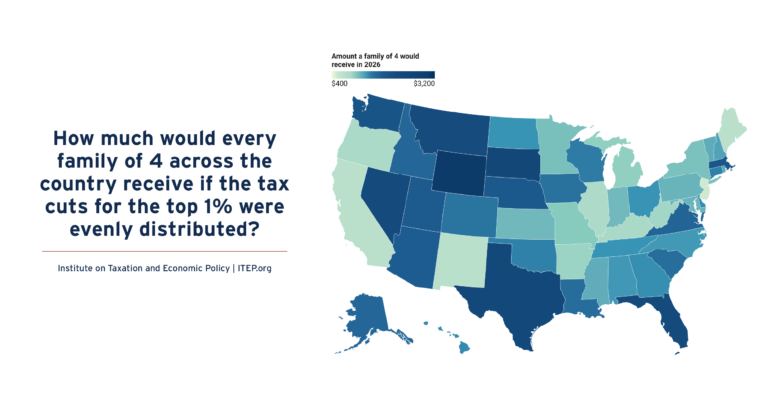
If instead of giving $117 billion to the richest 1 percent, that money had been evenly divided among all Americans, we'd each get $343 - or nearly $1,400 for a family of four.

Trump Megabill Will Give $117 Billion in Tax Cuts to the Top 1% in 2026. How Much In Your State?
• By Michael Ettlinger
The predominant feature of the tax and spending bill working its way through Congress is a massive tax cut for the richest 1 percent — a $114 billion benefit to the wealthiest people in the country in 2026 alone.

How Much Do the Top 1% in Each State Get from the Trump Megabill?
• By Carl Davis
The Senate tax bill under debate right now would bring very large tax cuts to very high-income people. In total, the richest 1 percent would receive $114 billion in tax cuts next year alone. That would amount to nearly $61,000 for each of these affluent households.
State Rundown 6/11: States in The Eye of a Fiscal Hurricane?
• By ITEP Staff
State legislatures are enjoying a relatively quiet period right now, though it is merely a temporary calm before the storm of the federal tax and budget debate begins raging again.

IRS Cooperation with ICE Will Damage Public Trust, Putting Tax Revenues in Jeopardy
• By Marco Guzman
Attempts by the Department of Homeland Security to secure private information from the IRS on people who file taxes with an Individual Taxpayer Identification Number is a violation of federal privacy laws that protect taxpayers. It is also a change that could seriously damage public trust in the IRS, which could jeopardize billions of dollars in tax payments by hardworking immigrant families.
State Rundown 3/20: It’s March, Welcome to Tax Policy Madness
• By ITEP Staff
March Madness kicks off today and the pressure is on as many states’ legislative sessions are nearing the final buzzer. Some state lawmakers are seemingly competing for the title of most regressive state tax policies while others are looking to lift up best practices for more equitable outcomes. The Mississippi legislature landed on a […]

Learn from Prop 13 History to Avoid Repeating Past Mistakes
• By Rita Jefferson
Worries about housing costs and property tax bills are leading people to check the history books for solutions, but there’s a danger that they’ll repeat past mistakes. If anti-tax lawmakers carelessly weaken property taxes as they did in the 1970s, as they did with California’s Proposition 13, they will undercut public finances, making municipalities, school districts, and other special districts worse off.

Institute on Taxation
and Economic Policy
ITEP is a non-profit, non-partisan tax policy organization. We conduct rigorous analyses of tax and economic proposals and provide data-driven recommendations to shape equitable and sustainable tax systems.
Subscribe to ITEP Emails
Tax research and policy news in your inbox.
Promote Fair Tax Policy
Your gift to ITEP promotes tax justice. With your help, we do research that supports taxing millionaires and billionaires, taxing big corporations and raising revenue for the things our people, our communities and our planet need.
Together, we can create a country with more economic justice, more racial justice, more climate justice… and more tax justice.