
Blog

State Rundown 9/10: States Brace for (and in Some Cases Embrace) Ballots and Budgets
• By ITEP Staff
States across the country will consider a host of ballot measures that could reshape the fairness and adequacy of their states’ tax systems, while other states are receiving budget forecasts that could further shape upcoming policy debates.

2026 Sessions in Review: States Fund Tax Credits by Preserving, Raising Revenue
• By Aidan Davis
In a year of cautious uncertainty around current and ongoing revenues, many state lawmakers strengthened their tax credits for families and children.
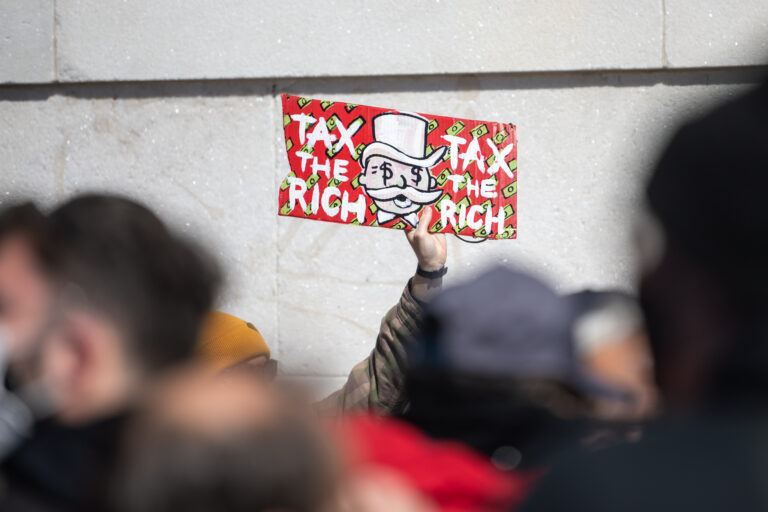
2026 Sessions in Review: States Move to Tax the Rich and Corporations
• By Aidan Davis
This year several states raised income tax rates on high-income people to fund crucial services and make progress toward remedying the regressive tilt of their tax codes.

A Growing Number of States Are Taxing the Sale of Advertising
• By Nick Johnson
ITEP’s report on taxing advertising identifies some reasons why states are curtailing longstanding sales tax exemptions for the ad sector.

States Can Raise Billions by Ending a Tax Giveaway to Big Tech
• By Nick Johnson
An advertising tax offers a way to raise significant money from a sector of the economy that has been getting a free ride for decades.
State Rundown 4/1: No Fooling Around Anymore in Washington, But Cruel Pranks in South Carolina
• By ITEP Staff
In Washington, Gov. Bob Ferguson and lawmakers decided to stop fooling around with one of the nation’s most upside-down tax codes and finally brought to life a new millionaires’ tax, the first new income tax created in a state since 1991.
State Rundown 3/18: New Mexico Enacts Most Significant Corporate Tax Reform of the Year
• By ITEP Staff
As states lawmakers continue to weigh their linkages to the federal tax code in light of the recent federal tax law, New Mexico provides a blueprint for limiting multinational corporate tax avoidance.
State Rundown 3/12: Washington Lawmakers Pass Millionaires’ Tax, Expand Working Families Tax Credit
• By ITEP Staff
Washington is on its way to making history after the legislature approved the “millionaires’ tax,” a 9.9 percent tax on income over $1 million. The bill, which is expected to raise more than $3 billion a year, making significant investments in public education and childcare, will also expand the Working Families Tax Credit – the […]
State Rundown 2/25: Sausage-Making Season Is Upon Us
• By ITEP Staff
National Sausage Month isn’t until October, but now is the time of year when state lawmakers are really diving into their sausage-making processes, as separate legislative houses and oftentimes political parties send competing bills, budgets, and visions back and forth to grind out their differences.
State Rundown 2/19: Necktie (NCTI) Offers a Way Out of a Knotty Situation
• By ITEP Staff
State lawmakers are grappling with a range of challenges as their fiscal outlooks deteriorate, federal tax enforcement wanes (after the Trump administration cut the IRS workforce by 25 percent), and a rewritten federal tax code sends states scrambling to decide what changes they might want to make in their own codes.

NCTI is an Important Part of the Federal Corporate Tax. States Should Adopt It Too.
• By Carl Davis
Including NCTI in state corporate tax law is an effective way to neutralize much of the tax avoidance that occurs when multinational companies artificially shift their profits into overseas tax havens.
State Rundown 2/11: This Valentine’s Day, Conscious Decoupling Is Our Love Language
• By ITEP Staff
While some may be excited for a romantic Valentine’s Day this weekend, many state lawmakers are breaking up and decoupling from recent federal tax changes that are poised to leave states with revenue shortfalls – much like a bad date who forgets their wallet and asks you to pick up the tab.

What Did 2025 State Tax Changes Mean for Racial and Economic Equity?
• By Brakeyshia Samms
The results are a mixed bag, with some states enacting promising policies that will improve tax equity and others going in the opposite direction.
State Rundown 1/14: New Year Brings New Resolutions for Funding Key Priorities
• By ITEP Staff
State governors are beginning to lay out their top priorities as legislatures reconvene in statehouses around the country.
State Rundown 1/7: New Year, New Opportunities for Progressive Revenue
• By ITEP Staff
As we kick off a new year, several states are facing revenue shortfalls. Some lawmakers are approaching the challenge with sustainable and equitable solutions.
State Rundown 12/10: ‘Tis the Season to Reclaim Lost Revenue
• By ITEP Staff
property tax debates are taking place throughout the nation.
State Rundown 10/27: As Temperatures Cool Tax Policy Heats Up
• By ITEP Staff
States across the nation are debating how best to respond to costly new federal tax cuts.
State Rundown 9/4: Colorado Tackles Offshore Corporate Tax Avoidance, Paves Way for State Conformity Best Practices
• By ITEP Staff
Despite an increasingly bleak state revenue outlook, state lawmakers across the country continue to prioritize regressive tax cuts.

State Tax Action in 2025: Amid Uncertainty, Tax Cuts and New Revenue
• By Aidan Davis, Neva Butkus, Marco Guzman
Federal policy choices on tariffs, taxes, and spending cuts will be deeply felt by all states, which will have less money available to fund key priorities. This year some states raised revenue to ensure that their coffers were well-funded, some proceeded with warranted caution, and many others passed large regressive tax cuts that pile on to the massive tax cuts the wealthiest just received under the federal megabill.

Which States Expanded Refundable Credits in 2025?
• By Neva Butkus
Refundable tax credits were a big part of state tax policy conversations this year. In 2025, nine states improved or created Child Tax Credits or Earned Income Tax Credits.
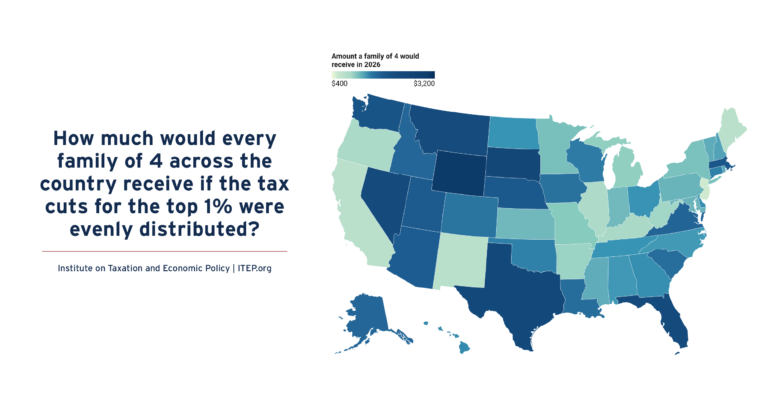
How Much Would Every Family in Every State Get if the Megabill’s Tax Cuts Given to the Rich Had Instead Been Evenly Divided?
• By Michael Ettlinger
If instead of giving $117 billion to the richest 1 percent, that money had been evenly divided among all Americans, we'd each get $343 - or nearly $1,400 for a family of four.

Trump Megabill Will Give $117 Billion in Tax Cuts to the Top 1% in 2026. How Much In Your State?
• By Michael Ettlinger
The predominant feature of the tax and spending bill working its way through Congress is a massive tax cut for the richest 1 percent — a $114 billion benefit to the wealthiest people in the country in 2026 alone.

How Much Do the Top 1% in Each State Get from the Trump Megabill?
• By Carl Davis
The Senate tax bill under debate right now would bring very large tax cuts to very high-income people. In total, the richest 1 percent would receive $114 billion in tax cuts next year alone. That would amount to nearly $61,000 for each of these affluent households.

IRS Cooperation with ICE Will Damage Public Trust, Putting Tax Revenues in Jeopardy
• By Marco Guzman
Attempts by the Department of Homeland Security to secure private information from the IRS on people who file taxes with an Individual Taxpayer Identification Number is a violation of federal privacy laws that protect taxpayers. It is also a change that could seriously damage public trust in the IRS, which could jeopardize billions of dollars in tax payments by hardworking immigrant families.
State Rundown 4/9: A Progressive Pushback
• By ITEP Staff
Residents and state lawmakers across the country are pushing back against anti-tax measures and are looking for ways to protect revenue and advance proposals that would raise revenue in progressive ways. This comes at a time when federal policy brings significant risks for state tax revenue.

Institute on Taxation
and Economic Policy
ITEP is a non-profit, non-partisan tax policy organization. We conduct rigorous analyses of tax and economic proposals and provide data-driven recommendations to shape equitable and sustainable tax systems.
Subscribe to ITEP Emails
Tax research and policy news in your inbox.
Promote Fair Tax Policy
Your gift to ITEP promotes tax justice. With your help, we do research that supports taxing millionaires and billionaires, taxing big corporations and raising revenue for the things our people, our communities and our planet need.
Together, we can create a country with more economic justice, more racial justice, more climate justice… and more tax justice.