
Publications

Circuit Breaker Credits: The Best Tools for Property Tax Affordability
• By Brakeyshia Samms, Nick Johnson
Robust and well-publicized circuit breakers have immense potential to improve property tax affordability and reduce the overall regressive tilt of property tax systems.

How the 50 Largest American Cities Raise Revenue and What That Means for Tax Equity
• By Rita Jefferson, Nick Johnson, Galen Hendricks
Large cities have the technical capacity, the economic base, and often more political might than smaller localities and governments that local officials should utilize to design fairer tax systems.

While States Debate New Trump Tax Changes, Equity Must Be at the Core
• By Brakeyshia Samms
States continue to debate whether and how to link their state tax codes to the 2025 federal tax law. This is not just a technical debate.

Local Vacancy Taxes: A Tool but Not a Panacea
• By Rita Jefferson
Vacancy taxes will not single-handedly solve problems in cities, but they are worth considering to address housing shortages, land use, and building thriving communities.

Anti-Tax Revolts Backfire: What We’ve Learned from 50 Years of Property Tax Limits
• By Rita Jefferson
Across-the-board property tax cuts create less fair local tax systems in the long run. State legislators and local governments should prioritize the residents who can least afford their property taxes, not the residents and businesses who can.

Housing Affordability and Property Taxes: How to Actually Move the Needle
• By Kamolika Das, Rita Jefferson
Tax policy alone cannot solve the housing crisis but lawmakers who are focused on tax policy solutions have better options available than sweeping property tax cuts and caps: property tax circuit breakers, renter credits, vacancy taxes, land value taxes, and changes to existing property tax assessments can move the needle on the affordable housing crisis.

High-Rent, Low-Wealth: Addressing the Racial Wealth Gap through a Federal Renter Credit
• By Brakeyshia Samms, Emma Sifre, Joe Hughes
While the federal tax code has some policies focused on raising income of low earners, it contains fewer provisions designed specifically to address wealth inequality. A renter tax credit offers a simple, administratively practical means of reaching low-wealth populations through the federal tax code without requiring a comprehensive measurement of every household’s wealth.
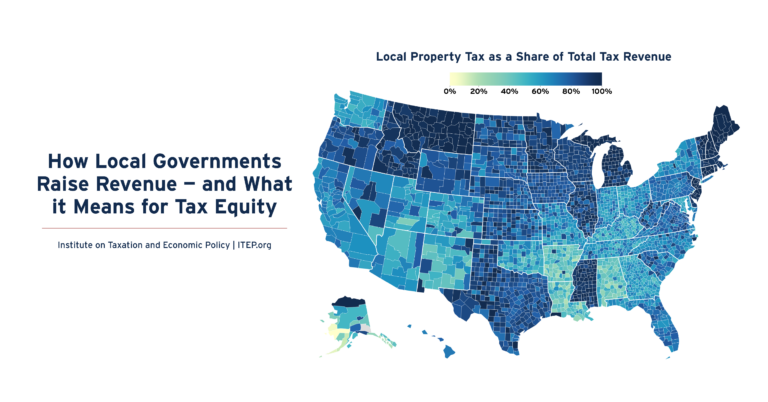
How Local Governments Raise Revenue — and What it Means for Tax Equity
• By Galen Hendricks, Rita Jefferson
Local taxes are key to thriving communities. One in seven tax dollars in the U.S.—about $886 billion annually—is levied by local governments in support of education, infrastructure, public health, and other priorities. Three fourths of this funding comes from property taxes, 18 percent comes from sales and excise taxes, and six percent comes from income taxes.

Local Mansion Taxes: Building Stronger Communities with Progressive Taxes on High-Value Real Estate
• By Andrew Boardman
More than one dozen cities and counties levy progressive taxes on high-price real estate transactions — sometimes called mansion taxes — and over a dozen more are considering such policies. By asking buyers and sellers with greater financial means to contribute more to the common good, these policies are equipping communities with resources to make progress on critical challenges of local and national concern.
America Used to Have a Wealth Tax: The Forgotten History of the General Property Tax
• By Carl Davis, Eli Byerly-Duke
Over time, broad wealth taxes were whittled away to become the narrower property taxes we have today. These selective wealth taxes apply to the kinds of wealth that make up a large share of middle-class families’ net worth (like homes and cars), but usually exempt most of the net worth of the wealthy (like business equity, bonds, and pooled investment funds).The rationale for this pared-back approach to wealth taxation has grown weaker in recent decades…

Preventing an Overload: How Property Tax Circuit Breakers Promote Housing Affordability
• By Brakeyshia Samms, Carl Davis
Circuit breaker credits are the most effective tool available to promote property tax affordability. These policies prevent a property tax “overload” by crediting back property taxes that go beyond a certain share of income. Circuit breakers intervene to ensure that property taxes do not swallow up an unreasonable portion of qualifying households’ budgets.

State Tax Codes as Poverty Fighting Tools: 2019 Update on Four Key Policies in All 50 States
• By Aidan Davis
This report presents a comprehensive overview of anti-poverty tax policies, surveys tax policy decisions made in the states in 2019 and offers recommendations that every state should consider to help families rise out of poverty. States can jump start their anti-poverty efforts by enacting one or more of four proven and effective tax strategies to reduce the share of taxes paid by low- and moderate-income families: state Earned Income Tax Credits, property tax circuit breakers,…
Property Tax Circuit Breakers in 2019
• By Aidan Davis
State lawmakers seeking to make residential property taxes more affordable have two broad options: across-the-board tax cuts for taxpayers at all income levels, such as a homestead exemption or a tax cap, and targeted tax breaks that are given only to particular groups of low- and middle-income taxpayers. This policy brief surveys the advantages and disadvantages of the circuit breaker approach to reducing property taxes.

Split Roll Property Taxes
• By Carl Davis
In the past half century, state lawmakers have explored a wide variety of approaches to scaling back property taxes. One such approach is the split roll property tax, also known as a classified property tax. Unlike a regular property tax system which taxes all types of real property at the same rate, a split roll property tax applies different tax rates to different types of property. This policy brief looks at the advantages and disadvantages…

Capping Property Taxes: A Primer
• By ITEP Staff
In response to what anti-tax advocates have branded as "out of control" property taxes, a number of states have decided to make use of tax "caps" to restrict the growth of local property taxes. California's Proposition 13 tax cap, approved in 1978, inspired numerous other states to enact similarly ill-conceived property tax caps. These caps can come in many forms, but all are poorly-targeted and costly. In most cases, these caps amount to a state-mandated…
How Property Taxes Work
• By ITEP Staff
The property tax is the oldest major revenue source for state and local governments. At the beginning of the twentieth century, property taxes represented more than eighty percent of state and local tax revenue. While this share has diminished over time as states have introduced sales and income taxes, the property tax remains an important mechanism for funding education and other local services. This policy brief discusses why property is taxed and how property taxes…

Institute on Taxation
and Economic Policy
ITEP is a non-profit, non-partisan tax policy organization. We conduct rigorous analyses of tax and economic proposals and provide data-driven recommendations to shape equitable and sustainable tax systems.
Subscribe to ITEP Emails
Tax research and policy news in your inbox.
Promote Fair Tax Policy
Your gift to ITEP promotes tax justice. With your help, we do research that supports taxing millionaires and billionaires, taxing big corporations and raising revenue for the things our people, our communities and our planet need.
Together, we can create a country with more economic justice, more racial justice, more climate justice… and more tax justice.