Three popular state tax credits support families with children: the Child Tax Credit (CTC, or child credit), the Child and Dependent Care Tax Credit (CDCTC, or dependent care credit), and the Earned Income Credit (EITC). While the EITC is intended to boost wages for low- and moderate-income workers and families, the CTC and CDCTC are specifically designed to reduce the costs of raising children. Despite their similar acronyms, they provide distinct types of support for raising children.
The federal government offers both a Child Tax Credit and a Child and Dependent Care Tax Credit. In addition, 16 states offer their own child credits and 26 states plus the District of Columbia offer their own dependent care credits. While state dependent care credits were all enacted before 2016, most state child tax credits were enacted after 2021 in response to the success of the temporary federal CTC expansion under the American Rescue Plan (ARPA) in reducing child poverty.
Figure 1
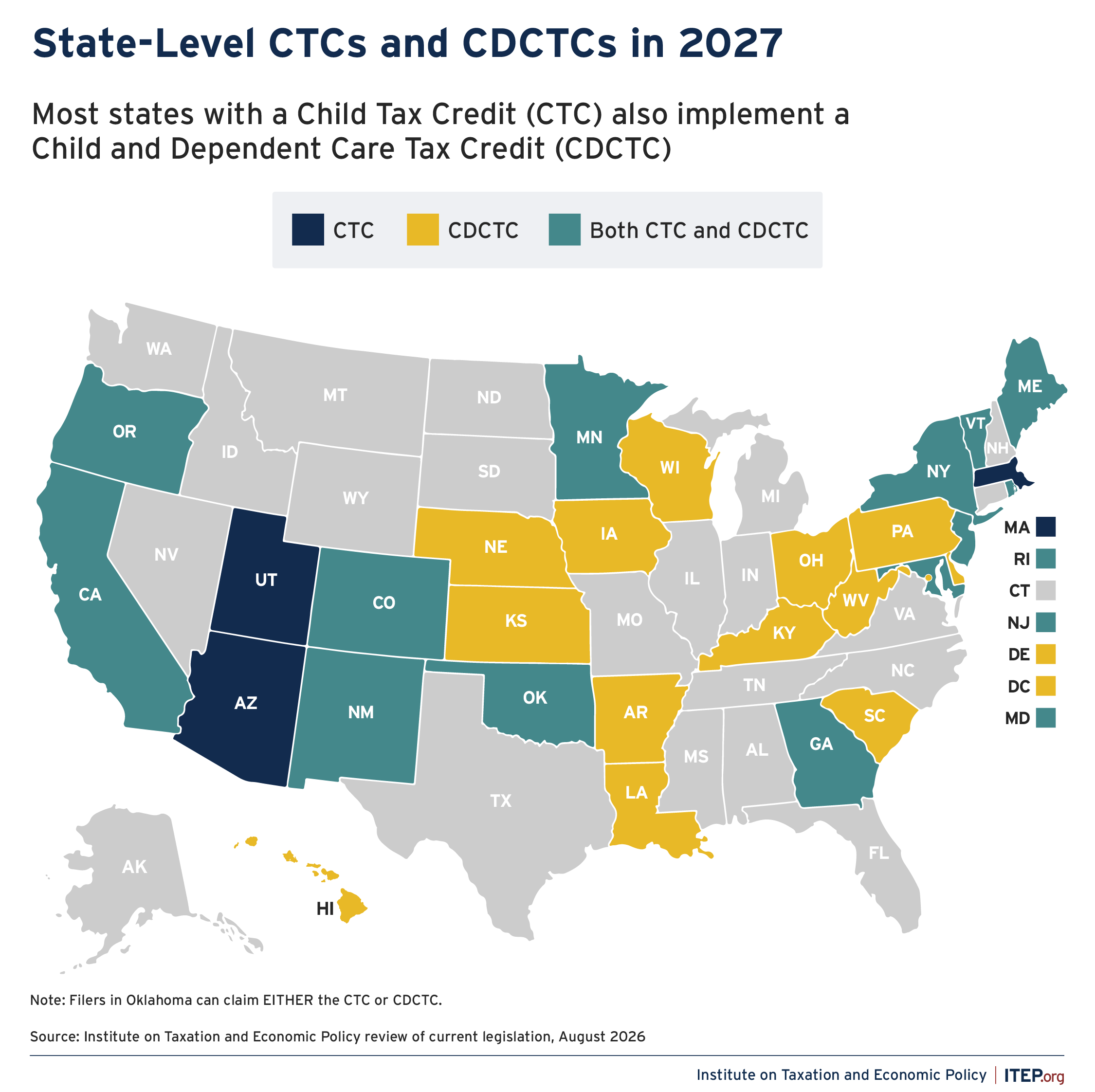
The Two Credits
The federal Child Tax Credit and Child and Dependent Care Tax Credit were both created to make child rearing more affordable, but they do so in different ways. The child credit provides broad cash support to spend on needs associated with raising children, while the dependent care credit is designed to improve childcare affordability by providing reimbursement for prior childcare costs.
At the federal level, the CTC is a partially refundable credit that boosts the income of recipients who can then decide how to spend it on their children. It now offers up to $2,200 per child, of which up to $1,700 can be received as a refund. While lawmakers increased this credit from $2,000 to $2,200 per child as part of 2025’s so-called “One Big Beautiful Bill Act” (OBBBA), low-income families with children are still prevented from accessing the full credit because the credit is not fully refundable.
The federal CDCTC is a nonrefundable credit that allows families to claim $3,000 in childcare expenses for one child or $6,000 for two or more children. Households with incomes under $15,000 qualify for the maximum match of 50 percent of these expenses, meaning that theoretically the maximum credit is $3,000. However, the non-refundability of this credit means it is nearly impossible to receive the full credit because low-income families who qualify for this amount rarely owe $3,000 in federal taxes after other credits are applied.
The structure of the child credit allows most people with qualifying children to benefit, though many families are excluded from receiving the full benefit because of limitations on the credit’s refundability rules. ITEP research has shown that 30 percent of all U.S. children are barred from receiving the full amount of CTC they could otherwise potentially claim, including about 40 to 50 percent of children in Black, Hispanic, and Native American families. Moreover, ITEP has also found that families with young children are less likely to receive the full credit than families with older children. While there are proposals in Congress to correct these shortcomings, they have yet to be enacted on a permanent basis.
Meanwhile, the non-refundability of the dependent care credit and limitation as a reimbursement for childcare tends to benefit families who can afford childcare upfront. This credit also creates barriers for people using family members to provide care, since provider information and payment records are required. The differences in flexibility and accessibility mean that low-income families have more obstacles accessing the dependent care credit than the child credit, even if they are indeed paying to secure childcare. This is reflected in federal costs. The Joint Committee on Taxation estimates that in 2027, $128 billion will be provided to support families through the CTC and less than $7 billion through the CDCTC.
In response to the COVID-19 pandemic, federal lawmakers temporarily expanded both credits to provide economic relief for families. For the 2021 tax year, policymakers made the child credit fully refundable, expanded the claimable amount to $3,600 per child, and allowed 50 percent of the credit to be dispensed monthly. The dependent care credit was also made fully refundable, allowing families to claim up to $8,000 in expenses for two or more children. The temporary expansions under ARPA showed states how to better serve low-income families. ARPA’s CTC expansion benefited families who needed support throughout the year by providing fully refundable monthly payments, and the CDCTC became more accessible by providing full refundability and increasing the maximum amount of qualifying expenses.
Many states have adopted the federal policy designs of the Child Tax Credit and Child and Dependent Care Tax Credit. For states that tie their credit closely to current federal law, the recent OBBBA expansion also expands those state CDCTCs. Unless additional state reforms have been made, state CDCTC expansions will still leave out families who cannot afford upfront childcare costs or have low tax liability.
Considerations for State Lawmakers and Advocates
Several policy enhancements should be considered for state Child Tax Credits and Child and Dependent Care Tax Credits.
For state child credits, meaningful reforms include prioritizing full refundability, expanding age eligibility, and increasing the dollar amount of the credit. Additionally, some states allow taxpayers to claim the credit using either an Individual Taxpayer Identification Number (ITIN) or a Social Security Number. A notable example is Minnesota. Minnesota’s CTC is fully refundable, includes ITINs, and allows filers to receive a portion of the credit as advance payments. This makes Minnesota’s child credit especially flexible for recurring expenses, like childcare.
Likewise, research and advocacy groups have recommended making state dependent care refundable and easing reporting requirements. They also encourage decoupling from the federal expense limits and income eligibility for the maximum percentage so low- and moderate-income families can access a more targeted and meaningful credit.
About half of state CDCTCs are at least partially refundable, making them more accessible for families with little tax liability. Similarly, the temporary refundability of the federal dependent care credit under ARPA expanded access to more low-income families. Several states target these credits towards lower-income families, but even state-expanded income cutoffs are still quite restrictive.
State lawmakers may also consider if constituents would benefit more from direct cash support or expense reimbursement. Regardless of the credit under consideration, full refundability and providing a meaningful credit amount can increase access for families who need help most.
Conclusion
The Child Tax Credit provides families with great flexibility because the credit boosts the income of recipients who can then determine what their children need, while the Child and Dependent Care Tax Credit is designed specifically for prior childcare expenses. The CTC remains a key vehicle to provide inclusive cash support that allows families to address the many financial demands of raising children. That said, several states have recognized the value and necessity of refundability in credit design and have extended this policy feature to their CTCs and CDCTCs.