
Federal Policy

Congressional Republicans Say D.C. Shouldn’t Be Allowed to Run Its Own Tax System
• By Matthew Gardner
This week a U.S. House of Representatives committee approved a bill that would effectively take away Washington, D.C.’s fiscal autonomy, requiring Congressional approval of any new D.C. laws that increase taxes or fees.

America at 250: It’s Time for a Tax Code That Lives Up to Our Ideals
• By Brakeyshia Samms
After 250 years, our leaders must show a commitment to completing the unfinished work of American democracy.

A Year Later, Many States Have Decided Not to Double Down on Trump’s Tax Cuts
• By Nick Johnson
Nearly one year after the Trump tax law was signed, many of the 42 states with income taxes are declining to incorporate significant parts of the new law into their own tax codes.

Why Corporations Must Pay More
• By Steve Wamhoff, Amy Hanauer
Corporate tax reforms could be more resilient than proposals to tax wealth or unrealized capital gains while achieving the same goal of more adequately taxing the income of billionaires.
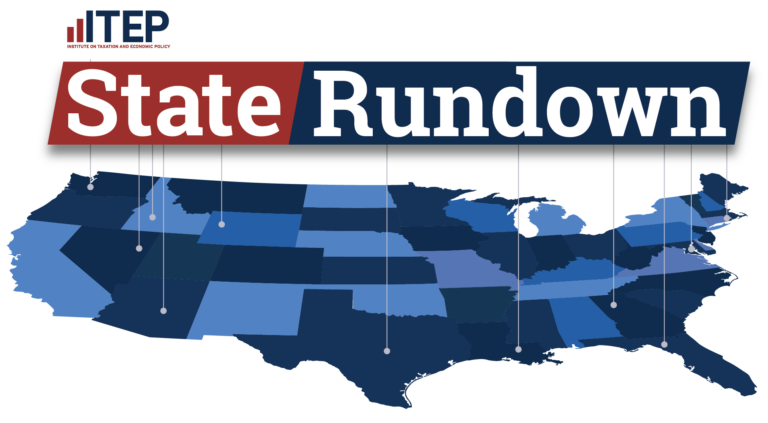
State Rundown 6/11: Taxing the Rich Heats Up
• By ITEP Staff
As we head into summer, many state legislatures are in the final stretches of their sessions. Rhode Island moved another step closer to joining the ranks of Washington, Maine, and Hawai’i in enacting a new high-income surcharge this year.

Tesla Reported Zero Federal Income Tax on $5.7 Billion of U.S. Income in 2025
• By Matthew Gardner
Tesla enjoyed almost $5.7 billion of U.S. income in 2025 but paid $0 in federal income tax. Over the past three years, the Elon Musk-led company reported $12.5 billion of U.S. income on which its current federal tax was just $48 million.

Trump Goes Outside the Law to Give Even More Tax Cuts to the Wealthy
• By Steve Wamhoff
Trump's Treasury is overstepping far beyond its constitutional role by giving unlegislated tax cuts to the wealthy.
Some Members of Congress Will Cash in from New Tax Law
• By ITEP Staff
Many lawmakers who were vocal supporters of this bill will see direct personal benefits while most of their constituents benefit little or will be worse off.

There Were Far Cheaper and Fairer Options Than the Trump Megabill
• By Steve Wamhoff, Joe Hughes, Jessica Vela
Congress and the president could have spent less than half that much money on a tax bill that does more for working-class and middle-class households.

Analysis of Tax Provisions in the Senate Reconciliation Bill: National and State Level Estimates
• By Carl Davis, Jessica Vela, Joe Hughes, Steve Wamhoff
Compared to its House counterpart, the Senate bill makes certain tax provisions more generous, including corporate tax breaks that it makes permanent rather than temporary. But the bottom line for both is the same. Both bills give more tax cuts to the richest 1 percent than to the entire bottom 60 percent of Americans, and both bills particularly favor high-income people living in more conservative states.

Trump Megabill’s Deduction for Car Loan Interest Would Not Offset Tariff-Related Auto Price Increases for Most Buyers
• By Carl Davis, Sarah Austin
The auto loan interest deduction that recently passed the House is designed, at least in part, to mitigate the impact of tariff-induced price increases on vehicles assembled in America. But the deduction is incapable of offsetting even small-scale price increases, especially for working-class families and others with moderate incomes.

Musk-Trump Feud Shows Need to Tax the Rich
• By Amy Hanauer
Our tax policies enable people like Elon Musk and Donald Trump to accumulate more wealth than anyone could ever use in a lifetime. They then use it to steer elections and shape public policy to further enrich themselves and others like them. We should defeat the enormously destructive tax bill in Congress and instead craft tax policy that taxes the rich, makes our democracy more fair, and returns resources to the rest of the country.
Analysis of Tax Provisions in the House Reconciliation Bill: National and State Level Estimates
• By Carl Davis, Jessica Vela, Joe Hughes, Steve Wamhoff
The poorest fifth of Americans would receive 1 percent of the House reconciliation bill's net tax cuts in 2026 while the richest fifth of Americans would receive two-thirds of the tax cuts. The richest 5 percent alone would receive a little less than half of the net tax cuts that year.

The House Tax Plan, By the Numbers
• By Carl Davis
The House of Representatives unveiled a sprawling piece of tax legislation earlier this week that would extend temporary tax changes enacted in 2017 and layer various kinds of tax cuts and increases on top. The JCT analysis makes clear that the House tax plan would be regressive, meaning it would offer larger tax cuts as a share of income to high-income taxpayers than to either middle-class or working-class families. It also makes clear that most…

America Has Left the Building: U.S. Loses from Our Global Tax Policy Choices, Others Could Gain
• By Amy Hanauer
Countries that once looked to the U.S. for direction on tax policy have concluded they need to form alliances without us. If so, it will often be to the benefit of other people around the globe and to the deficit of U.S. communities.

Sharp Turn in Federal Policy Brings Significant Risks for State Tax Revenues
• By Carl Davis
Summary The new presidential administration and Congress have indicated that they intend to bring about a dramatic federal retreat in funding for health care, food assistance, education, and other services that will push more of the responsibility for providing these essential services to the states. Meeting these new obligations would be a challenging task for […]

Federal Tax Policy: What Should It Accomplish?
• By Steve Wamhoff
The U.S. needs a tax code that is more adequate, meaning any major tax legislation should increase revenue, not reduce it. The U.S. also needs a tax code that is more progressive, meaning any significant tax legislation should require more, not less, from those most able to pay.
How Would the Harris and Trump Tax Plans Affect Different Income Groups?
• By Jon Whiten
Presidential candidates Kamala Harris and Donald Trump have put forward a wide range of different tax proposals during this year’s campaign. We have now fully analyzed the distributional impacts of the major proposals of both Vice President Harris and former President Trump in separate analyses. In all, the tax proposals announced by Harris would, on average, lead to a tax cut for all income groups except the richest 1 percent of Americans, while the proposals…

Institute on Taxation
and Economic Policy
ITEP is a non-profit, non-partisan tax policy organization. We conduct rigorous analyses of tax and economic proposals and provide data-driven recommendations to shape equitable and sustainable tax systems.
Subscribe to ITEP Emails
Tax research and policy news in your inbox.
Promote Fair Tax Policy
Your gift to ITEP promotes tax justice. With your help, we do research that supports taxing millionaires and billionaires, taxing big corporations and raising revenue for the things our people, our communities and our planet need.
Together, we can create a country with more economic justice, more racial justice, more climate justice… and more tax justice.