
Iowa
State Tax Watch 2026
March 9, 2026 • By ITEP Staff
ITEP tracks tax discussions in legislatures across the country and uses our unique data capacity to analyze the revenue, distributional, and racial and ethnic impacts of many of these proposals. State Tax Watch offers the latest news and movement from each state.
As many state legislative sessions near or cross the halfway point, lawmakers are facing tough choices.
Education Week: How Do Schools Solve a Problem Like Property Taxes?
February 19, 2026
As tax season dawns, backlash to a nationwide surge in property-tax bills is spurring states to double down on proposals to diminish one of the main revenue sources for school districts. At least 10 states are pitching the end of one of schools’ chief revenue sources. Read more.
State Rundown 1/14: New Year Brings New Resolutions for Funding Key Priorities
January 14, 2026 • By ITEP Staff
State governors are beginning to lay out their top priorities as legislatures reconvene in statehouses around the country.
State Rundown 1/7: New Year, New Opportunities for Progressive Revenue
January 7, 2026 • By ITEP Staff
As we kick off a new year, several states are facing revenue shortfalls. Some lawmakers are approaching the challenge with sustainable and equitable solutions.
State Rundown 12/17: Tax Policy ‘Naughty or Nice’ List Has Late Entrants
December 17, 2025 • By ITEP Staff
With a little over a week left, some states are solidifying their spots on the tax policy “naughty or nice” list.
Linking to Tipped and Overtime Income Deductions Would Worsen State Shortfalls, Do Little to Help Workers
December 8, 2025 • By Neva Butkus, Galen Hendricks

State deductions for tips and overtime are not only ineffective at supporting working-class people, it will come at a substantial cost to state budgets.
State Rundown 11/24: States Say ‘No Thank You’ to Federal Tax Cuts Reducing State Revenue
November 24, 2025 • By ITEP Staff
Lawmakers in two more states have wisely said “no thank you” to federal tax cuts that would have flowed through to their state tax codes and undermined funding for their priorities
States across the nation are debating how best to respond to costly new federal tax cuts.
Sales Tax Holidays Miss the Mark When it Comes to Effective Sales Tax Reform
July 17, 2025 • By Miles Trinidad

Sales tax holidays are often marketed as relief for everyday families, but they do little to address the deeper inequities of regressive sales taxes. In 2025, 18 states offer these holidays at a collective cost of $1.3 billion.
How Much Would Every Family in Every State Get if the Megabill’s Tax Cuts Given to the Rich Had Instead Been Evenly Divided?
July 14, 2025 • By Michael Ettlinger
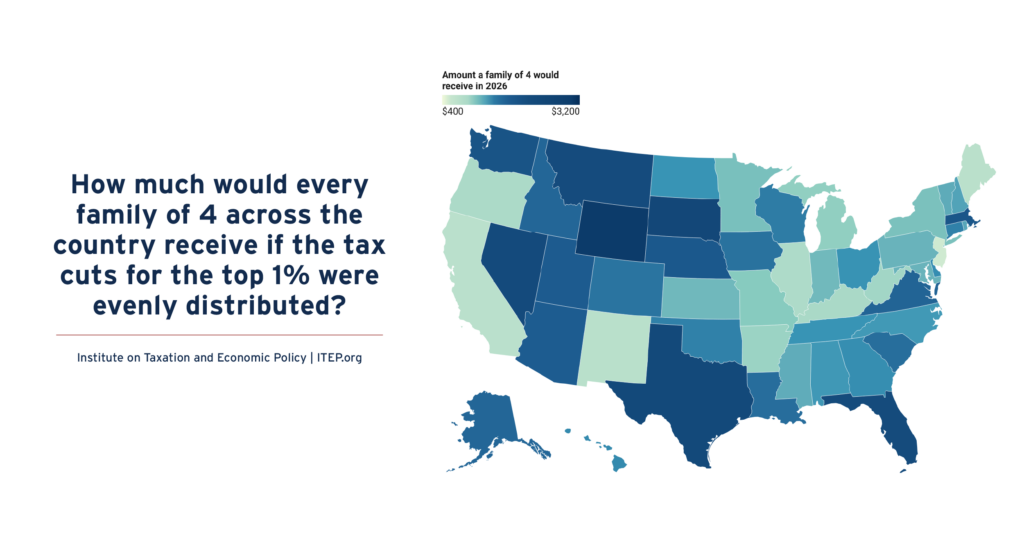
If instead of giving $117 billion to the richest 1 percent, that money had been evenly divided among all Americans, we'd each get $343 - or nearly $1,400 for a family of four.
Analysis of Tax Provisions in the Trump Megabill as Signed into Law: National and State Level Estimates
July 7, 2025 • By Steve Wamhoff, Carl Davis, Joe Hughes, Jessica Vela

President Trump has signed into law the tax and spending “megabill” that largely favors the richest taxpayers and provides working-class Americans with relatively small tax cuts that will in many cases be more than offset by Trump's tariffs.
Trump Megabill Will Give $117 Billion in Tax Cuts to the Top 1% in 2026. How Much In Your State?
June 30, 2025 • By Michael Ettlinger

The predominant feature of the tax and spending bill working its way through Congress is a massive tax cut for the richest 1 percent — a $114 billion benefit to the wealthiest people in the country in 2026 alone.
How Much Do the Top 1% in Each State Get from the Trump Megabill?
June 30, 2025 • By Carl Davis

The Senate tax bill under debate right now would bring very large tax cuts to very high-income people. In total, the richest 1 percent would receive $114 billion in tax cuts next year alone. That would amount to nearly $61,000 for each of these affluent households.
Analysis of Tax Provisions in the House Reconciliation Bill: National and State Level Estimates
May 22, 2025 • By Carl Davis, Jessica Vela, Joe Hughes, Steve Wamhoff
The poorest fifth of Americans would receive 1 percent of the House reconciliation bill's net tax cuts in 2026 while the richest fifth of Americans would receive two-thirds of the tax cuts. The richest 5 percent alone would receive a little less than half of the net tax cuts that year.
State Rundown 5/21: Big and Not-So Beautiful Tax Cut Bills Abound in States
May 21, 2025 • By ITEP Staff
As a sprawling, regressive tax bill continues to take shape at the federal level, many states are moving forward with major tax cut proposals of their own.
State Rundown 5/7: As Budget Season Heats Up, Tax Proposals Are Getting Serious
May 7, 2025 • By ITEP Staff
With spring in full bloom ,many state lawmakers are reaching tax policy agreements. Out west, lawmakers in North Dakota and Texas have moved major property tax cuts. Meanwhile, in the east and south, Vermont appears likely to pass an expansion to its Child Tax Credit and Earned Income Tax Credit, and South Carolina lawmakers are aiming to make deep, drastic cuts to the state’s income tax.

Want to know more about the tax and spending megabill that President Trump recently signed into law? We've got you covered.
State Rundown 5/1: State Tax Debates Wrapping Up, and Just Beginning
May 1, 2025 • By ITEP Staff
The rampant uncertainty this year extends far beyond the national economy and federal policy, as many state legislatures are declaring their tax and budget debates finished, and just getting started, sometimes in the same breath.
State Rundown 4/16: No Vacation from Spring Tax Breaks as Bills Advance
April 16, 2025 • By ITEP Staff
While students and families are enjoying spring break vacations, legislative sessions are still in full swing. And some are poised for a spring tax break season as proposals advance with major implications for the sustainability of state budgets.
IRS Cooperation with ICE Will Damage Public Trust, Putting Tax Revenues in Jeopardy
April 10, 2025 • By Marco Guzman

Attempts by the Department of Homeland Security to secure private information from the IRS on people who file taxes with an Individual Taxpayer Identification Number is a violation of federal privacy laws that protect taxpayers. It is also a change that could seriously damage public trust in the IRS, which could jeopardize billions of dollars in tax payments by hardworking immigrant families.
State Rundown 3/26: Lawmakers Navigate Shortfalls, Potholes, and Pitfalls
March 26, 2025 • By ITEP Staff
State lawmakers around the country are navigating a range of potential hazards this week. Leaders in Maryland and Washington are facing budget holes but are smartly working to get out of them through progressive taxes on those with the most ability to pay. Both North Dakota and Washington state are looking to fill literal potholes […]
March Madness kicks off today and the pressure is on as many states’ legislative sessions are nearing the final buzzer. Some state lawmakers are seemingly competing for the title of most regressive state tax policies while others are looking to lift up best practices for more equitable outcomes. The Mississippi legislature landed on a […]
Shelter Skelter: How the Educational Choice for Children Act Would Use Tax Avoidance to Fuel School Privatization
March 18, 2025 • By Carl Davis

The Educational Choice for Children Act of 2025 would ostensibly provide a tax break on charitable donations to organizations that give out private K-12 school vouchers. Most of the so-called “contributions,” however, would be made by wealthy people solely for the tax savings, as those savings would typically be larger than their contributions.
Circuit Breakers Are a Better Option for Property Tax Relief
March 13, 2025 • By Brakeyshia Samms

To curb the impact of property taxes on working families, lawmakers should improve or implement a property tax circuit breaker program. The program works like this: when families are overloaded with their property taxes, the circuit breaker kicks in and helps alleviate the pressure these taxes put on family budgets.
