In the understatement of the week, Transportation Secretary Sean Duffy recently said that L3Harris, the defense contractor that appears to be responsible for shutting down every airport in America last Friday, is “not doing great work for us.”
While lawmakers will sensibly scrutinize L3Harris’ actions leading up to last week’s aviation meltdown, an equally important question to ask is exactly what American taxpayers are getting for the hundreds of millions of dollars in tax breaks, including $449 million in research and development tax breaks, the so-called “One Big Beautiful Bill Act” (OBBBA) gave L3Harris last year alone.
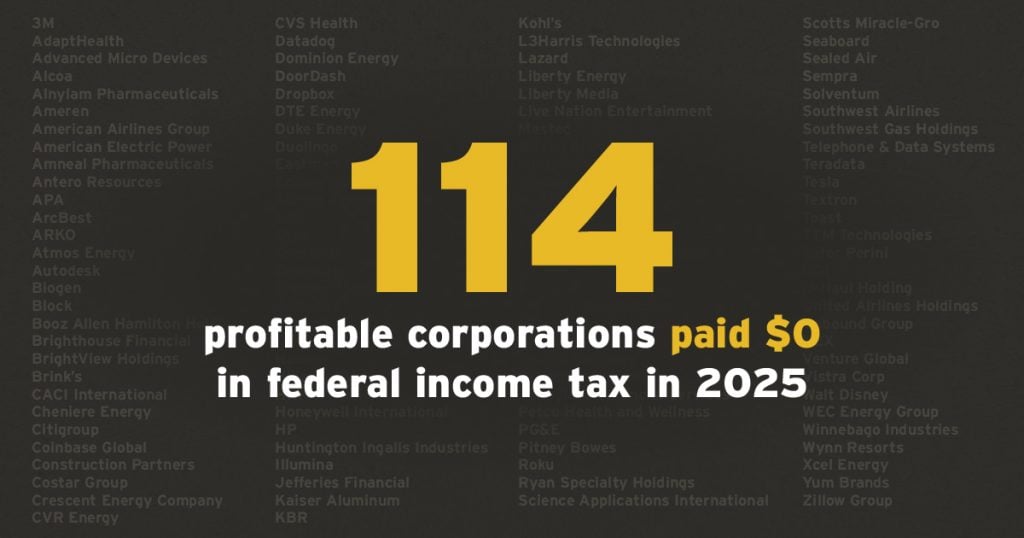
L3Harris is one of 114 Fortune 1000 corporations that paid no federal income taxes on substantial U.S. profits in 2025, according to our recent analysis. This should have been challenging for L3Harris, which reported $1.6 billion of pretax income in the U.S. But OBBBA made it easy: the 2025 tax cut pushed through by a Republican Congress and President Trump allowed companies to immediately write off domestic R&D expenses, with the stated goal of “enabl[ing] them to expand domestic research programs.”
L3Harris discloses in its 2025 annual report that it claimed $449 million in federal tax breaks from this one OBBBA provision in 2025. That’s on top of $226 million in R&D tax credits and $22 million in advanced manufacturing credits. This smorgasbord of tax breaks explains why L3Harris avoided every last dime of federal income tax liability in 2025—and in 2024 as well, when it recorded zero current federal income taxes on $1.4 billion of domestic pretax profit.
What makes the federal government’s generosity toward L3Harris extra puzzling is that the defense contractor is already heavily dependent on the federal government for its income. Last year, 75 percent of its revenues came from sales to the U.S. government. So, there’s every reason to hope L3Harris would prioritize doing good work for its biggest client, American taxpayers, even without the extra tax breaks.
The incoming Democratic majority in the U.S. House and Senate may usher in a welcome new era of corporate accountability, and assessing L3Harris’ actions leading up to last week’s aviation meltdown will likely be high on lawmakers’ to-do list. But a basic and indefensible bias in the federal government’s budget process— that spending bills are scrutinized annually while tax breaks are left on autopilot—means it’s far less likely that lawmakers will ask even basic questions about what American taxpayers are getting in return for shoveling out over half a billion in tax breaks to this one company in just one year.
Unlike the direct budgetary spending Congress authorizes each year, corporate tax breaks like the R&D expensing authorized by OBBBA are on cruise control until the car crashes. The 2025 tax law made immediate expensing of R&D (and bonus depreciation, which allows companies like L3Harris to immediately write off their capital expenditures, even when they’re being made in areas like AI that American taxpayers really dislike) permanent features of the tax law.
There is simply no process in place for lawmakers to come back in a year, five years, or even a decade to ask whether these expensive giveaways are achieving any useful social policy objectives. So while the incoming Democratic majority will hopefully clarify the role L3Harris’ actions played in last week’s airline gridlock, it’s far less likely that anyone will ask whether half a billion dollars in tax breaks made this outcome any less damaging.
It’s always possible that L3Harris used its $449 million of R&D breaks last year for something more helpful than a new “what happens if we disconnect THIS wire” initiative, as appears to be the case. But until Congress chooses to scrutinize corporate tax breaks with the same skeptical eye it applies to direct government spending, we’ll never know. Friday’s paralyzing ground stop highlights the pitfalls of Congress’ “blank check” approach to corporate tax breaks.