
New York
Tuesday’s elections shook up statehouses, governors’ offices, and tax laws in many states, and in this week’s Rundown we bring you the top 3 election state tax policy stories to emerge. First, voters in Kansas and other states sent a message that regressive tax cuts and supply-side economics have not succeeded and are not welcome among their state fiscal policies. Meanwhile, residents of many other states, including most notably Illinois, voted for representatives who reflect their preference for equitable, sustainable policies to improve their state economies through smart public investments and improve the lives of all residents through progressive tax structures. Lastly, while some states missed…
Amazon HQ2 Finalists Should Disclose the Financial Incentives They Promised
November 6, 2018 • By Guest Blogger

The Crystal City and Long Island City subsidy offers are among the many Amazon HQ2 bids that remain completely hidden. Citizens have no idea what their elected officials have promised to a company headed by the richest person on earth.
Comments to be delivered during IRS hearing on “Contributions in Exchange for State or Local Tax Credits” (REG-112176-18)
November 5, 2018 • By Carl Davis
ITEP views this proposal as a sensible improvement, and one that is actually overdue, to the way the charitable deduction is administered. At the end of my remarks I will discuss a few ways that the regulation could be improved. But the core point I want to emphasize is that the general approach taken here, where quid pro quo rules are applied in a broad-based fashion to all significant state and local tax credits, is the correct one.
Policymakers and residents in all 50 states and the District of Columbia got new ITEP data this week on how their tax structures and decisions affect their high-, middle-, and low-income residents. As our “Who Pays?” report outlines, most state and local tax codes exacerbate economic inequalities and all states have room to improve. The data can serve as an important informative backdrop to all state and local tax policy debates, such as whether to change the valuation of commercial property in California, how to improve funding for early childhood education in Indiana, and how to evaluate tax-related ballot measures…
New York: Who Pays? 6th Edition
October 17, 2018 • By ITEP Staff
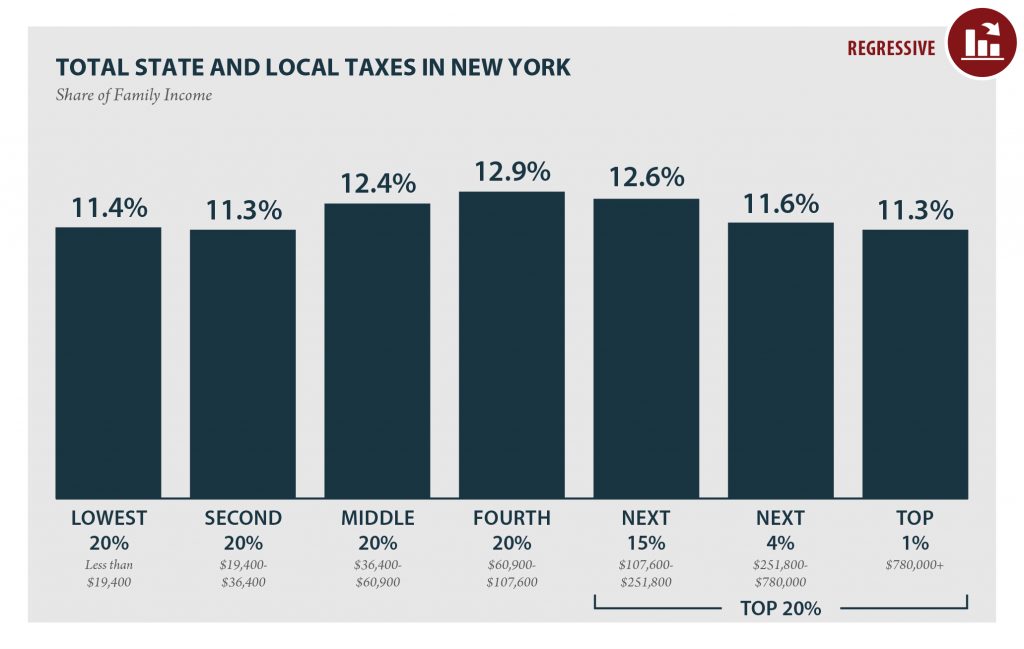
NEW YORK Read as PDF NEW YORK STATE AND LOCAL TAXES Taxes as Share of Family Income Top 20% Income Group Lowest 20% Second 20% Middle 20% Fourth 20% Next 15% Next 4% Top 1% Income Range Less than $19,400 $19,400 to $36,400 $36,400 to $60,900 $60,900 to $107,600 $107,600 to $251,800 $251,800 to $780,000 […]
State Rundown 10/12: Local Jurisdictions Fighting for Revenues, Independence
October 12, 2018 • By ITEP Staff
Voters all around the country are educating themselves for the upcoming elections, notably this week around ballot initiatives in Arizona and Colorado and competing gubernatorial tax proposals in Georgia and Illinois. But not all eyes are on the elections, as the relationship between state and local policy made news in Delaware, Idaho, North Dakota, and Ohio.
New York Times: White Americans Gain the Most From Trump’s Tax Cuts, a Report Finds
October 11, 2018
The tax cuts that President Trump signed into law last year are disproportionately helping white Americans over African-Americans and Latinos, a disparity that reflects longstanding racial economic inequality in the United States and the choices that Republicans made in crafting the law.
ITEP Comments and Recommendations on Proposed Section 170 Regulation (REG-112176-18)
October 11, 2018 • By Carl Davis
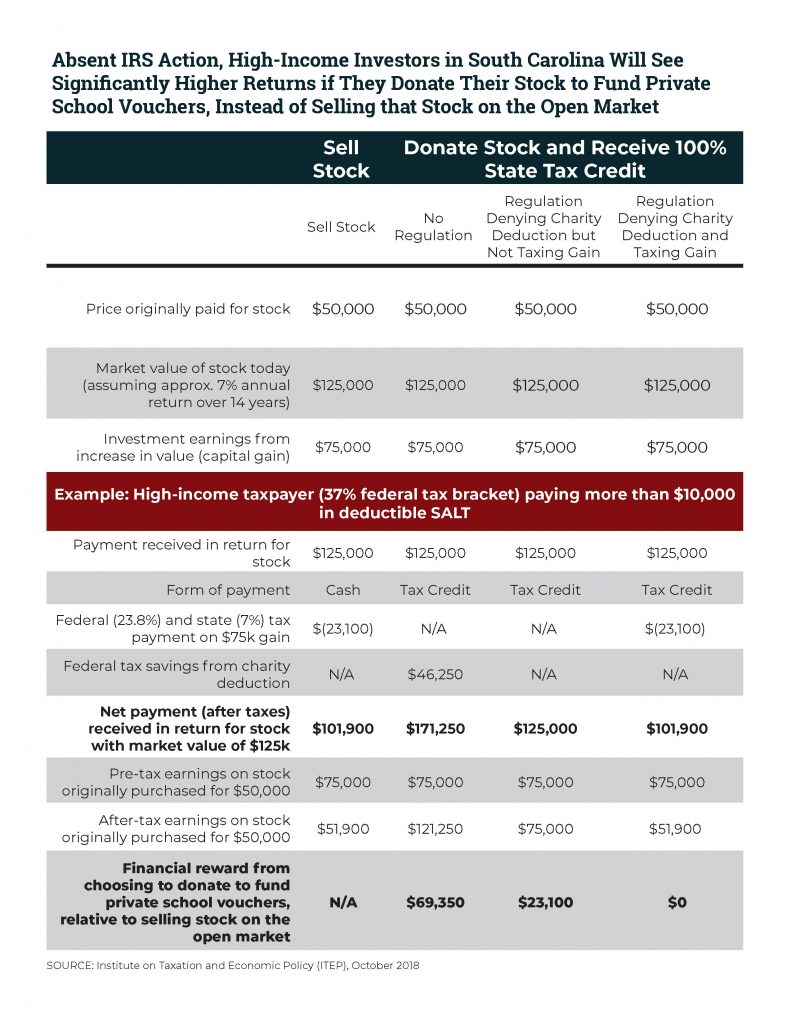
The IRS recently proposed a commonsense improvement to the federal charitable deduction. If finalized, the regulation would prevent not just the newest workarounds to the $10,000 deduction for state and local taxes (SALT), but also a longer-running tax shelter abused by wealthy donors to private K-12 school voucher programs. ITEP has submitted official comments outlining four key recommendations related to the proposed regulation.
Concerned about Trump-family tax gaming? His law may prompt others to dodge.
October 5, 2018 • By Steve Wamhoff
“The IRS is wildly outgunned,” says Steve Wamhoff, director of federal tax policy at the Institute on Taxation and Economic Policy, a think tank in Washington. “You can’t keep cutting IRS funding and not expect more things like what The New York Times wrote about the Trumps. That’s bound to happen even more now.”
South Carolina lawmakers have finally passed a federal conformity bill in response to last year’s federal tax-cut legislation. Voters in many states are hearing a lot about tax-related questions they’ll see on the ballot in November, particularly residents of Florida, Montana, and Oregon, where corporate donors and other anti-tax interests are spending major sums to alter policy in their states. And states continue to work on ensuring they can collect online sales taxes and, in some states, online sports betting taxes.
The New Yorker: The Trump Family’s Tax Dodging Is Symptomatic of a Larger Problem
October 3, 2018
This experience points to an enduring scandal that goes well beyond the Trumps. “The key takeaway from the New York Times article . . . is that the wealthy and powerful abide by a different set of rules than the rest of us,” Alan Essig, the executive director of the Institute on Taxation and Economic Policy, a nonpartisan […]
NYT Expose on Trump Family Tax Avoidance Demonstrates There’s a Different Set of Rules for the Rich and Powerful
October 2, 2018 • By Alan Essig
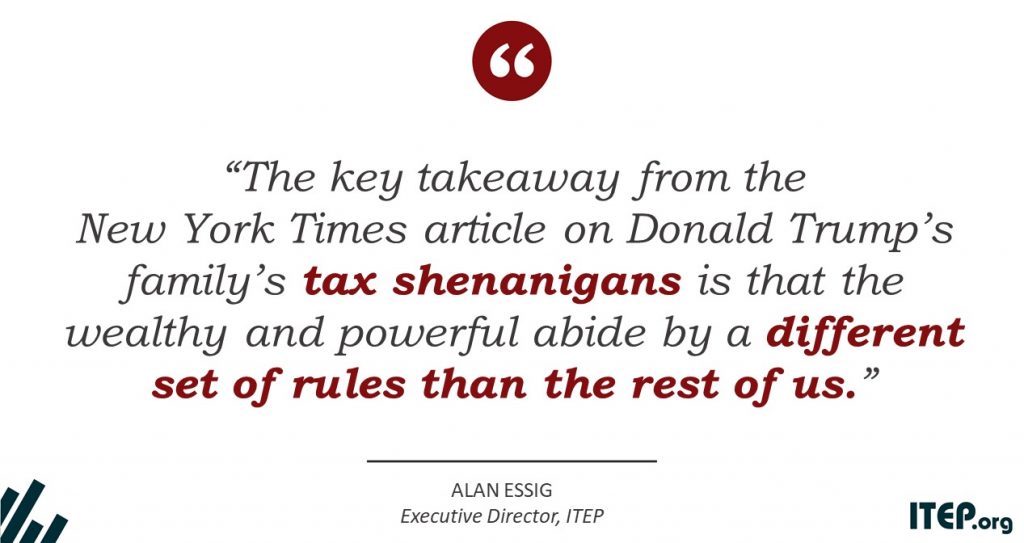
Following is a statement by Alan Essig, executive director of the Institute on Taxation and Economic Policy, regarding an expose in today’s New York Times that reveals Donald Trump’s family engaged in complex schemes to avoid taxes.
Tax Cuts 2.0 – New York
September 26, 2018 • By ITEP Staff
The $2 trillion 2017 Tax Cuts and Jobs Act (TCJA) includes several provisions set to expire at the end of 2025. Now, GOP leaders have introduced a bill informally called “Tax Cuts 2.0” or “Tax Reform 2.0,” which would make the temporary provisions permanent. And they falsely claim that making these provisions permanent will benefit […]
NJ.com: Murphy Pushes Plan to Save Property Tax Breaks
September 26, 2018
Only residents of New York, Connecticut, and California deduct more from federal taxes than New Jerseyans, according the progressive Institute on Taxation and Economic Policy. Most of the states hit hardest send billions of dollars more to Washington than they get back in services. Read more
The Rundown is back after a few-week hiatus, with lots of state fiscal news and quality research to share! Maine lawmakers found agreement on a response to the federal tax-cut bill, states continue to sort out how they’ll collect online sales taxes in the wake of the Wayfair decision, and policymakers in several states have been working on summer tax studies and other preparations for 2019 legislative sessions. Meanwhile, work on ballot measures and candidate tax plans to go before voters in November has been even more active, particularly in Arizona, California, Florida, Hawaii, and Missouri. Our “What We’re Reading” section has lots of great research and reading on inequalities, cities turning…
State Tax Codes as Poverty Fighting Tools: 2018 Update on Four Key Policies in All 50 States
September 17, 2018 • By Aidan Davis, Misha Hill
This report presents a comprehensive overview of anti-poverty tax policies, surveys tax policy decisions made in the states in 2018, and offers recommendations that every state should consider to help families rise out of poverty. States can jumpstart their anti-poverty efforts by enacting one or more of four proven and effective tax strategies to reduce the share of taxes paid by low- and moderate-income families: state Earned Income Tax Credits, property tax circuit breakers, targeted low-income credits, and child-related tax credits.
Education Week: How a Proposed Tax Rule Could Hurt School Vouchers
September 11, 2018
Under the Tax Cuts and Jobs Act passed in 2017, wealthy residents in states such as New York and California face sizable increases in their federal tax bills because of a $10,000 cap on state and local tax deductions they can make on their federal returns. Democratic lawmakers allege the so-called SALT-cap unfairly targets left-leaning […]
Reuters: U.S. Treasury, IRS move to block states dodging tax deduction cap
August 23, 2018
Under the proposed rule, however, a New York taxpayer could not receive a federal charitable deduction for the portion of their donation to the fund for which they received a state tax credit, unless the credit was for 15 percent or less. “If you make a donation of $100 and you get a big chunk […]
New Jersey Online: Trump Administration Rejects Efforts to Save Your Property Tax Break
August 23, 2018
And in New Jersey, more than four in 10 taxpayers claimed that tax break and deducted an average deduction of $17,850 in 2015, according to the Pew Charitable Trusts. Only residents of New York, Connecticut and California deduct more from federal taxes than New Jerseyans, according the progressive Institute on Taxation and Economic Policy. Read more
State Rundown 8/16: November Ballots and 2019 Debates Coming into Focus
August 16, 2018 • By ITEP Staff
Even as the haze from western wildfires reduced visibility across the nation this week, voters got more clarity on what to expect to see on their ballots this fall, particularly in California (commercial property taxes and corporate surcharges), Colorado (income taxes for education), Missouri (gas tax update), and North Dakota (recreational cannabis). Meanwhile, although Virginia lawmakers won’t return until 2019, they got a preview of a clear-headed federal conformity plan they should strongly consider. And look to our “What We’re Reading“ section for further enlightenment from researchers on the [in]effectiveness of charitable contribution credits, the [lack of] wage growth for…
State Rundown 8/8: States Setting Rules for Upcoming Tax Decisions
August 8, 2018 • By ITEP Staff
August is often a season for states to define the parameters of tax debates to come, and that is true this week in several states: a tax task force in Arkansas is nearing its final recommendations; residents of Missouri, Montana, and North Carolina await results of court challenges that will decide whether tax measures will show up on their ballots this fall; and Michigan and South Dakota are taking different approaches to making sure they’re ready to collect online sales taxes next year.
Consumers’ growing interest in online shopping and “gig economy” services like Uber and Airbnb has forced states and localities to revisit their sales taxes, for instance. Meanwhile new evidence on the dangers and causes of obesity has led to rising interest in soda taxes, but the soda industry is fighting back. Carbon taxes are being discussed as a tool for combatting climate change. And changing attitudes toward cannabis use have spurred some states to move away from outright prohibition in favor of legalization, regulation and taxation.
Although most state legislatures are out of session during the summer, the pursuit of better fiscal policy has no "off-season." Here at ITEP, we've been revamping the State Rundown to bring you your favorite summary of state budget and tax news in the new-and-improved format you see here. Meanwhile, leaders in Massachusetts and New Jersey have been hard at work in recent weeks and are already looking ahead their next round of budget and tax debates. Lawmakers in many states are using their summer break to prepare for next year's discussions over how to implement online sales tax legislation. And…
State Rundown 7/19: Wayfair Fallout and Ballot Preparation Dominate State Tax Talk
July 19, 2018 • By ITEP Staff
In the wake of the U.S. Supreme Court's recent Wayfair decision authorizing states to collect taxes owed on online sales, Utah lawmakers held a one-day special session that included (among other tax topics) legislation to ensure the state will be ready to collect those taxes, and a Nebraska lawmaker began pushing for a special session for the same reason. Voters in Colorado and Montana got more clarity on tax-related items they'll see on the ballot in November. And Massachusetts moves closer toward becoming the final state to enact a budget for the new fiscal year that started July 1 in…
Sales Tax Holidays: An Ineffective Alternative to Real Sales Tax Reform
July 12, 2018 • By Dylan Grundman O'Neill
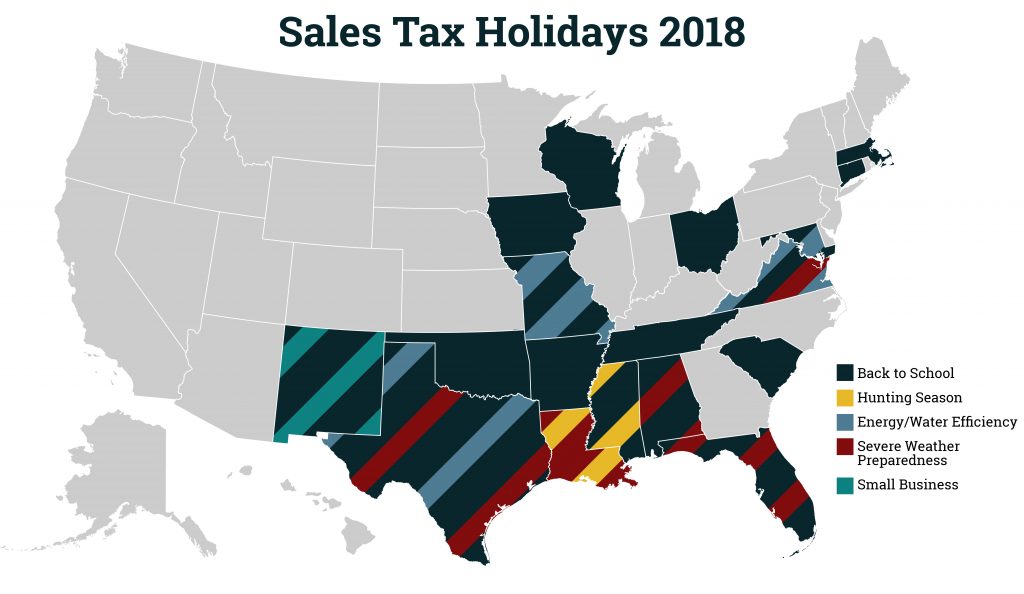
An updated version of this brief for 2019 is available here. Read this report in PDF. Overview Sales taxes are an important revenue source, composing close to half of all state tax revenues.[1] But sales taxes are also inherently regressive because the lower a family’s income, the more the family must spend on goods and […]
