ITEP has tracked $204 billion in federal tax breaks disclosed by publicly traded U.S companies so far for 2025. But those benefits were not spread evenly across the corporate sector: six companies alone accounted for $83 billion of them.
The stunning size of the federal income tax breaks corporations claimed this year dwarfs past corporate tax breaks, themselves sizeable. Microsoft received $18.7 billion in federal income tax breaks, a record high for single-year federal tax breaks for one publicly traded company. Alphabet claimed a staggering $18.4 billion, and Amazon walked away with $17.4 billion in tax breaks. Meta received $13.7 billion, JPMorgan Chase received $8.3 billion, and Nvidia received $6.8 billion.
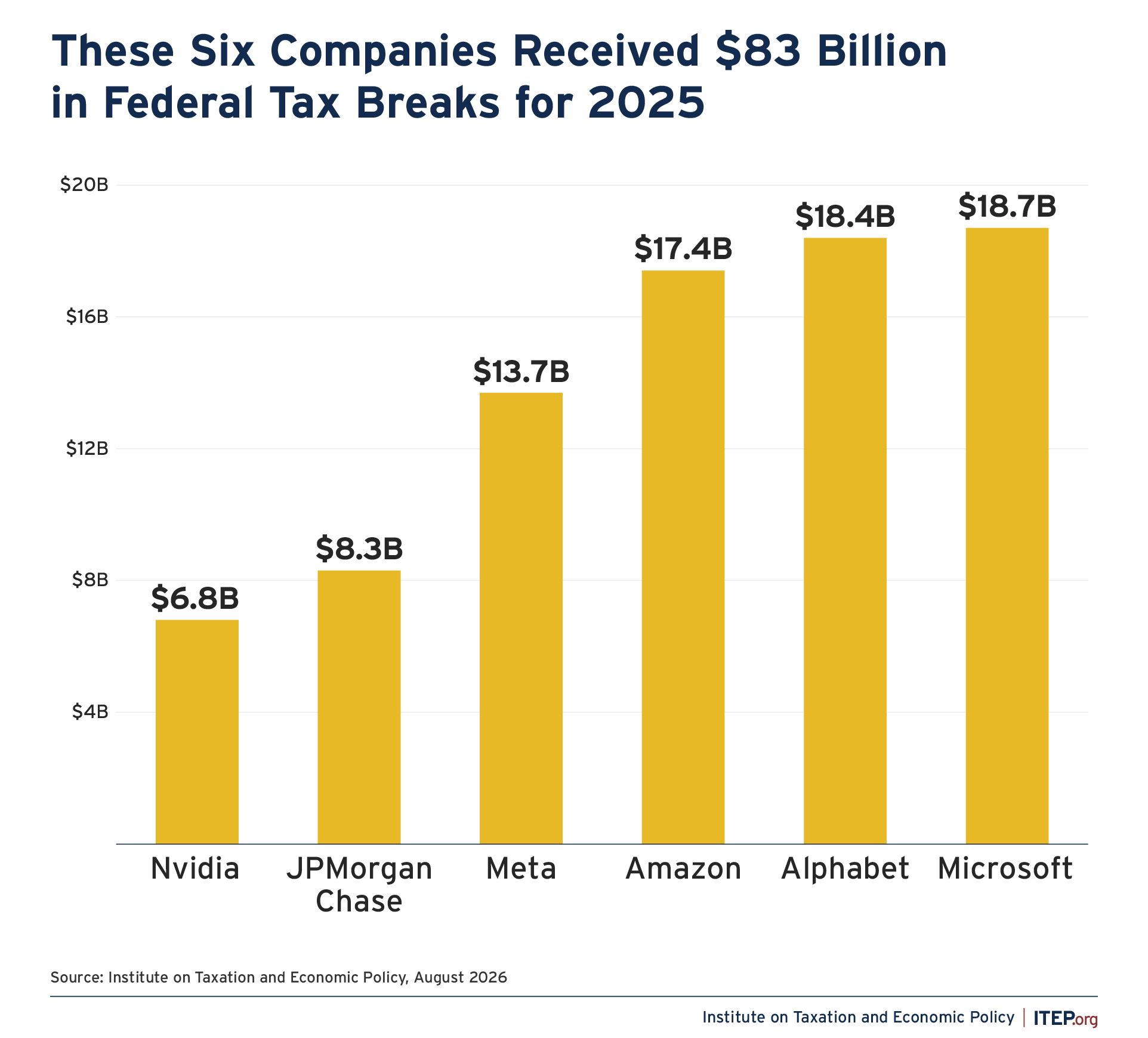
Together, the tax breaks for these six companies account for more than 40 percent of the total in 2025. Or put another way, the $83 billion in tax breaks these six corporations collected in a single year exceeds the entire annual discretionary budget of the U.S. Department of Education, which is $82.4 billion.
To put these enormous tax breaks in context, the largest single-year tax break ITEP’s work has documented for any corporation before 2025 was J.P. Morgan’s $5.2 billion haul in 2024. Two companies had tax breaks triple that size in 2025, and four had breaks more than double that size.
The concentration is even more striking for the four tech companies at the top. Microsoft, Alphabet, Amazon, and Meta collectively received $68 billion in federal income tax breaks – which represents roughly 33 percent of the overall total.
These figures show what Americans intuitively know: corporate profits and economic power are increasingly concentrated among a relatively small number of extremely large companies. The presence of half a dozen tech CEOs at Donald Trump’s January 2025 inauguration was a stark reminder that the economic leverage these companies are gaining is being translated into political power as well. That makes the tax treatment of these companies especially important.
Corporate tax rates continue to decline under the policies backed by President Trump and Congressional Republicans. ITEP’s most recent analysis found that at least 88 large, profitable corporations paid no federal corporate income tax in 2025 despite collectively earning more than $105 billion in U.S. pretax income.
But the concentration of tax breaks among a small group of companies raises another important question: What happens when some of the country’s most profitable companies are also among the biggest beneficiaries of the tax code?
The answer matters for federal revenue. It also matters for how policymakers think about the corporate tax system at a time when a handful of companies have enormous influence over the economy. To put that in perspective, the $83 billion handed to just six companies represents nearly 18 percent, or almost $1 out of ever $5, of total federal corporation tax collections according to the Congressional Budget Office.
Those companies benefited from a combination of tax breaks, including accelerated depreciation, research and development provisions, tax credits, and deductions related to stock options. According to SEC Form 10-K annual filings, the top tech recipients hold over $460 billion in liquid cash reserves, allowing them to fund massive AI buildouts and stock buybacks without needing federal subsidies to drive their strategy.
The point is not that every corporate tax break is unjustified. Tax provisions can be designed to encourage investment or other activities policymakers consider beneficial. But when billions of dollars in tax benefits flow to a small number of already highly profitable companies, policymakers should take a close look at whether those provisions are achieving their intended goals and whether their costs are justified.
These are companies that also have outrageous amounts of cash on hand. Amazon had $86.8 billion in cash at the end of 2025, and Alphabet and Microsoft collectively sat on $51.6 billion between the two of them.
As corporate profits become more concentrated, ensuring that the largest and most profitable companies contribute an appropriate share of federal revenue becomes increasingly important. The corporate tax system should not be judged only by its overall cost. It should also be judged by who benefits from it.